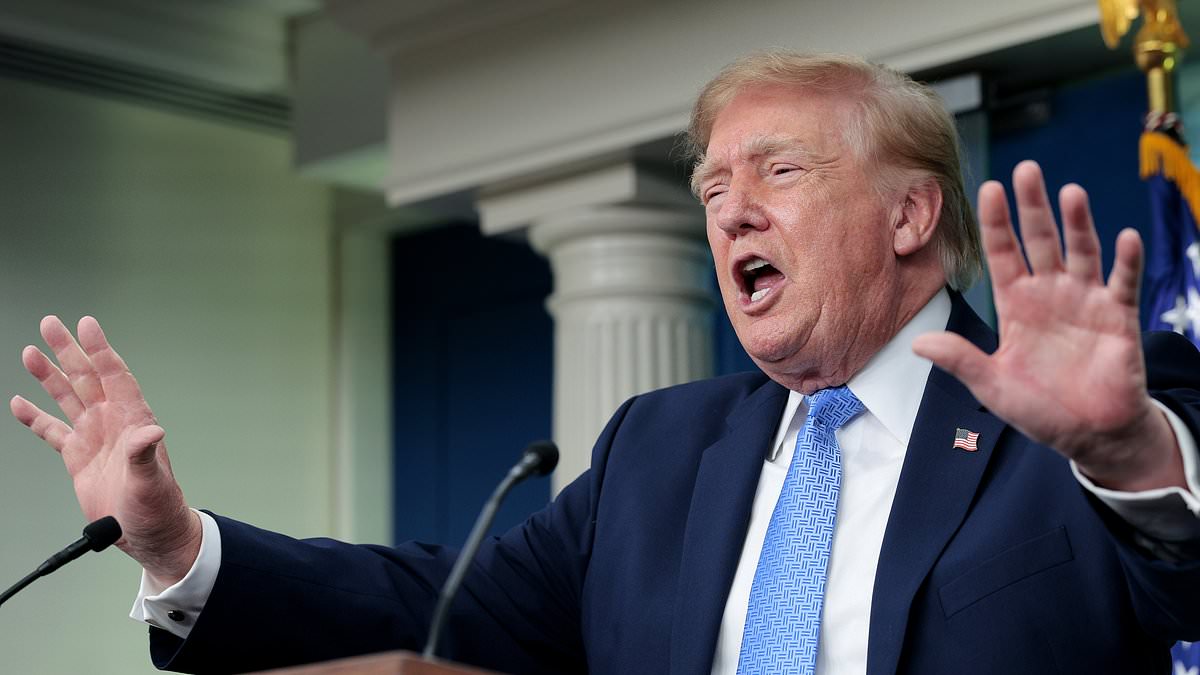
Donald Trump has said the Iran war is 'effectively over militarily' and that there is a 'good chance' it 'could get ended'.
The US President suggested he is not prepared to resume missile strikes on the Islamic Republic, at least for now.
He made a surprise visit to the White House briefing room on Monday after meeting earlier in the day with Qatar's prime minister, Sheikh Mohammed bin Abdulrahman bin Jassim Al Thani.
Mr Trump told reporters: 'Iran militarily is effectively over. We're just keeping it the status quo.'
He added that Iran has been 'decapitated' but said he is still looking to make sure there's a long-term solution to ensuring that Iran's nuclear programme is defanged.
It was some of Mr Trump's most definitive comments about moving away from his threat to resume strikes on Iran after the US midterm elections had passed.
The President's Republican Party lost both chambers of Congress to Democrats in last week's elections.
The elections were shadowed by dissatisfaction among the US electorate over the eight-month-old war, which has led to a surge in fuel prices that have affected nearly every sector of the global economy.
Donald Trump has said the Iran war is 'effectively over militarily' and that there is a good chance it 'could get ended'
Defense Secretary Pete Hegseth, one of the most prominent defenders of the war, has come under fire over the conflict
US-Israeli attacks have devastated Iran and caused reverberations across the world.
Over the course of the conflict, Mr Trump has repeatedly said he is on the cusp of ordering US forces to escalate attacks if Iran's leaders don't quickly agree to US terms to end the war, only to back down.
In earlier cycles, he has also edged away with a last-minute declaration, sometimes at the behest of Gulf allies, that he's going to give diplomacy more time.
In a posting on social media shortly before speaking to reporters, Mr Trump once again asserted that Middle East allies – Qatar, Saudi Arabia, UAE, Bahrain, Kuwait and others – 'would prefer the status quo'.
Minutes later, in his exchange with reporters, he sought to assure war-weary Americans that there was 'positive momentum' and that he saw a 'good chance' that the war 'could get ended.'
'They're talking to us, and they're talking very politely, and we'll see what happens,' Mr Trump said.
He added: 'The military action doesn't seem to be a very necessary thing, but we're locked and loaded, ready to go for any reason that changes.'
But the President gave no hint of a drawdown of the thousands of US troops who have been shifted to the waters off of Iran and maintain a naval blockade to stem the flow of Iranian oil into the global market.
Republican representative Thomas Massie (pictured) says Mr Hegseth should be impeached over his handling of the the war
He said: 'We're keeping it going. We have the greatest military blockade ever.'
Qatari officials last week presented proposals on Iran's nuclear programme, according to two Middle East government officials familiar with the matter who spoke on the condition of anonymity.
The White House declined to comment, though Mr Trump last week alluded to ongoing indirect talks with Tehran.
But Tehran continues to insist on several concessions from the US, which Mr Trump has declined in the past.
Among the core demands that Iran says must be met before engaging in nuclear talks: ending the US blockade on Iran's ports, lifting sanctions, unfreezing its assets, issuing compensation for war damage and ending hostilities throughout the region, including Israeli operations in Lebanon.
Earlier on Monday, Defense Secretary Pete Hegseth, who has come under fire over the conflict, said the next steps on the war are up to Mr Trump, including the possibility of telling Iran: 'Hey, we're done, and we're going to watch your nuclear material. You better not move it.'
Mr Hegseth has been one of the administration's most prominent defenders of the war.
Critics say the administration launched the war without proper authorisation, violated the War Powers Resolution and subverted congressional war-declaring powers.
Republican representative Thomas Massie of Kentucky moved on Monday to force a vote to impeach Mr Hegseth, largely over his execution of the war.
Mr Trump told CNN in a phone interview on Sunday that as long as the US sees progress in negotiations with the Iranians and they sign a 'strong agreement', it's 'highly unlikely it's going to be necessary' to resume strikes.
The President said, however, that the US had identified infrastructure targets, including 38 bridges, that it would strike if military action resumes.
The US military, meanwhile, has still carried out limited strikes on Iran, including against its air defences, at least twice over the past week.
It also fired on and disabled a commercial ship Saturday that the US says was trying to breach its naval blockade on Iranian ports.
After Mr Trump met the Qatari prime minister on Monday, he wrote on Truth Social: 'I had an excellent conversation with Sheikh Mohammed bin Abdulrahman bin Jassim Al Thani, the Prime Minister of Qatar, wherein much was discussed with respect to the Islamic Republic of Iran.
'Most importantly, Qatar, Saudi Arabia, UAE, Bahrain, Kuwait, and others, would prefer the status quo, in other words, a continuation of the Greatest Naval Blockade in History, and the new Operation Iron Gate — Therefore, Land and Sea.
'All have agreed that Iran cannot have a nuclear weapon — that is non-negotiable!
'Should there be any change with respect to developments in the Middle East, the United States of America is 'locked and loaded' and ready to go.
'At this point, however, that seems to be quite unlikely. Israel, and the entire Middle East, are protected from Iranian danger and threats.
'We are seeing positive momentum toward an end to this conflict, and will ensure that America's interests are at all times protected.
'At the conclusion of this military engagement, the American people, and the world, will be far safer and more secure.'