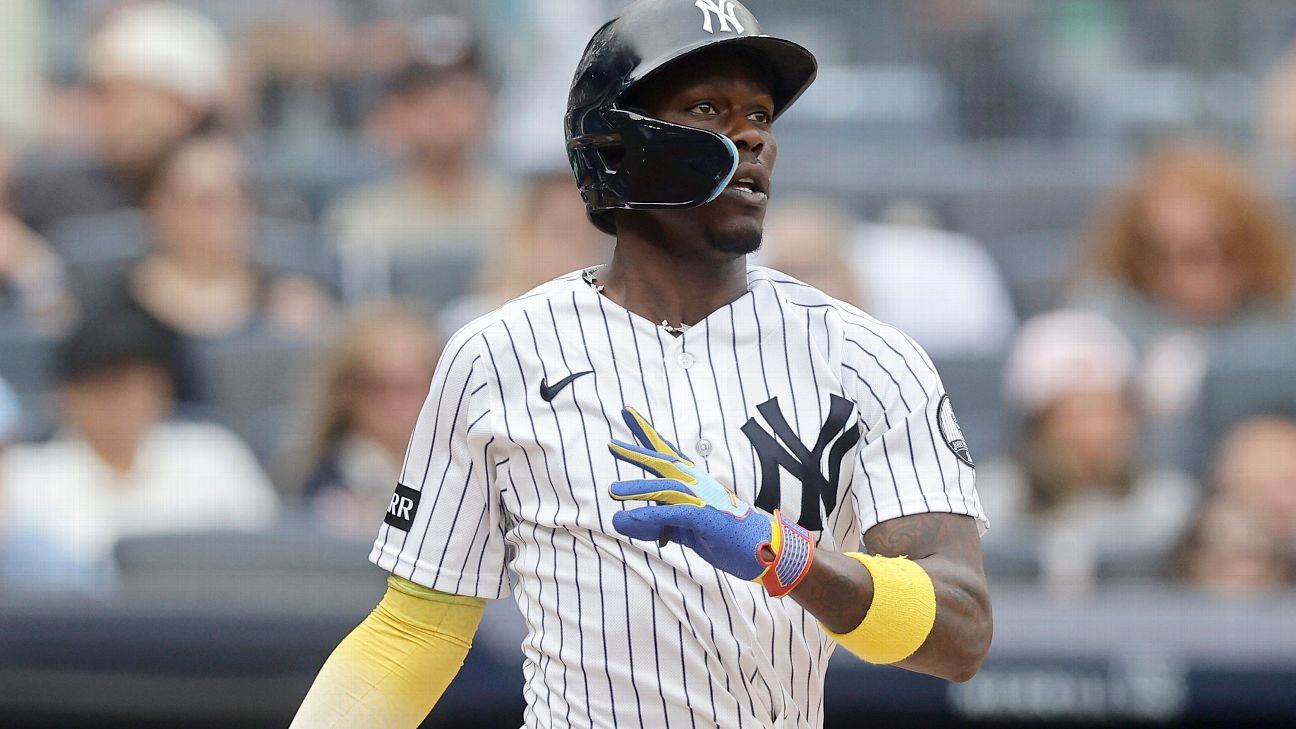
Jorge CastilloNov 27, 2026, 04:46 PM ET
Close
ESPN baseball reporter. Covered the Washington Wizards from 2014 to 2016 and the Washington Nationals from 2016 to 2018 for The Washington Post before covering the Los Angeles Dodgers and MLB for the Los Angeles Times from 2018 to 2024.
Reactions
The Toronto Blue Jays and second baseman Jazz Chisholm Jr. are in agreement on a one-year contract with an option for a second year that guarantees him $34.5 million, sources told ESPN's Jeff Passan on Friday.
The deal includes a $16 million player option for 2028 that becomes a $40 million club option if Chisholm declines it. The Blue Jays will pay Chisholm a $1.5 million buyout if both sides decline their respective options. Chisholm will receive a $6 million signing bonus and $12.5 million salary in 2027.
After two-plus seasons with the New York Yankees, Chisholm figures to start at second base for Toronto, but he provides versatility with experience at third base and in center field if needed. Offensively, he provides some much-needed pop for a team that ranked last in the majors in runs scored and home runs last season.
The Yankees did not aggressively pursue retaining Chisholm, who was in line for a robust multiyear deal before his relative struggles last season shifted his anticipated market. They are expected to replace him with a combination of in-house options, including Anthony Volpe and Luis García J.
Chisholm, who turns 29 in February, is an ultra-talented enigma. His tools are uncommon. His power-speed combination, as evidenced by his 31-31 season in 2025, is elite. But after setting career lows in batting average (.231), slugging (.399) and OPS (.711) for a full season in 2026, he leaves the Yankees just as he arrived: with loud whispers about his maturity and focus.
The Yankees dismissed those concerns at the trade deadline in 2024. Chisholm, with 2½ years of team control, filled a need for pop and athleticism, so New York acquired him from the Miami Marlins for three minor leaguers.
After second baseman Gleyber Torres refused to move to third base, Chisholm was asked to make the move and he happily obliged. He starred in his role, batting .273 with 11 home runs, 18 steals in 20 attempts, and an .825 OPS in 46 games after the trade. The postseason was a struggle -- he hit .182 with a .559 OPS in 14 games -- but the Yankees reached the World Series with Chisholm as their starting third baseman.
He followed that introduction with a career season. After starting the year at third base before returning to second, Chisholm batted .242 with 31 home runs, 31 steals and an .813 OPS. He finished the year with a career-high 4.3 fWAR in 130 games while making his second All-Star team.
With that, he confidently arrived at spring training for his platform year, predicting he'd become the second player ever with a 50-50 campaign. Chisholm fell well short. By the end of the season, the left-handed hitter was sitting against left-handed starting pitchers and his stock entering free agency had plummeted.
Chisholm said he "sucked" this season. Yet, after the Yankees were eliminated by the Tampa Bay Rays in the American League Division Series, Chisholm questioned why Yankees fans booed him after he entered the game as a pinch-hitter in the seventh inning and popped out.
He attracted scrutiny beyond the downturn in production. He was picked off first base while fiddling with his sliding mitt in April. He took the field for an inning in a June game against the Detroit Tigers with a green lollipop in his mouth. He made several ill-advised defensive plays, including a no-look double play turn that resulted in a wild throw to first base during a three-error first inning in Game 2 of the ALDS against the Rays. Following the game, Chisholm said he did not regret the throw.
In seven MLB seasons with the Marlins and Yankees, Chisolm has a career .245 batting average with 127 home runs, 363 RBIs and 171 stolen bases in 216 attempts.