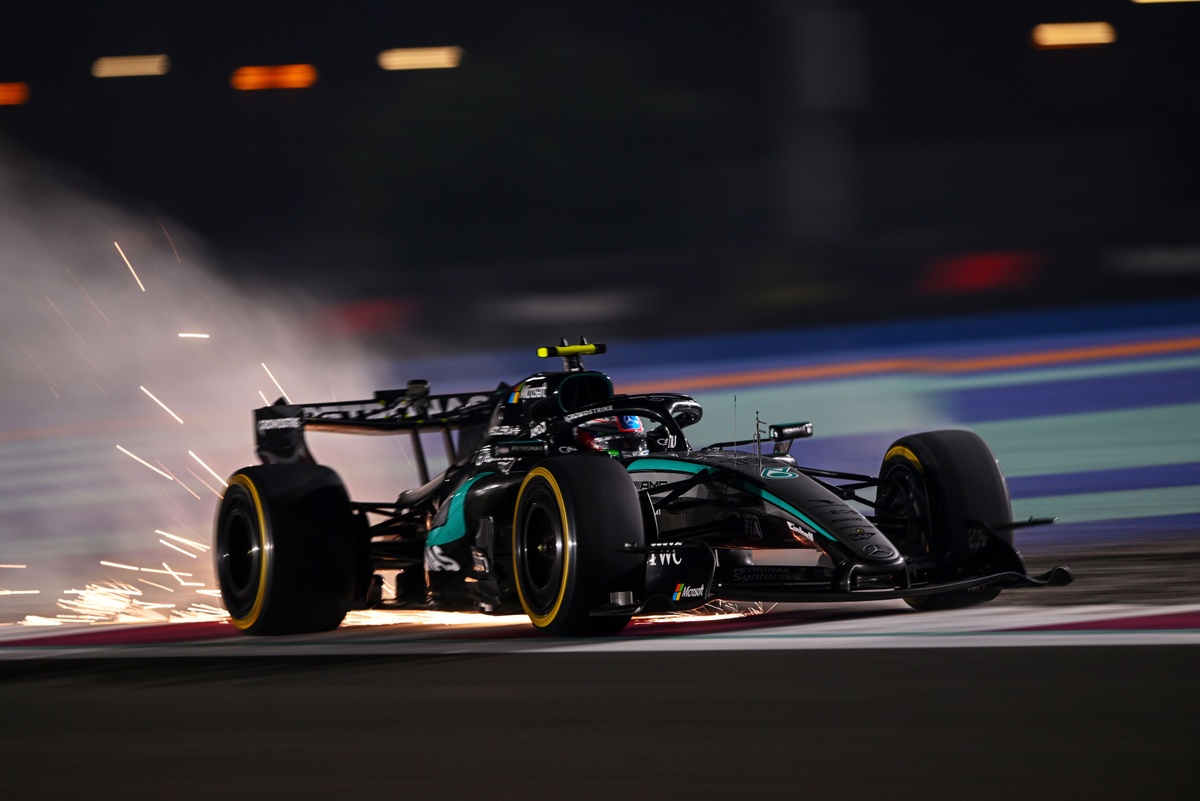
Kimi Antonelli heads into the penultimate race weekend of the 2026 Formula 1 season in Qatar as the early favourite. The reigning world champion dominated Friday practice at the Lusail International Circuit, both over a single lap and in the race simulations. His advantage on the long runs was particularly impressive: his closest challenger, Max Verstappen, was on average 0.83s per lap slower in the adjusted long-run analysis.
Antonelli had already set the fastest time in the opening free practice session, outpacing his team-mate George Russell by 0.507 seconds. Mercedes' dominance continued in the second session, although several incidents and red flags limited the usefulness of the qualifying simulations.
Of the leading teams, only Red Bull and McLaren managed to complete flying laps on the soft tyres. Nevertheless, neither team was able to beat the times set by Mercedes on the mediums. Antonelli topped the timesheets with a 1:23.077, with Russell just over a tenth and a half behind. Lando Norris, the closest challenger to the Mercedes duo, was already nearly half a second adrift.
The competitive picture was even more pronounced in the race simulations. Once differences in tyre compounds and stint lengths were accounted for, Antonelli emerged as comfortably the fastest driver in the field. Even Russell was, on average, 0.90 seconds per lap slower than his team-mate.
Why is Mercedes so dominant in Qatar?
Andrea Kimi Antonelli, Mercedes
Photo by: Steven Tee / LAT Images via Getty Images
The size of Mercedes' advantage is particularly noteworthy given that the team has not traditionally been known for unleashing the full potential of its car during Friday practice. The works team typically takes a rather conservative approach, particularly when it comes to engine performance.
While differences in fuel loads and engine settings cannot be entirely ruled out on the basis of the practice data, Mercedes’ usual approach provides some grounds for believing its advantage reflects genuine underlying pace, although the extent of that advantage remains uncertain.
A closer look at the sector times instead offers some clues as to where Mercedes' strengths lie. The world championship-winning team is significantly faster to its rivals in the first and third sectors, both of which are characterised by medium- and high-speed corners.
In the opening sector, Mercedes holds an advantage of around three-tenths of a second over Red Bull, its closest challenger. In the final sector, Mercedes gains approximately 0.25s on McLaren and as much as four tenths on Red Bull – despite its rivals running on the softer tyre compound.
Only in the second sector are Red Bull and McLaren able to match Mercedes. However, the soft tyre is likely to offer a particular advantage in this section of the circuit, where tighter, slower corners place greater demands on traction.
Red Bull or McLaren: Who will emerge as Mercedes' closest challenger?
Oscar Piastri, McLaren
Photo by: Steven Tee / LAT Images via Getty Images
Behind Mercedes, little separates Red Bull and McLaren, at least over a single lap. Lando Norris, Oscar Piastri, Max Verstappen and Isack Hadjar were separated by around 0.06s in the qualifying simulations.
Over the long runs, however, the balance of power shifted in Red Bull's favour. The Milton Keynes-based team was particularly effective at managing tyre degradation compared to McLaren. While Verstappen was an average of 0.83 seconds per lap slower than Antonelli, his team-mate Hadjar was 1.02 seconds adrift. Norris, meanwhile, was 1.24 seconds per lap off the pace, with Piastri trailing by as much as 1.40 seconds.
As things stand, Red Bull therefore appears to be Mercedes' most promising challenger in race conditions. Given the considerable deficit to the lead Mercedes, however, the data suggests Russell may be a more realistic target for Verstappen than Antonelli.
Is Ferrari facing a midfield battle in Qatar?
Charles Leclerc, Ferrari, Arvid Lindblad, Racing Bulls
Photo by: Manuel Eletto
Assessing Ferrari's performance is considerably more difficult. The Scuderia pursued a different programme during the second free practice session, spending a relatively long time on qualifying simulations before switching to race simulations late in the session.
Ferrari’s single-lap pace, however, was unconvincing. Over a lap, Ferrari was more than a second off Mercedes' pace. That placed the Scuderia closer to Racing Bulls, albeit with a slight advantage over Red Bull's sister team.
In the long runs, Lewis Hamilton completed just three laps, while Charles Leclerc managed only two. Consequently, their calculated deficits of 1.28s per lap for Hamilton and 2.18s for Leclerc are hardly representative.
In particular, actual tyre degradation over a longer stint cannot be reliably assessed on the basis of so few laps. Hamilton's relatively small deficit to the McLaren drivers should therefore be treated with caution.
Racing Bulls dominates the midfield as Haas struggles
Oliver Bearman, Haas F1 Team
Photo by: Sam Bloxham / LAT Images via Getty Images
A similarly clear-cut picture to that at the front of the field emerged in the midfield. Racing Bulls was comfortably the fastest of the traditional midfield teams, both in the qualifying simulations and over the long runs.
Over a single lap, the team held an advantage of around two tenths of a second over Audi. In the race simulations, Arvid Lindblad was 1.59 seconds per lap slower than Antonelli, while Liam Lawson was 1.79 seconds adrift.
Arvid Lindblad, Racing Bulls
Photo by: Rudy Carezzevoli / Getty Images
Behind Racing Bulls lies an enormous gap: Audi, the next-fastest midfield team, was already 2.77 seconds per lap off the leading pace. Gabriel Bortoleto was the only driver to trial the hard tyre in the race simulations.
Williams (+2.97s), Alpine (+3.28s) and Aston Martin (+3.32s) form the next group. Haas endured a particularly poor showing, with a deficit of 3.80s per lap. Only Cadillac was slower, trailing by 4.71s.
The sizes of these gaps was a notable feature of Friday's running – both between Antonelli and the other leading drivers, and between the top teams and the midfield.
Why Qatar's mandatory two-stop strategy may have been necessary anyway
Pierre Gasly, Alpine
Photo by: Karim Jaafar / AFP via Getty Images
Tyre strategy will once again play a particularly important role in Qatar. Due to safety concerns, a maximum stint length of 27 laps has been imposed. With a race distance of 57 laps, at least two pit stops will be required.
Last year, tyre degradation was so low by the end of the race weekend that, a one-stop strategy would have been feasible without the restriction. This year's Friday practice, however, painted a rather different competitive picture.
During the qualifying simulations, some drivers were still able to set personal bests on the ninth or tenth lap of their stints. In the long runs, by contrast, numerous drivers struggled with significant tyre degradation. In some cases, lap times deteriorated by around two seconds within ten laps.
Gabriel Bortoleto, Audi F1 Team
Photo by: Mark Sutton / Formula 1 via Getty Images
Interestingly, some drivers saw their tyres recover after this critical phase, with lap times subsequently improving. The soft tyre performed particularly poorly and was used in the race simulations by, among others, Oliver Bearman and Fernando Alonso. However, the medium also exhibited relatively high degradation, with an average time loss of 0.18 seconds per lap.
The hard tyre proved considerably more consistent in Bortoleto's hands, with degradation of just 0.065 seconds per lap. However, Bortoleto was the only driver to provide long-run data on the hard compound.
As grip levels improve, tyre degradation is likely to decrease over the remainder of the weekend. Given the high levels of degradation observed on Friday, however, a two-stop strategy appears likely even without the mandatory stint limit. As things stand, the medium and hard compounds are expected to be the preferred race tyres.
Read Also:
Formula 1Pirelli reintroduces stint limit for F1 Qatar GP
We want your opinion!
What would you like to see on Motorsport.com?
Take our 5 minute survey.
- The Motorsport.com Team