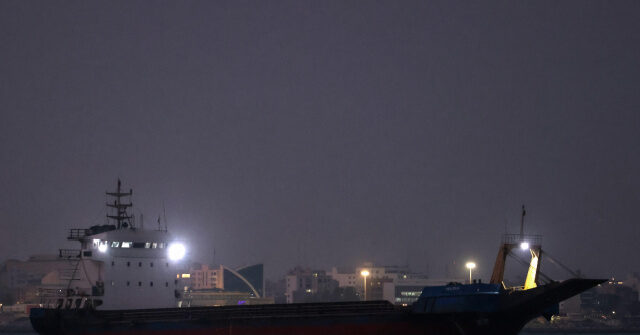
U.S. forces struck and disabled a commercial vessel attempting to breach the naval blockade of Iranian ports, U.S. Central Command (CENTCOM) announced Friday, as Tehran threatened military action from “the air and sea.”
The strike comes as the Trump administration intensifies its campaign to cut off the Islamic Republic’s remaining sources of revenue, while Iranian officials vow to break the American blockade and maintain what they claim is their closure of the Strait of Hormuz.
A U.S. military aircraft struck the Palau-flagged M/V Pacific Archer in the Gulf of Oman Thursday after the bulk carrier departed the Iranian port of Bandar Abbas and attempted to evade the blockade despite multiple warnings, CENTCOM said.
The strike disabled the ship’s propulsion system, leaving its civilian crew unharmed.
“CENTCOM continues to strictly enforce the blockade,” the command said, noting that U.S. forces have redirected 158 commercial vessels and disabled six that refused to comply.
Islamic Revolutionary Guard Corps (IRGC) Aerospace Force Commander Majid Mousavi warned Friday that Iran’s enemies should expect military action from “the air and sea,” vowing to break the U.S. blockade.
“No blockade will withstand Iran’s national will and defence capabilities,” Mousavi wrote on X. “Breaking the blockade is a mission and a firm resolve.”
Iranian Navy Commander Adm. Shahram Irani claimed operations to break the blockade were already underway, saying Supreme Leader Mojtaba Khamenei had lifted geographical restrictions on Iran’s military operations.
Speaking on Iranian state television, Irani claimed U.S. forces were now “begging” for passage through the Strait of Hormuz and vowed to drive them back to the Bay of Pigs in Cuba, “where they belong.”
“We have a free hand to carry out the assigned missions,” he said
Iranian Deputy Foreign Minister Kazem Gharibabadi had declared the blockade an “act of war” last Saturday, vowing that Tehran would take whatever measures necessary to break it.
President Donald Trump dared Tehran to challenge the blockade Sunday, warning, “I hope they do; they’ll all be at the bottom of the sea like the rest of the navy.”
The president touted the effectiveness of the blockade during a Thanksgiving call Thursday, praising sailors aboard the USS Portland for their role in enforcing what he described as “the most successful blockade in naval history.”
“Not one ship has gotten through to Iran,” Trump said.
While Trump has signaled that he is inclined to hold off on another major military offensive against Iran until after the start of the new year, his administration has continued to escalate its economic campaign against the Islamic Republic.
The Treasury Department unveiled sweeping new sanctions Monday targeting Iran’s shadow banking networks, which Treasury Secretary Scott Bessent described as “the last financial lifeline of a bankrupt regime.”
Bessent revealed Wednesday that Iran had exhausted its remaining supplies of oil available for sale at sea.
“The Iranian regime is a sinking ship,” he wrote. “After failing to load a single tanker since Treasury launched Operation Economic Outcast in August, Iran doesn’t have a drop of oil on the water left to sell.”
Beyond restricting Iran’s maritime trade, Washington has moved to shut down alternative routes Tehran uses to circumvent sanctions, with CENTCOM announcing Task Force Iron Gate earlier this month to target illicit shipments through overland corridors and the Caspian Sea.
Following reports that Washington had pressed Baghdad to shut down routes used to disguise Iranian crude as Iraqi oil, Trump voiced support Friday for Iraqi Prime Minister Ali al-Zaidi’s efforts to assert state authority throughout Iraq and “stop the smuggling of Iraqi oil.”
Iranian President Masoud Pezeshkian himself acknowledged the severity of the economic pressure last Saturday, describing it as a “silent war” that was “far more difficult than one in which missiles are launched and destruction is caused.”
Iranian authorities have been forced to ration electricity and scale back food subsidies amid mounting economic hardship, while a truckers’ strike triggered by rising fuel costs and rampant inflation entered its sixth day Friday.
Despite the economic toll, Mohammad Mokhber, an adviser to Iran’s supreme leader, insisted Friday that Tehran would not allow the U.S. naval blockade to remain in place, while maintaining Iran’s claim that the Strait of Hormuz would remain closed.
Joshua Klein is a reporter for Breitbart News. Email him at jklein@breitbart.com. Follow him on Twitter @JoshuaKlein.