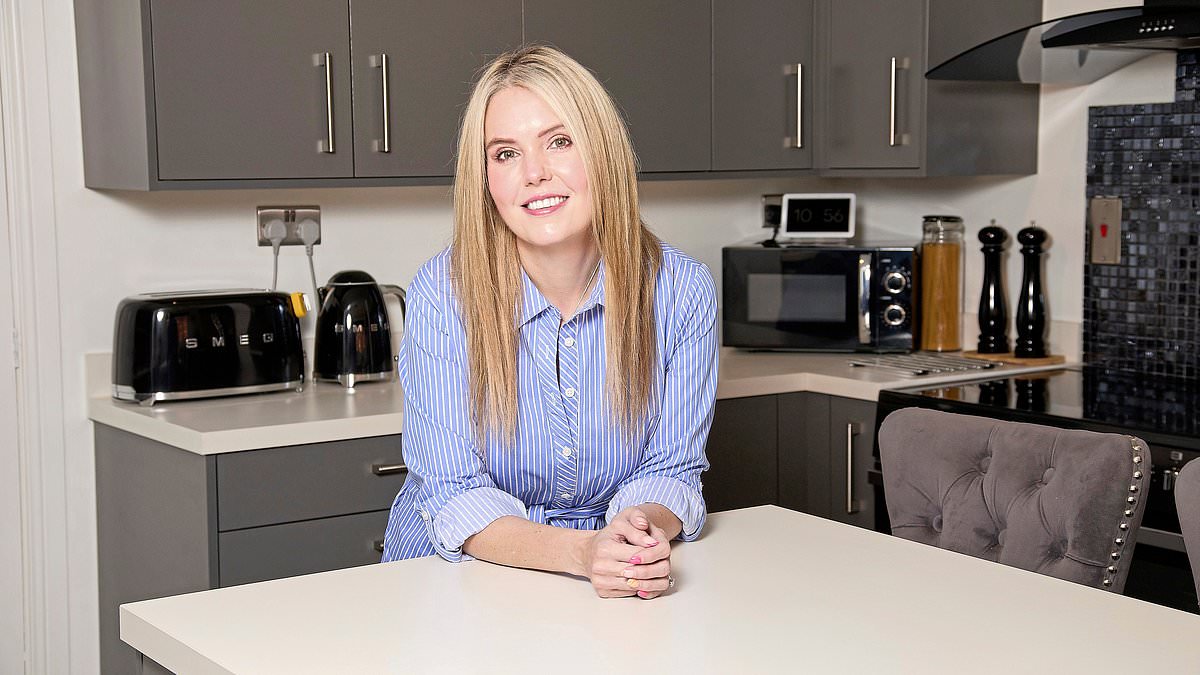
Claire Sisk hates peeling potatoes. ‘The amount of gashes I’ve had,’ she says, sitting in a café, lifting up her hands. ‘I bought thimbles, to start with, and these silicone finger covers.’ Nothing helped. ‘But then I found this chopping board that’s got spikes in it. You just ram the potato on to it, and peel away!’
Sisk, 46, is a well-known cook and she also, 11 years ago, became blind. In October 2021, Sisk began posting videos, detailing her life without vision, to social media. They were small (and mostly culinary) subjects – ‘How does a blind girl measure her ingredients?’ or ‘How does a blind girl make a cup of tea?’ – and people loved them.
By January 2022, Sisk had 35,000 Instagram followers; now, that number is 114,000.
Sisk has now left her job working in admin for an airline company to do full-time social media. She acts as a global ambassador for the Royal National Institute For Blind People and appears regularly on ITV’s This Morning, where she does cooking demonstrations, with the help of her nifty spiky chopping board.
Sisk grew up, ‘bog standard’, in West Sussex. She became a postwoman at 18, met a man through work, married, and had her daughter Jade at 21. Then, aged 29, she had two strokes in a year. ‘My consultant said, “You kind of sit in this little black hole of young adults who have strokes and we have absolutely no idea why. It’s just one of those things.”’
When Claire Sisk began losing her sight 17 years ago, her main priorities were studying her daughter’s fac
Afterwards, she noticed changes in her vision; road signs became blurry. Sisk had always been shortsighted – ‘I was minus something, I can’t remember’ – so went to the opticians. They referred her to a doctor, who referred her to a specialist, and, after tests and tests and tests, she was told her ‘cones and rods’ [the eye’s light-detecting cells] had been destroyed. Doctors first thought this was due to Sisk’s strokes; now, they realise that it was because she had several ocular diseases (some genetic), including retinitis pigmentosa, where your core vision erodes. So, aged 30, Sisk sat in a room at Moorfields Eye Hospital and was told ‘by the age of 40, you will be completely blind’.
From here, things moved slowly – and pragmatically. Sisk decided she should prepare herself for a life without vision. She blindfolded herself and cooked (she says she can tell when chicken is done from the sound of its sizzle) and mastered how to apply a full face of make-up with her eyes shut (the hardest part is eyebrows, apparently. Sisk says, ‘I need silence when I do those, because they’re furry, so you can hear the scratching’).
In 2013, her driver’s licence was removed; by 2015 she was tripping over occasionally and couldn’t see at night.
On 31 October 2017 – ‘just a normal day’ she has no specific memories of – her eyesight was ‘distorted’, but she could still, for instance, read. ‘I could make out large font.’
‘And then, on 1 November 2017, I woke up and I could barely see anything.’ Apart from two pockets of vision in the top left part of both of her eyes – which Sisk describes as like seeing through a thin straw – things were dark.
Sisk was by then divorced and her daughter was at her ex-husband’s for the night.
‘So I was at home on my own. I got up, I washed my face, I went to the toilet, and I thought, “I’m just tired. Go back to sleep, it’ll be fine when you wake up.” Well, turns out, you can’t go back to sleep when something like that’s happened, because every two minutes you’re opening your eyes again to see if it [your vision] is still like that.’
She managed to book herself a taxi – ‘I couldn’t really see my phone’ – and went to hospital, where an ophthalmologist examined her. ‘And she said, “I’m really sorry, Claire, but we’re going to have to register you as blind.” And that was it.’
Claire with Cat Deeley and Ben Shephard on This Morning
According to Sisk, most people think blindness means living in darkness. But, for the 340,000 people in the UK registered blind, only seven per cent have total vision loss. And, for Sisk, what she could see out of her aforementioned straw-like hole of vision was, initially, clear.
It meant that she spent a lot of time looking through that small hole at things she wanted to remember. ‘So, I could look at my daughter’s face and I could still see it [on her periphery]. I’d be holding her head, going “stay still”, and my eyes would be moving, trying to track bits of her face, and trace it in my head.’
By 2019, she ‘lost that [slither of] clarity’ and Sisk describes her vision now as looking through a straw, through frosted glass. Today, her daughter, her family and friends ‘are all kind of frozen in time from 2019. So I don’t truly know what they look like.’ Sisk pauses. ‘I try not to think about that because then I upset myself.’
After she was diagnosed, Sisk stopped seeing friends.
‘I felt as if I was a burden, like, “Oh, who’s going to look after Claire? Who’s going to take Claire to the toilet?”’ For a long time her life – which had previously been filled with concerts and parties – became ‘go to work, do the food shopping, come home’.
Then, when Sisk went shopping with Jade, she held a pair of shoes. They felt sequined and, as Jade confirmed, they were bright pink. Sisk loved them (‘I do have a bit of a unique fashion sense’) and decided she wanted to get them. ‘My daughter said, “But you never go out.” And I was like, “Right. I’m going to go out and I’m going to wear these shoes.”’
She started going back to concerts, to parties, to seeing friends. And last year she got married to a man called Sergio, who she met through work and had known long before she lost her vision. Sisk remembers him asking, on an early date in 2017, about her eyesight. She told him she would, likely, be blind and asked if that bothered him. ‘And he said no. And I thought that was too good to be true.’ It turns out, it wasn’t. ‘I just got very, very lucky with him. I’ve had my fair share of frogs but he really is Prince Charming.’
Claire with her husband, Sergio, at their wedding last year
Sisk and her daughter have a plan to visit all 50 states in America and have so far been to 39. (On a recent trip to Alaska, Sisk dropped her cane while posing for a photo in front of a bear enclosure. ‘The bears went over, sniffed it, and walked away.’)
Last year, she went scuba-diving in Cyprus. Vision-wise, Sisk can detect light from dark, but it’s harder to make these distinctions under water. ‘And I don’t know what it was in Cyprus, but I had a one-to-one diver with me and when he put his arm out, it was like his arm was illuminated. Maybe he was just really pale against the sun, I don’t know, but I could follow where his arm was.’ They swam together until she saw a dark mass coming towards her; it looked a bit ‘like a dog’. When they surfaced, Sisk’s guide told her it was a turtle. ‘And I got a lot of happiness and joy from that.’
Sisk is not Pollyanna-ish about her condition. ‘I have days – my “I don’t want to be blind” days – where I just lie on the sofa and want to give up.’ So yes, sometimes, ‘life sucks. But actually, then I think, I get to do a job I love. I get to help people. I get to swim with turtles. It’s not all that bad.’
Follow Claire on Instagram at @canseecantsee_