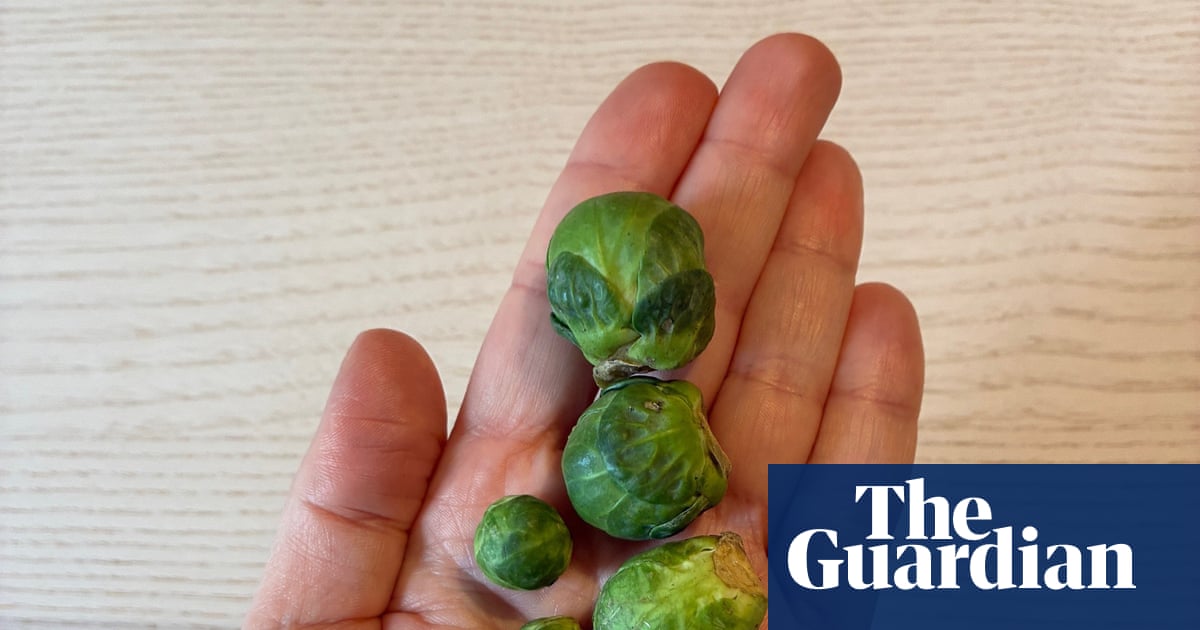
They are a key ingredient in many Christmas dinners, but brussels sprouts appearing on diners’ plates this festive season are likely to be smaller than usual, after the hot, dry summer took its toll on the water-loving crop.
Sprouts are generally planted outdoors between March and early June, meaning they were already in the ground when the UK faced a series of heatwaves and drought conditions across Wales and most of England.
Low water-reserves limited the amount growers could use to irrigate their crops, slowing down the growth of sprouts and other brassica such as cabbages, broccoli and cauliflowers.
Sprouts grow on a stalk, maturing from the bottom upwards. This means the largest sprouts are found at the bottom, with the smallest at the top. Supermarkets and other food retailers generally select only the mid-sized sprouts, found in the middle.
Food retailers generally select the sprouts growing in the middle of the stalk. Photograph: Oddbox
Higher volumes of stunted sprouts are available this year after a challenging growing season, according to the low-waste food retailer Oddbox, which is known for supplying wonky fruit and vegetables.
“We would typically see smaller sprouts heading to Oddbox, because that’s the product that growers don’t tend to have outlets for, but this year there’s an awful lot more of them,” said Gavin Phelps, the company’s head of sourcing.
Most of the sprouts available are from Lincolnshire, where quantities of brassica and other crops are grown, but which has had extended periods of drought.
Most of the sprouts available are from Lincolnshire. Photograph: Oddbox
Some consumers may believe that smaller sprouts will be harder to peel than larger ones, making the much-maligned vegetable more difficult to prepare.
Phelps said this was not the case: “Peeling small sprouts is of course going to be a bit of extra effort, but you can also save some prep time because you don’t need to cut them in half like you typically do with the larger size ones. So it equals out.”
Sprouts are harvested in the UK between September and March, although a quarter of their annual consumption takes place in the two weeks leading up to Christmas.
skip past newsletter promotion
after newsletter promotion
Growers say that tweaks to sprout breeding and the introduction of new varieties have made the vegetable – sometimes criticised for perceived bitterness – tastier. More than half of adults (56.4%) polled by YouGov in October said they liked sprouts, while the number who said they disliked them has fallen from 26% to under 22% in the past six years.
Sprouts with kaiserfleisch. Cooks may want to try roasting, pickling or even smashing sprouts this Christmas. Photograph: Eugene Hyland/The Guardian
Cooking techniques have also improved, said Phelps. “Back 20 or 30 years ago there was this obsession with boiling everything. I feel people have come round to them more because there is just so much more out there in terms of recipe inspiration.”
Cooks may want to try roasting, pickling or even smashing sprouts this Christmas, while Phelps is planning to crisp his in an air fryer.