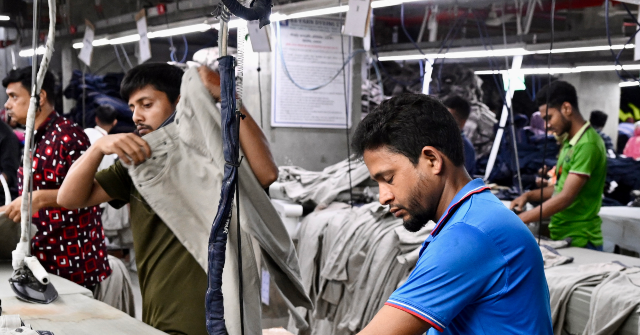
MUNIR UZ ZAMAN/AFP via Getty Images
Global fashion brands have shifted at least $254 million in orders from Bangladesh to India as political unrest and garment-worker protests make buyers nervous.
Bangladesh’s garment industry, which supplies most exports and many manufacturing jobs, faces steep losses if unrest drives fashion buyers to India, Vietnam, or Cambodia.
Ousted prime minister Sheikh Hasina plans to return from exile in India on December 16 despite facing a death sentence.
Top global fashion houses such as Zara, Marks & Spencer, and H&M are shifting factory orders from Bangladesh to India, in part due to anxiety about growing political unrest as ousted Prime Minister Sheikh Hasina prepares to return to the country — and possibly face execution.
Several factory owners told Reuters on Thursday that some $254 million worth of orders were moved out of Bangladesh between November 1 and 18, most of them shifting to factories in India.
The Bangladesh Garment Manufacturers and Exporters Association (BGMEA) offered an even more dire account, lamenting over $400 million in production losses due mostly to the pro-Hasina protests that broke out early this month.
Until now, Bangladesh has been the world’s second-largest exporter of apparel products, bested only by China. Both countries offer very cheap labor to the fashion industry, but the taint of forced labor in China prompted some brands to diversify their supply lines into Bangladesh.
Labor costs are rising in Bangladesh as workers demanded more than double their current wages and the government countered with a mere 36 percent increase in the minimum wage. Protests by underpaid garment workers have combined with the pro-Hasina movement to create a volatile security environment.
“Since November 1, most of my buyers have stopped placing orders because of the unrest. They are telling us our orders have been shifted, postponed, or cancelled and that they have already found alternative solutions,” said Khan Monirul Alam, managing director of the Alps Apparels Group, a top Bangladeshi supplier of garments for European brands.
India’s garment industry wages are higher than those in Bangladesh, although not by very much, so India evidently proved to be an attractive third option for the fashion industry, at least temporarily. Indian factories also promise quick delivery, although industry consultants told Reuters that Vietnam and Cambodia are even faster and might be able to pick up some of Bangladesh’s business if the exodus continues.
The garment industry accounts for over 80 percent of Bangladesh’s exports and almost 40 percent of its manufacturing jobs, so a permanent loss of business could be catastrophic for an already unstable country.
The Hasina situation is scheduled to come to a head on December 16, when the former PM said she will return from exile in India. She was convicted in absentia of crimes against humanity for using excessive force against protesters who drove her from office in August 2024, and she has been sentenced to death — a sentence the administration of current Prime Minister Tarique Rahman says it will carry out if she returns from India.
In fact, the Rahman government said it would only allow Hasina into the country if India extradites her as a prisoner, a demand India has refused several times since Hasina fled there.
Hasina’s Awami League party was banned from politics after she went into exile, but it remains one of the two largest parties in the country. Its supporters have been demonstrating and rioting ever since Hasina said she would return. The government has already deployed paramilitary forces in anticipation of further unrest leading up to December 16, which is also the date Bangladesh celebrates winning its independence from Pakistan in 1971.
The Indian Express noted on Friday that Hasina’s popularity has grown as the economy declined, first under interim leader Muhammad Yunus and then Rahman. In fairness, the economy never really recovered from the Wuhan coronavirus pandemic, which occurred under Hasina’s leadership, but her supporters credit her with running a prosperous system before the pandemic. If the current unrest continues to damage the vital garment industry, memories of Hasina’s days in office could become rosier — even though her supporters are the ones causing the unrest.