It's a chore that many Brits dread – but just how often do you wash your towels?
As temperatures in parts of the UK plummet this week, a microbiologist claims the answer should be after every two to three uses.
Dr Gareth Nye, biomedical sciences lecturer at the University of Salford, said: 'During the winter months, lower ambient temperatures and higher indoor relative humidity, reduce the rate of water evaporation, so towels remain damp for longer periods.
'Therefore, microorganisms have an extended window for growth and microbial loads reach higher concentrations between uses.
'This means more frequent washing is required.
'In winter, hair towels should be washed every 2 to 3 uses or active drying methods such as heated towel rails or tumble dryers should be used after every use.'
It's a chore that many Brits dread – but just how often do you wash your towels? As temperatures in parts of the UK plummet this week, a microbiologist claims the answer should be after every two to three uses
The frequency of towel washing has been heavily debated across social media for years, with answers ranging from daily to monthly.
'I feel like every use is an overkill. I wash mine once a week,' one user said on Reddit.
Another suggested: 'So… I sniff the towel and replace as necessary. I don't know how often I replace it. This is the way.'
And one joked: 'When it smells bad it's too late.'
As a general rule of thumb, Dr Nye says that washing your towels once a week is fine.
'Towels should be washed after every 3 to 4 uses, or once a week if hair is washed every other day,' he told M&S.
However, the problem in the winter is that towels don't dry properly - making them breeding grounds for bacteria.
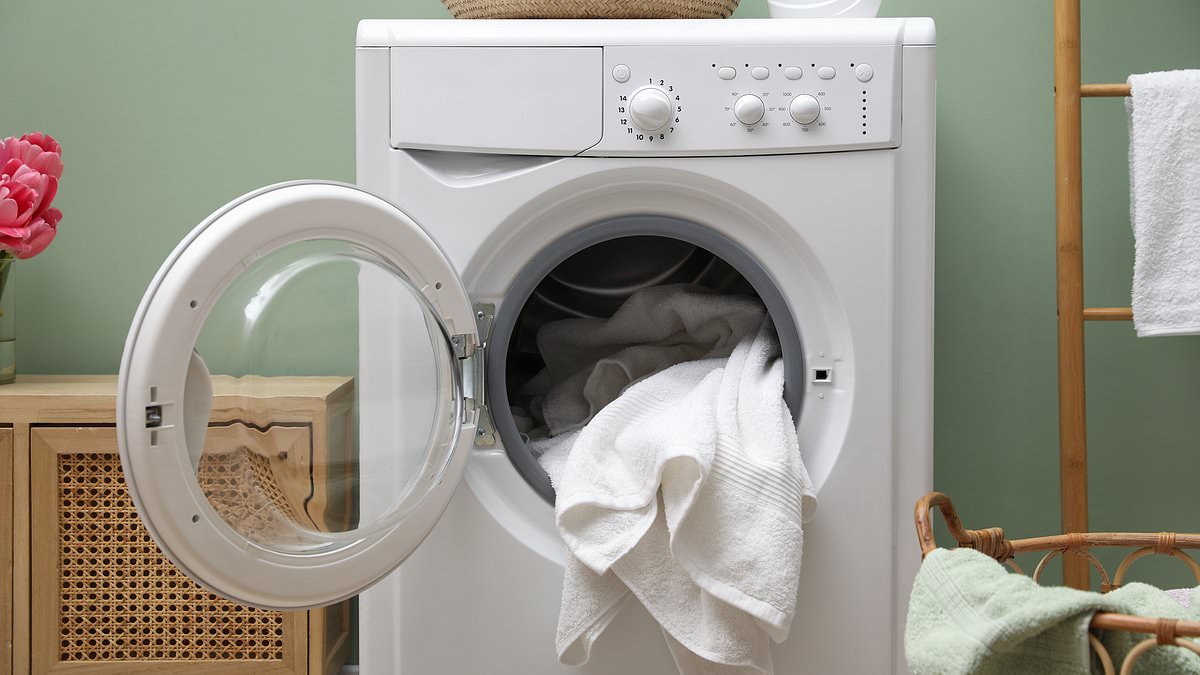
Alongside bacteria, wet towels are also known to gather yeasts, dead skin cells, sebum and sweat, and residues from styling products (stock image)
Dr Nye explained: 'Every time a towel dries wet hair, it absorbs water alongside organic matter from the scalp and hair itself.
'Towels which retain moisture within a warm bathroom environment create an ideal breeding ground for microorganisms to grow, meaning microbial populations multiply rapidly between washes.'
Alongside bacteria, wet towels are also known to gather yeasts, dead skin cells, sebum and sweat, and residues from styling products.
Over time, contact with these back on to your hair and skin can increase your risk of dandruff, itching, inflammation, and greasiness.
'Transferring concentrated bacteria and fungi found on unwashed towels back onto a freshly washed scalp disrupts the local skin microbiome and compromises the epidermal barrier,' Dr Nye said.
'This increases the risk of folliculitis or contact dermatitis (inflammation of the hair follicles or scalp), seborrheic dermatitis (dandruff flares), and can trigger local inflammation, itching, and accelerated skin turnover.
'Also, towels absorb excess skin oils and lipid-based hair products during drying.
'When an unwashed towel is reused, mechanical friction transfers those particles back onto clean hair shafts.
'This coats the outer hair cuticle, weighing the strands down and causing hair to appear greasy shortly after washing.'
To effectively wash your towels this winter, the microbiologist advises washing them at 60°C, and drying them immediately and completely.
He advised: 'Fully dry towels, immediately after washing.
'Tumble drying provides secondary heat reduction of remaining microbes.
'If air-drying, spread the towel fully open in a warm, well-ventilated space.'