Australians could pay hundreds of dollars more for overseas holiday airfares under a fuel-transition plan backed by billionaire mining magnate Andrew Forrest's charity, even as the Fortescue founder continues to travel by luxury private jet.
A new Grattan Institute report released on Sunday calls for Australia to cut its dependence on imported oil, electrify transport and replace conventional fuels, including jet fuel, with domestically produced clean alternatives.
Forrest, whose Minderoo charity helps fund the Grattan Institute, uses a long-range Bombardier Global personal jet for travel, with flight data appearing to show he used it to travel to the COP31 UN climate summit in Turkey earlier this month.
The report authors argue the plan would not only help the environment, but strengthen Australia's fuel security, reduce exposure to international supply shocks and help to shield the economy from future oil crises.
But they also admit it would make flying more expensive, with the Fuelling the Future report recommending clean fuels eventually supply half of Australia's aviation fuel needs.
It estimates clean jet fuel would cost more than double at about $2.94 per litre, compared to just $1.03 per litre for conventional jet fuel.
Under the report's modelling, a typical Sydney-to-Melbourne airfare would rise by about $27 per ticket.
A family of four flying return from Perth to Bali would pay roughly $570 more, or about $142 per passenger, once the policy is fully rolled out.
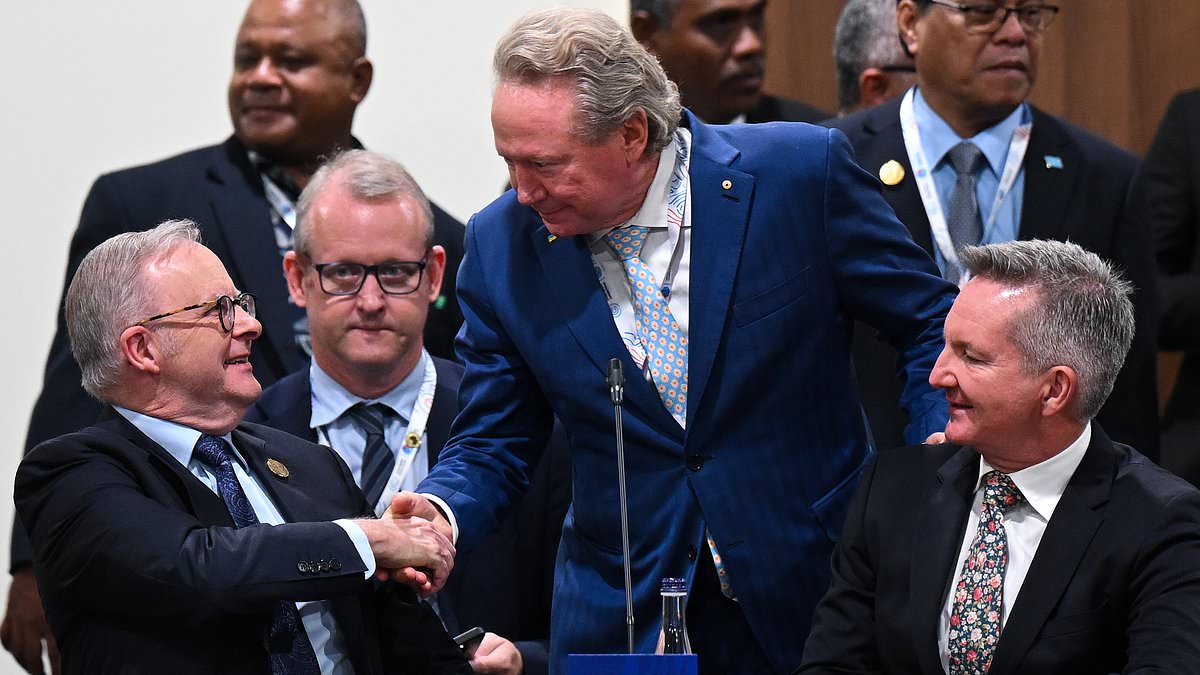
Andrew 'Twiggy' Forrest's charity (centre) is a financial backer of the Gratton Institute (pictured at the COP31 UN Climate summit in Antalya, Turkey on November 12)
Forrest flies around the world in his Bombardier jet (pictured) he acquired for $98million back in 2021
Long-haul international fares could climb even higher.
Based on the report's fuel-cost assumptions, a family flying to Europe could face airfare increases running well into the four figures compared with flights using conventional jet fuel.
Nationals Leader Matt Canavan raised concerns about the impact on families already struggling with rising living costs.
Asked about the links between the report and the Minderoo Foundation, Canavan said he did not begrudge Forrest's involvement in public policy debates but disagreed with the plan.
'Twiggy's got his views. I'm happy to debate them any day of the week, but I don't attack people for their wealth or their contribution.' he told the Daily Mail.
However, he questioned whether Australia could afford policies that increase travel costs.
'What we need is a government that focuses on the cost of living right now and a government that gets down living costs, not puts them up,' Canavan said.
'Low-carbon liquid fuels into things like airlines is just not economic right now.'
Matt Canavan (pictured) said Australian households could not afford higher costs for travel
The Minderoo Foundation, set up by Forrest and his wife Nicola, has distributed more than $1.6billion to social and environmental causes since 2016.
It is an Endowment Supporter of the Grattan Institute, with its logo appearing on the report.
The billionaire reportedly acquired his Bombardier jet in 2021 for about $98million.
The report estimates Australians would spend an extra $19billion a year on aviation fuel by 2050 as airlines transition to cleaner alternatives.
But its authors insist Australians would benefit in the long term, despite higher airfares.
The report has already drawn criticism from major industry groups.
Speaking in Canberra on Monday, Tania Constable, chief executive of the Minerals Council of Australia, warned proposals targeting fuel tax credits would ultimately hurt consumers and regional Australia.
'This is not the way to make sure that we have fuel security in Australia, that we have the most productive industries, keep on producing the minerals, keep on building the homes, keep on constructing the infrastructure and importantly producing the food we need,' she said.
Under the Grattan Institute plan airfares would rise because cleaner jet fuel would be used
She dismissed the report's argument that Australians should tolerate higher costs now in exchange for future savings from electric vehicles and increased fuel security.
'That's a ridiculous proposition. We are in a cost-of-living crisis,' Ms Constable said.
'Adding one more dollar to the cost for Australians is one more dollar too high at this particular stage.'
Canavan warned the policy risked creating another cost burden for households, particularly those living outside the major cities.
'We'd have another hike in costs for Australians, which would just be higher costs for Australian families who need to travel for health, for business and particularly those of us that live in regional areas,' he said.
'Flights are a big part of the cost of doing business, and we can't afford to pay more than we already are.'
The Daily Mail has contacted Forrest via his company Fortescue for comment.
WHAT THE GRATTAN INSTITUTE REPORT RECOMMENDS
Set a target to have 650,000 electric trucks on our roads by 2050. This would cut diesel use by 5 billion litres a year. To fuel this fleet, the government should invest $1.1 billion in a national network of chargers, and $2.4 billion in vouchers for trucking firms to buy electric trucks.
Cap diesel fuel tax credits at $35 million per corporate group per year. This would cut diesel use by 3.5 billion litres a year and cut government spending by $76 billion by 2050.
Introduce a mandatory target for clean jet fuel, and put $6 billion towards the first fleet of clean refineries. By 2050, this would deliver 9.8 billion litres of clean jet fuel a year.