Fierce storms are expected to hit both US coasts this week, threatening Thanksgiving travel disruptions for millions.
AccuWeather’s holiday forecast shows parts of 14 states facing poor travel conditions Wednesday, with trouble spots stretching from the Pacific Northwest to the Ohio Valley and Southeast.
A winter cyclone could strengthen rapidly as it moves toward the Northeast, bringing wind gusts of up to 50mph, flooding and ‘bursts of heavy rain and embedded thunderstorms’ on Thanksgiving Day, according to the National Weather Service (NWS).
On the West Coast, coastal flood warnings are in place as unusually high ‘king tides’ coincide with an incoming Pacific storm. Breaking waves could reach 30 feet along parts of the Northern California coast Wednesday.
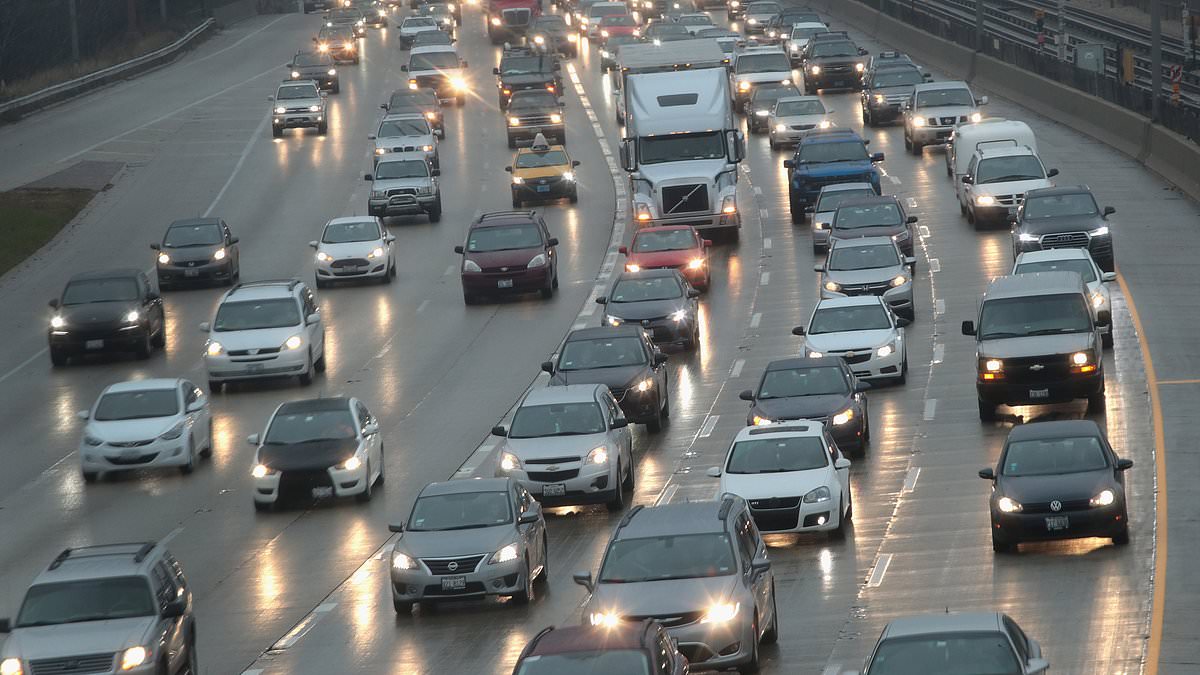
The forecasts come as AAA projects that 81.5 million Americans will travel at least 50 miles from home between Tuesday and Monday, November 30, including 72.9 million making their journeys by car.
AccuWeather’s map identifies poor conditions Wednesday across parts of Indiana, Ohio, Kentucky, West Virginia, Virginia, Tennessee, North Carolina, South Carolina, Mississippi, Alabama, Georgia and Florida.
Coastal portions of Washington and Oregon bring the total to 14 states, although the difficult conditions are not expected to cover every part of those states.
Much of the Northeast, Great Lakes and California are rated fair for Wednesday, while large sections of the Plains and Southwest are expected to offer more favorable weather.
AccuWeather's holiday forecast shows parts of 14 states facing poor travel conditions Wednesday, with trouble spots stretching from the Pacific Northwest to the Ohio Valley and Southeast
In the Southeast, heavy rain and gusty winds could make roads hazardous ahead of the holiday.
The NWS forecasts 2 to 3 inches of rain and gusts reaching 35mph across central North Carolina from Wednesday afternoon into Thanksgiving morning.
Water collecting on roads could increase the risk of hydroplaning, while minor flooding could affect urban and low-lying areas.
Parts of the coastal Carolinas could receive 3 to 5 inches of rain, with flooding concerns extending from around Charleston to the southern Outer Banks.
Farther south, additional downpours could worsen existing flooding in parts of Florida, including the St Johns River watershed.
Forecasters are increasingly confident the developing coastal storm will bring dangerous conditions as it forms off the Southeast coast Wednesday and moves north.
Unusually warm Atlantic waters are expected to help fuel its development. The system could undergo ‘rapid cyclogenesis,’ meaning it strengthens quickly as atmospheric pressure falls and winds intensify around its center.
NWS outlooks warn of widespread, potentially heavy rain, strong winds, coastal flooding and dangerous surf Wednesday and Thursday, stretching from southeastern Virginia to waters off New Haven, Connecticut.
A winter cyclone could strengthen rapidly as it moves toward the Northeast, bringing wind gusts of up to 50mph, flooding and ‘bursts of heavy rain and embedded thunderstorms’ on Thanksgiving Day (stock)
Winds could reach 40mph or higher along the Northeast’s Interstate 95 corridor by midweek.
New York City Emergency Management has urged residents to monitor forecasts and weather alerts.
‘The forecast shows a storm that could bring strong winds, rain, and coastal flooding to the city on Thanksgiving Day, with gusts of 40 to 45mph possible and 1 to 2 inches of rain,’ the agency said.
The conditions could also affect the giant balloons at Macy’s Thanksgiving Day Parade.
City regulations prohibit the balloons from flying when sustained winds exceed 23mph or gusts exceed 34mph, although the parade itself has never been canceled because of weather.
Across the West, repeated Pacific storms are expected to bring rain to lower elevations and snow to the mountains of Washington, Oregon and Northern California.
The areas facing the greatest disruption will shift as each system follows a different track.
Standing water could slow traffic along Interstate 5 through Seattle and Portland, as well as on highways around the San Francisco Bay Area.
On the West Coast, coastal flood warnings are in place as unusually high ¿king tides¿ coincide with an incoming Pacific storm. Breaking waves could reach 30 feet along parts of the Northern California coast Wednesday. Above are barriers built ahead of the king tides
The forecasts come as AAA projects that 81.5 million Americans will travel at least 50 miles from home between Tuesday and Monday, November 30, including 72.9 million making their journeys by car (stock)
In the Sierra Nevada, heavy snowfall and strong winds could severely reduce visibility and force closures along Interstate 80 over Donner Pass. Drivers crossing the mountains should check forecasts and road conditions before setting off.
Along the coast, the NWS has issued a flood warning for San Francisco and San Pablo Bay from Monday through Thursday, with king tides expected to peak Wednesday.
Farther north, storm surge could push tide levels in Humboldt Bay to 11 feet. That is a tide-gauge level, rather than an 11-foot rise above normal.
High tides combined with powerful surf could worsen flooding and erosion, wash water onto coastal roads and push water levels toward record highs in some locations.
Los Angeles and San Diego could also see rain, with water pooling on urban roads and possible mud and debris flows on steep slopes adding to the disruption.
The systems will push inland, spreading mountain snow and rain or snow showers across lower elevations of the West. Denver and Salt Lake City could experience more than one round of unsettled weather.
Phoenix and Las Vegas are expected to remain comparatively dry, with little precipitation beyond a possible passing shower.