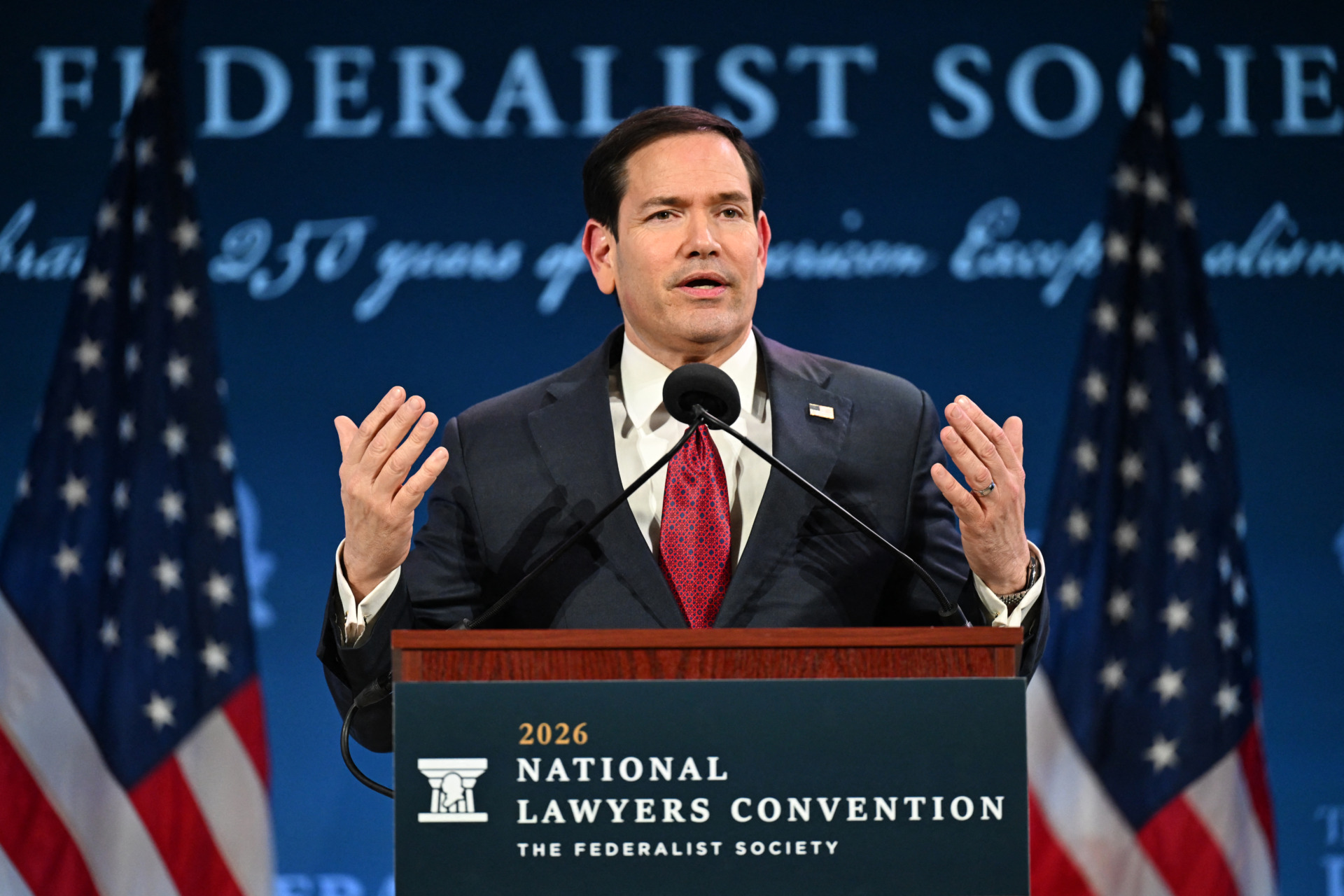
Earlier this month, Secretary of State Marco Rubio presented a muscular U.S. posture toward the International Criminal Court (ICC) that would seek to exercise jurisdiction over Americans:
[I]f they’re foolish enough to try to enforce their paper decrees on Americans, our answer will probably be the same as the Roman general, Pompey, when he said to those who were trying to invoke their cities’ charters against his legions. He said, “Stop quoting laws to men with swords.”
Lost in many reactions to this line in the secretary’s remarks is the context. Immediately preceding those provocative lines, Secretary Rubio outlined a long-standing U.S. objection:
Americans have never agreed to submit to the ICC’s authority, but that court and its allies in the global bureaucracy have appointed themselves judge and jury and executioner of the international order, ruling over all … but they are accountable to no one, armed with the power to investigate, to prosecute, to persecute, and to jail our citizens according to laws we neither consent nor control.
What many may not realize is that Secretary Rubio was emphasizing an ongoing objection which the United States has held across presidential administrations since the ICC was created by the 1998 Rome Statute and which Congress codified – in the American Servicemembers’ Protection Act of 2002 – soon after the Statute came into force.
And despite the name of that domestic statute, this protection is not merely limited to servicemembers. As cited in the then-Acting U.S. Attorney General Todd Blanche’s June 29, 2026 letter to the ICC, this bipartisan legislation was an explicit rejection of the ICC’s asserted jurisdiction over any U.S. nationals. As he emphasized, this is a recurring U.S. rejection, stating that the United States has “never” consented to the ICC’s authority.
Indeed, as I discuss at length in this article, the United States has objected to the ICC jurisdiction over U.S. nationals ever since the negotiating history of the Rome Statute itself. The articulation of the U.S. view, however, has been nuanced. It has sounded in the register of “legitimacy” and policy without clearly crossing the line into a legal argument about jurisdiction. Consistent with the current administration’s position, the Acting U.S. Attorney General’s letter, however, takes it to that final step. The letter’s opening paragraph reads:
The United States Department of Justice unequivocally rejects any assertion of jurisdiction by the International Criminal Court (ICC) over U.S. persons. The United States is not a party to the Rome Statute and has never consented to the ICC’s authority. As a matter of international law, a treaty cannot bind a non-consenting country. Accordingly, the ICC has no jurisdiction over U.S. persons-anywhere in the world-and any attempt to assert such authority is illegitimate, unlawful, and a direct affront to the sovereignty of the United States.
and, “As a matter of international law, a treaty cannot bind a non-consenting country.”
Secretary Rubio and the Blanche letter spoke of Americans generally. As a military prosecutor, I am particularly concerned with servicemembers—Pompey’s “legions,” if you will. Unlike private travelers, they are ordered abroad to carry out national imperatives, remain subject to American military discipline, and often serve under agreements negotiated by the United States with host governments. Their conduct is bound by the law of armed conflict. Their legal status also implicates the rights and obligations of the sovereign that sent them.
What then are the policy and legal goals served by the long-standing U.S. position on the ICC’s jurisdiction? My argument is that maintaining the American objection helps protect these servicemembers by preserving a legal position the United States can assert in their defense. It neither exempts them from the laws of war nor denies foreign States’ authority to prosecute their crimes. Rather, it articulates the legal framework to justify the assertion that U.S. forces will act within the system of international law as must the institutions, such as the ICC, that operate within the rules-based order.
“Protect Our Servicemen” — A Bipartisan American Objection
As discussed above, the objection is not a new one, and its history is worth exploring. It began with the Clinton administration’s negotiations over a permanent international criminal court. At the 1998 Rome Conference, the United States helped negotiate an institution capable of prosecuting genocide, crimes against humanity, and serious war crimes. But the U.S. negotiators opposed subjecting the official acts of personnel from nonparty States to the Court’s jurisdiction without the nationality State’s consent or a Security Council referral. Ambassador David Scheffer, the chief American negotiator, warned that otherwise “the ratification procedure would be meaningless for governments.”
The American proposal failed. Under Article 12 of the Rome Statute, territorial-State acceptance generally suffices for the ICC to exercise jurisdiction in State-referral or prosecutor-initiated cases, even if the accused’s nationality State has not joined the treaty. Accordingly, consistent with those objections, the United States voted against the adoption of the treaty text in Rome in 1998.
President Clinton nevertheless signed it on December 31, 2000, believing engagement might help improve the institution. But his statement accompanying signature preserved the objection: “Court jurisdiction over U.S. personnel should come only with U.S. ratification of the Treaty.” He continued: “The United States should have the chance to observe and assess the functioning of the Court, over time, before choosing to become subject to its jurisdiction. Given these concerns, I will not, and do not recommend that my successor … submit the Treaty to the Senate for advice and consent until our fundamental concerns are satisfied” (emphasis added).
In short, Clinton declined to recommend ratification until fundamental American concerns were resolved. It was then that Congress gave the continued jurisdictional objection statutory force in the American Servicemembers’ Protection Act. The Senate amendment containing the legislation passed by a significant bipartisan vote (75 to 19 with 6 not voting). The legislative debate is particularly revealing. Senator Joe Biden opposed the ASPA amendment because he questioned its proposed protective measures. Yet even in his 2002 floor statement, he said:
The Court statute purports to provide jurisdiction over individuals from nations which have not become party to it. That is wrong as a matter of treaty law and of basic fairness. We can and must protect our servicemen from the jurisdiction of this tribunal. (emphasis added)
Similarly, the congressional findings listed in the APSA also states:
Ambassador Scheffer went on to tell the Congress that: “Multinational peacekeeping forces operating in a country that has joined the treaty can be exposed to the Court’s jurisdiction even if the country of the individual peacekeeper has not joined the treaty. Thus, the treaty purports to establish an arrangement whereby United States armed forces operating overseas could be conceivably prosecuted by the international court even if the United States has not agreed to be bound by the treaty. Not only is this contrary to the most fundamental principles of treaty law, it could inhibit the ability of the United States to use its military to meet alliance obligations and participate in multinational operations, including humanitarian interventions to save civilian lives.” (emphasis added)
(See also Ambassador Scheffer’s testimony.)
The distinction between opposing jurisdiction and choosing how to respond to it persisted. The George W. Bush administration rejected ICC jurisdiction over U.S. nationals, though it supported other ICC cases (e.g., Darfur); the Obama administration engaged more constructively with the Court without withdrawing the American objection. In Executive Order 14022, President Biden revoked President Trump’s first-term sanctions against ICC personnel while expressly maintaining opposition to ICC jurisdiction over personnel of nonparty States such as the United States and its allies, absent their consent or a Security Council referral. He also pledged to protect current and former American personnel against attempts to exercise that jurisdiction.
The second Trump administration has formulated U.S. opposition to the ICC jurisdiction in explicit legal terms. The opening of the Blanche letter of June 29, 2026 is among the clearest examples. In the same vein, Executive Order 14203 of Feb. 6, 2025 imposing sanctions on the ICC states: “The ICC has no jurisdiction over the United States or Israel, as neither country is party to the Rome Statute or a member of the ICC.” (The first Trump administration’s executive order sanctioning the ICC did not include such a statement.) In domestic litigation, the Justice Department has described Executive Order 14203 as countering the ICC efforts “to investigate and prosecute ‘protected persons,’ as defined by the EO, not subject to the ICC’s jurisdiction” (emphasis added).
These presidential administrations differed substantially over ICC cooperation and sanctions. Yet the stated opposition at least in policy terms to ICC jurisdiction over American personnel endured. Rubio’s language may be more forceful than that of some predecessors; but its protective object is familiar.
“The Cornerstone of the System” — Rome Is Not Geneva
Why does continuing to object matter? Because the dispute is not resolved simply by the ICC asserting jurisdiction. The United States’ refusal to accept that assertion preserves a legal position it can advance with host nations, allies, and international institutions. It warns that the United States will contest efforts to treat the ICC’s authority over its personnel as an established entitlement, and it gives continuity to the practical protections Congress authorized.
Those protections are not merely rhetorical. Alongside the authority to secure the release of covered personnel, the American Servicemembers’ Protection Act authorizes legal assistance and defense of American interests in proceedings connected to the ICC. Diplomatic protest, negotiated agreements, and statutory measures serve the same protective purpose. Objection does not itself create immunity or invalidate jurisdiction that otherwise exists; it refuses to concede a jurisdictional claim that the United States may dispute.
Nor does protection from the ICC mean protection from the law of war. The United States is a party to the four Geneva Conventions of 1949. The grave breach provisions of those four Conventions—Articles 49, 50, 129, and 146, respectively—require contracting States to seek out alleged offenders and bring them before their courts regardless of nationality, or hand them over for trial to another concerned State party under the prescribed conditions. The 1958 ICRC Commentary on the Fourth Geneva Convention, prepared under the general editorship of Jean Pictet, called Article 146 “the cornerstone of the system” for repressing breaches. (One caveat: that claim is limited to international armed conflict, as the obligation to prosecute or extradite does not apply to non-international armed conflict.)
When the United States ratified the Geneva Conventions in 1955, it accepted obligations that could entail foreign sovereign prosecution of American servicemembers. Geneva was never a promise of exclusive American jurisdiction. Nor does it foreclose international prosecution: the ICRC’s updated 2025 Commentary to Article 146 expressly contemplates surrender to an international criminal court or tribunal, but notably one “that has jurisdiction.” Geneva’s accountability obligations therefore do not themselves resolve the separate question of whether a particular tribunal has jurisdiction over a particular case.
Congress has drawn the same distinction. The War Crimes Act imposes federal penalties for specified war crimes, and the Uniform Code of Military Justice provides criminal jurisdiction over servicemembers wherever they serve. In 2023, Congress expanded the War Crimes Act to reach certain offenders present in the United States irrespective of nationality. In the same legislation, it disclaimed any inference of American support for joining the Rome Statute or of “consent by the United States to any assertion or exercise of jurisdiction by any international, hybrid, or foreign court.”
That provision does not nullify jurisdiction independently established by existing laws. But it makes Congress’s distinction unmistakable: accountability for war crimes is an obligation; acceptance of the ICC’s asserted authority is a separate legal question.
“A Form of Negotiable Instrument” — The Jurisdictional Objection
The strongest criticism of any American legal objection to ICC jurisdiction begins with a sound principle. A sovereign state ordinarily has jurisdiction to prosecute crimes committed within its territory, including crimes committed by foreigners. The United States has long recognized that principle for its own troops.
In Wilson v. Girard, 354 U.S. 524 (1957), an American soldier accused of causing a Japanese woman’s death was permitted to face Japanese prosecution under the governing arrangements. The Supreme Court found “no constitutional or statutory barrier” to the United States’ decision. American nationality, standing alone, does not prevent foreign prosecution.
But critics then ask an important question: If Japan, or any other territorial sovereign, may prosecute an American, why can it not authorize an international court to do the same? Scholars including Michael Scharf and Dapo Akande defend the view that States may collectively exercise criminal jurisdiction they can exercise individually. They also correctly observe that prosecuting an individual does not necessarily make that person’s government legally responsible for the crime or bind it to the tribunal’s treaty.
That is the real argument for ICC jurisdiction. It deserves an answer grounded not in the ICC’s own interpretation of the Rome Statute, but in the laws that govern nations generally.
A treaty cannot create rights or obligations for a third State without its consent. That rule, known classically as pacta tertiis nec nocent nec prosunt, is reflected in Article 34 of the Vienna Convention on the Law of Treaties. But nonratification alone is not a complete answer: trying an individual does not necessarily impose a treaty obligation on the individual’s State. The legal issue is whether the asserted exercise of international jurisdiction would impair a right that the nonconsenting State retains independently of the Rome Statute.
That is why the distinction between territorial prosecution and international prosecution matters. A territorial sovereign exercises criminal jurisdiction within an existing network of obligations to other States. Those obligations do not disappear when it joins a treaty creating a separate tribunal. As Scheffer argued in 1999, crediting Professor Madeline Morris, territorial jurisdiction is not simply “a form of negotiable instrument” that can be transferred without regard to its limits.
He elaborated:
It is therefore a very serious question whether the customary international law of territorial jurisdiction permits the delegation of territorial jurisdiction to an international court without the consent of the state of nationality of the defendant. Can, and should, the nationals of a non-consenting, non-party state–particularly when they are associated with official actions of that state–be subject to prosecution before a treaty-based international court? The requirements of the Vienna Convention on the Law of Treaties cannot be so easily avoided.
Consider a commander sent abroad under American orders and an agreement governing the legal status of U.S. forces. The host State may possess criminal jurisdiction while owing the United States specific obligations concerning its exercise. Article VII of the NATO Status of Forces Agreement, for example, allocates primary jurisdiction to the sending State over certain official-duty offenses. Such arrangements do not establish a general immunity from war crimes prosecution. Their significance depends on their terms: priority to prosecute is not necessarily a prohibition on surrender, and neither necessarily removes an international court’s adjudicative jurisdiction. But an applicable obligation cannot be disregarded merely because the host State has joined the Rome Statute.
Morris’s analysis raises a related concern: prosecuting an officer for official acts may require examining the legality of the government conduct the officer carried out. That concern deserves attention, but an effect on sovereign interests is not itself a jurisdictional bar. As Akande argues, an individual prosecution may implicate a State’s conduct without requiring adjudication of that State’s legal responsibility. The U.S. argument must therefore identify the legal right allegedly impaired and explain why the particular prosecution would impair it.
Critics correctly observe that international courts are not inherently forbidden from prosecuting nationals of nonparty States. The International Military Tribunal at Nuremberg was established by the London Agreement and its annexed Charter. Its judgment invoked both the Allies’ authority following Germany’s surrender and their ability to exercise jurisdiction collectively: the signatories had “done together what any one of them might have done singly.” Nuremberg therefore supplies a substantial precedent for collective prosecution, but its distinctive legal setting in history does not provide a sufficient justification to imply it is a historical basis for transferring ICC jurisdiction over nonparty nationals; indeed, the Nuremberg precedent may also be limited to jurisdiction in the context of lawful military occupation. Further, Security Council-created tribunals rest on a different source of authority under the U.N. Charter, and are likewise disanalogous.
A separate protection concern is that of surrender rather than jurisdiction. Under the 2002 U.S.-Afghanistan agreement, Afghanistan agreed not to surrender American military personnel to the ICC without U.S. consent. Article 98(2) of the Rome Statute likewise prohibits the Court from proceeding with surrender requests that would violate qualifying international agreements requiring the sending State’s consent. Provided the agreement remains applicable, the United States can invoke this protection without conceding the Court’s jurisdiction. Such an agreement does not invalidate an arrest warrant or foreclose every route to custody. But it illustrates an important distinction: even where the Court asserts jurisdiction, its ability to obtain custody remains subject to independent legal constraints.
None of this means that official military status automatically defeats ICC jurisdiction, or that a status-of-forces agreement settles the question in every case. It means that territorial consent does not eliminate the need to examine applicable legal limits. Where the United States identifies an independent right, the inquiry must address its scope, whether it constrains prosecution or surrender, and whether the proposed exercise of ICC authority would violate it.
This is the reasoned legal position behind the American objection: The ICC’s Article 12 rule is an assertion of jurisdiction contained in a treaty. Whether a particular exercise of that jurisdiction lawfully affects a nonparty State’s military personnel must also be answered by the law governing relations among sovereigns. The treaty’s parties cannot make that external question disappear by agreeing among themselves.
“The United States Continues to Object” — The Premise of a Persistent Objection
Continued objection also has a potential role in customary international law. Under the persistent objector doctrine, a State that clearly and publicly objects to a customary rule while it is forming, and maintains that objection, may prevent the rule from becoming opposable to it. This matters because a rule expressed in a treaty can acquire a separate basis in custom, including for States that never joined the treaty.
The doctrine does not, however, independently defeat jurisdiction founded on authority already established under international law. Its relevance here depends on identifying the disputed customary rule, establishing timely and consistent American opposition, and explaining why the rule’s non-opposability to the United States would preclude prosecution of its personnel. If territorial States already possessed the relevant power to confer jurisdiction, objection to the Rome Statute would not by itself remove that power.
Afghanistan illustrates the very danger American negotiators anticipated when helping frame the ICC. Afghanistan joined the Rome Statute in 2003; the United States did not. Nevertheless, in 2017 the ICC prosecutor sought judicial authorization to investigate alleged war crimes involving U.S. armed forces and CIA personnel during operations connected to Afghanistan. An investigation authorized by the Appeals Chamber in 2020 encompassed those allegations on the basis of territorial jurisdiction. American servicemembers sent overseas under national orders thus became potential subjects of a treaty-based tribunal their government had refused to join. On Nov. 12, 2026, the Court published a decision closing the records of the original Afghanistan situation, while a separate investigation concerning Taliban crimes continued. Related earlier decisions were already under appeal. Those procedural developments do not themselves resolve the underlying objection to jurisdiction over American personnel, but rather illustrate the relevance of the need for persistent objection.
Ukraine, however, complicates any claim of an unqualified American objection to ICC jurisdiction over all nonparty nationals. Given the worldwide condemnation of Putin’s aggression in Ukraine, Biden supported proceedings against Russian officials despite Russia’s nonparty status. Yet Biden’s Executive Order 14022 expressly maintained:
“[T]he United States continues to object to the International Criminal Court’s (ICC) assertions of jurisdiction over personnel of such non-States Parties as the United States and its allies absent their consent or referral by the United Nations Security Council and will vigorously protect current and former United States personnel from any attempts to exercise such jurisdiction.”
That languages’ express emphasis on the United States and its allies is significant, although those words did not exclude other nonparty States from the objection. That administration’s position during those times of heightened political tension appear to have accommodated support for prosecuting Putin while preserving its opposition to jurisdiction over American personnel: even Secretary of State Antony Blinken described jurisdiction over Russian nonparty nationals as a “fact-specific analysis,” while State Department spokesperson Matthew Miller, invoking Ukraine’s acceptance of the Court’s authority, said “that’s why they have jurisdiction in that matter.”
These statements must be acknowledged as a potential qualification of the United States’ otherwise consistent messaging across decades of bipartisan leadership, even before the formation of the ICC: complete opposition to jurisdiction over nonparty nationals. The Biden administration’s action came in the context of the Senate unanimously passing a resolution and Congress passing legislation supporting the ICC’s investigation of Russian war crimes in Ukraine. However, even with these potential concessions in mind, one thing has been consistent: the protection of the objection to the ICC’s jurisdiction over American servicemembers.
U.S. policy toward Russia and the ICC has also shifted since. At the opening of a trilateral summit between the United States, Russia, and China, President Trump said, “In another area of potential cooperation, I’ll be suggesting ways to protect our nations’ sovereignty from rogue globalist organizations, such as the international criminal court, which has gotten out of control, which I believe we all agree has really strayed far from beyond its jurisdiction.” The meeting ended with an official statement that “[t]he three heads of state recognized that the principle of state consent and respect for immunities of State officials are of paramount importance, and concurred that the International Criminal Court and other similar bodies must not abuse their jurisdiction.”
“All Means Necessary and Appropriate” — The Law Behind the Warning
Rubio invoked the swords carried by Pompey’s legions. But the American objection he maintained is not that military power places servicemembers above law. For nearly three decades, American officials of both parties have distinguished the duty to punish war crimes, which we regularly demonstrate domestically, from accepting a treaty-created court’s jurisdiction over personnel of a nonconsenting State.
Congress gave that distinction practical force when it authorized in 2002 the President to use “all means necessary and appropriate” to secure the release of covered Americans detained at the ICC’s request. Maintaining the objection is part of that protection: it preserves the United States’ ability to challenge the Court’s asserted legal authority, insist upon negotiated rights, and defend the personnel it sends abroad.
Thus, unlike Pompey’s legions, the United States does not wear its sword in defiance of the law, but in its defense.
FEATURED IMAGE: Secretary Marco Rubio delivers a keynote speech at Federalist Society National Lawyers Convention, in Washington, DC on November 13, 2026. (Photo by ROBERTO SCHMIDT / AFP via Getty Images)