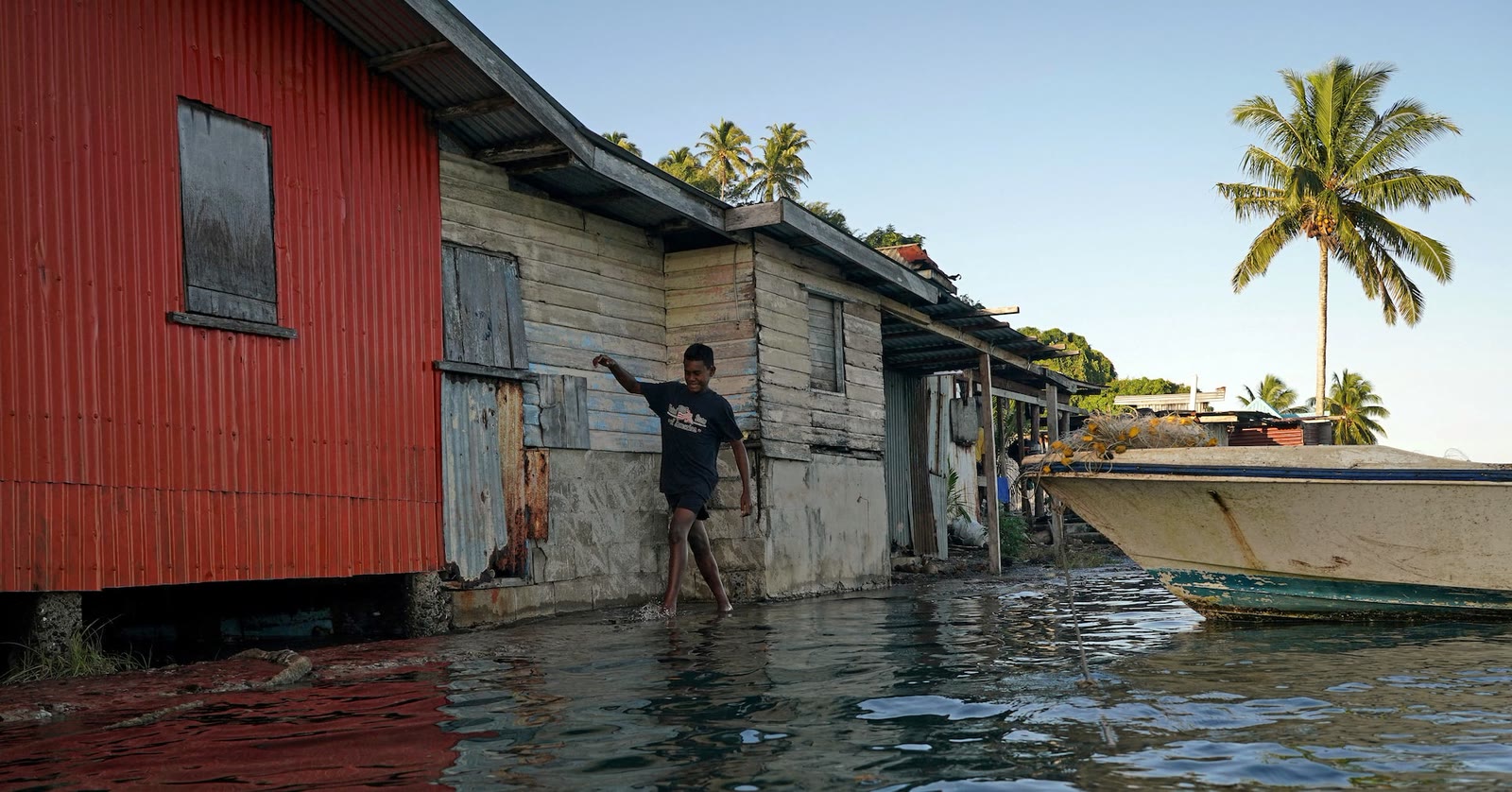
Local boy Ratusela Waqanaceva, 14, wades through seawater flooding over an ineffective sea wall at high tide, as the community experiences flooding in Serua Village, Fiji, July 15, 2022. Purchase Licensing Rights, opens new tab
SummaryEndowment fund could hit $2.6 billion by 2035, document showsInvestment returns to help fund adaptation projectsCould surpass current international public adaptation finance
ANTALYA, Nov 13 (Reuters) - A group of small island states aims to create a fund backed by a charge on money that islanders receive from abroad to eventually raise around $3 billion a year for projects to make their nations less vulnerable to climate change.
That would exceed the roughly $2 billion in international public adaptation finance they received in 2021-2022, according to a 2025 study by non-profit research group the Climate Policy Initiative.
The Misinformation Monitor newsletter rounds up international misinformation narratives, with a "Real or Fake?" quiz in every edition. Sign up here.
Country representatives meeting until the end of next week in the Mediterranean city of Antalya in Turkey for COP31 climate talks are trying to agree ways to increase funding for adaptation to a warming world.
Representatives of Small Island Developing States, or SIDS, have decided they cannot wait for the long-running international debate on financing to deliver more help.
"We decided that there had to be a way that we can guarantee more reliable sources of funding for the islands," Antigua and Barbuda's UN ambassador Walton Webson said. "We cannot rely solely on development assistance again."
"What we are now trying to do is create our own."
The SIDS grouping brings together island nations in the Pacific, the Caribbean and the Atlantic, Indian Ocean, and South China Sea that are particularly vulnerable to the impact of rising sea levels as the planet warms.
Many of them also have large amounts of national debt that constrain their ability to invest in protection, such as measures to halt coastal erosion.
Webson said preliminary discussions had taken place with several development banks and a broader meeting with them and SIDS leaders was planned for January to try to make progress by COP32 in 2027.
Their plan would create the first platform to use earnings sent by the overseas diaspora rather than international development aid to build a permanent endowment fund for climate resilience.
EMIGRES SEND BILLIONS BACK HOME
Total remittances from the many islanders who have emigrated were around $22 billion and grew at a compound annual rate of 7% between 2010 and 2023, according to numbers provided by the SIDS group.
It aims for the planned platform to capture about a third of that total by its 10th year of operation.
Drafted with the help of non-profit organisation, the International Institute for Environment and Development, a first phase would draw on remittances to the Dominican Republic, Haiti, Jamaica and Guyana in year one. Fiji, Samoa and Tonga would be included in year two and Comoros, Cabo Verde and Mauritius in year three.
The SIDS platform would charge senders 3% per transaction, lower than average costs of around 5% to 9% across the markets studied.
The commercial sector in total charges up to $1.3 billion a year to cover transfer fees and foreign exchange margins, the SIDS document seen by Reuters showed. By contrast, multilateral climate funds approved just $202 million for SIDS in 2023.
After costs, 2 to 2.5 percentage points of each transaction would enter the fund, be held as an endowment and invested, seeking base-case returns of 6.5%. Of the returns, 85% would be spent on resilience measures and the rest held as a disaster reserve.
By year 10, the base-case scenario estimates the endowment would have reached $2.59 billion. Matching grants and other income streams such as tourism levies could take the total to $5.53 billion and generate $306 million a year in distributable surplus.
Leverage through tools such as guarantees could help mobilise up to $3.13 billion a year.
Palau's President Surangel Whipps Jr said the small islands that did not create the climate crisis are expected to borrow more money to cope with it than those that did.
"This proposal turns that logic around. It takes money that is already ours, already flowing home across the Pacific, the Caribbean and beyond, and puts it to work for our own resilience," he said.
Reporting by Simon Jessop; editing by Barbara Lewis
Our Standards: The Thomson Reuters Trust Principles., opens new tab
Simon leads a team tracking how the financial system and companies more broadly are responding to the challenges posed by climate change, nature loss and other environmental, social and governance (ESG) issues including diversity and inclusion.