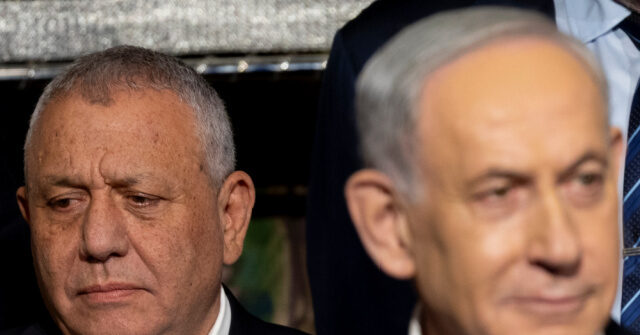
Israeli Prime Minister Benjamin Netanyahu offered Saturday to let his chief political rival, former military chief Gadi Eisenkot, serve first as prime minister in a national unity government, warning of an “existential danger” should a government dependent on Arab parties take power.
The dramatic concession by Israel’s longest-serving prime minister comes a month after parliamentary elections left neither of the country’s two major political blocs with a governing majority, as Eisenkot moves closer to forming a government that could depend on the parliamentary support of Islamist and other Arab lawmakers.
Netanyahu and Eisenkot are set to meet Sunday morning in Herzliya, a coastal city north of Tel Aviv, after the former military chief gave Netanyahu 24 hours to demonstrate the seriousness of his offer.
In a lengthy statement, Netanyahu pointed to a series of incidents in the Knesset since its inauguration earlier this month, including Arab lawmakers walking out during Israel’s national anthem at the swearing-in ceremony and the defeat Wednesday of legislation intended to prevent the return of terrorists’ bodies to their families.
“What we are seeing in the Knesset today is only the beginning. This will happen in the government too,” he warned. “Without firing a single shot, hostile forces will take over the country from within.”
Netanyahu warned that such a government could grant Israeli citizenship to hundreds of thousands of Palestinians under the pretext of family reunification, withdraw Israeli forces from security zones in Gaza, Syria, and Lebanon, and ultimately pave the way for the establishment of an Iranian-backed Palestinian state.
“This unity is the need of the hour,” Netanyahu declared. “We are called upon to confront immediate dangers that threaten our very existence.”
Noting that his Likud party received roughly a quarter of a million more votes than Eisenkot’s Yashar party, Netanyahu said he should, under normal circumstances, lead a unity government or at least serve first under a rotation agreement.
“But given the gravity of the existential danger and the possibility that a government will be formed that lacks the ability to confront it, my responsibility as a leader requires me to set everything aside, including the principle of the largest party, and agree that Gadi Eisenkot will serve first as prime minister, while I will serve as alternate prime minister at the beginning of the term,” he said.
Eisenkot responded that a detailed policy proposal had been conveyed to Netanyahu the previous Sunday through a confidential channel established at Netanyahu’s request, accusing the prime minister of failing to respond despite weeks of efforts to advance negotiations.
“If Likud is ready for genuine unity, I am ready to assess the seriousness of its intentions over the next 24 hours,” he said, inviting Netanyahu and his negotiating team to the Dan Accadia Hotel in Herzliya, where Eisenkot has been conducting coalition talks.
Eisenkot, who was tasked by President Isaac Herzog with forming the next government, reportedly has until December 6 to do so, with the possibility of a two-week extension.
The October 27 election produced a deeply divided 120-seat Knesset, with Netanyahu’s Likud ultimately securing 27 seats to Eisenkot’s 21. Netanyahu’s bloc of nationalist and religious parties commands 53 seats, while the four predominantly Jewish opposition parties hold 48 — leaving both short of the 61 seats required for an outright majority.
The remaining 19 seats are divided between the Arab-led Joint List, an alliance encompassing communist and Arab nationalist factions that secured 11 seats, and the Islamist Ra’am (United Arab List) party, led by Mansour Abbas, which won eight.
Eisenkot has already signed coalition agreements with former Defense Minister Avigdor Liberman’s secular nationalist Yisrael Beytenu (Israel Our Home) party and former deputy military chief Yair Golan’s left-wing Democrats, while pursuing negotiations with United Torah Judaism, an ultra-Orthodox alliance traditionally aligned with Netanyahu.
In a significant reversal, Liberman, whose party has long campaigned against sweeping military exemptions for ultra-Orthodox men, has expressed willingness to sit alongside ultra-Orthodox parties and compromise on conscription legislation, while insisting that the next government have a Jewish majority.
Together, Israel’s two ultra-Orthodox parties hold 13 seats, enough to give Eisenkot’s bloc an outright majority should both join it. While United Torah Judaism has entertained negotiations with Eisenkot, the Sephardic ultra-Orthodox Shas party has remained more firmly aligned with Netanyahu.
The prospect of taking power with the help of Arab lawmakers, however, has encountered resistance even within Liberman’s own party.
Yisrael Beytenu lawmaker Sharon Sharabi, whose brother Yossi died in Hamas captivity and whose brother Eli’s two daughters were murdered during the October 7 massacre, declared that he would not participate in a government dependent on Ra’am.
“In every decision I make as a Knesset member, I see before me the images of my brother Yossi and Eli’s daughters, Noya and Yahel, who were murdered by Hamas,” Sharabi said, adding that if a government were formed through Ra’am’s “abstention, acquiescence or support,” he would refuse to be part of it.
“Period. End of story.”
Abbas, meanwhile, has warned Eisenkot’s bloc against assuming that Ra’am would merely abstain in a parliamentary vote to install the next government, insisting that his party’s support would come at a political price.
His reported demands include ministerial positions, a multiyear government investment plan for Arab communities, and commitments on regulating construction in Bedouin communities in southern Israel.
With his party’s prospective role in the next government under mounting scrutiny, Abbas explicitly described Hamas as a terrorist organization for the first time Saturday during an interview with Israel’s Channel 12, addressing a potential obstacle to cooperation with Eisenkot.
While Abbas maintained that his position on Hamas was longstanding, he acknowledged that he might not have made the declaration had it not been for legislation his party was asked to support.
Asked why it had taken him so long to do so, Abbas replied, “I have no answer.”
Netanyahu’s offer also exposed divisions between former prime ministers Naftali Bennett and Yair Lapid, whose joint B’Yachad (Together) party holds 12 seats and remains the only prospective coalition partner in Eisenkot’s four-party bloc yet to reach an agreement with him.
Bennett welcomed Netanyahu’s concession, saying the prime minister had made the right decision in offering to establish a government headed initially by Eisenkot and based on an “alliance of those who serve.”
He nevertheless demanded commitments on military conscription, a state commission of inquiry into the October 7 massacre, judicial policy, and limits on prime ministerial tenure, warning that Netanyahu would have to demonstrate that his proposal was genuine.
Lapid, by contrast, has advocated swearing in an Eisenkot-led government without Likud before negotiating its possible inclusion.
A unity government bringing together Likud and Eisenkot’s entire bloc would command 75 of the Knesset’s 120 seats, providing a comfortable majority without relying on either the Arab or ultra-Orthodox parties.
Netanyahu, however, has indicated that a unity agreement should also accommodate his longstanding ultra-Orthodox partners, particularly on the contentious issues of military conscription and Torah study.
Looming over the negotiations is a dispute between Netanyahu and Eisenkot over the urgency of the Iranian threat — an issue that could also determine when Netanyahu would relinquish the premiership.
According to Israeli media reports, Netanyahu has sought to remain prime minister through a potential confrontation with Iran before handing power to Eisenkot under a rotation agreement, a condition Eisenkot has reportedly rejected.
Netanyahu’s government has reportedly pressed the Trump administration in recent weeks to support renewed military action against Iran, including through discussions between Israel’s Mossad chief and senior American officials in Washington.
Eisenkot, meanwhile, has publicly questioned whether the Iranian threat requires immediate military action before a new Israeli government is formed.
President Donald Trump twice endorsed Netanyahu ahead of last month’s election, emphasizing the importance of their continued cooperation in confronting Iran.
Netanyahu’s unity appeal also comes days after a series of judicial setbacks for prosecutors in the corruption proceedings against him, which the prime minister declared Wednesday had “fallen apart” following a decade of investigations and legal battles.
The prosecution, which remains ongoing, has helped fuel the longstanding political boycott of Netanyahu that has repeatedly frustrated efforts to establish broader governing coalitions in Israel.
In his Saturday statement, Netanyahu argued that the latest revelations in court had removed the justification for maintaining that boycott, calling on his political rivals to match his willingness to compromise.
“I expect that, in light of this agreement on my part, we will immediately begin genuine, sincere, and accelerated negotiations in which the other side will also be willing to make similar compromises and concessions,” he said, calling for a government that will “repel these dangers and ensure Israel’s security and future.”
Sunday’s meeting will mark the first test of whether Netanyahu’s concession can break the political deadlock or whether Eisenkot will press ahead with his stated intention of swearing in a government in the coming days.
Joshua Klein is a reporter for Breitbart News. Email him at jklein@breitbart.com. Follow him on Twitter @JoshuaKlein.