The social and political struggles that came to define Liverpool over the last century are at the heart of a book that is in the running to win the most high-profile prize in history writing.
If Liverpool: A Story of Britain wins the Wolfson Prize next week, it will become one of only a handful of books that focuses on a single city to do so, following in the footsteps of Stalingrad, and books about London, Paris and Pompeii.
Antony Beevor's account of the battle-siege of Stalingrad in World War Two went on to become a best-seller, and winners such as Simon Schama and Mary Beard are among the most well-known historians in the business.
So for author Sam Wetherell, winning the £50,000 prize could be life-changing. And success could also bring some of what he calls the "remarkable subplots" of Liverpool's 20th Century history to a wider audience than they have reached before.
Wetherell, a University of York historian and, in his own words, an "outsider" to Liverpool, said he had "long felt that the best way to write about Britain's history is to tell it through a single space, a single city, partly because you can tell a series of interconnected interwoven stories".
It traces the sharp decline of Liverpool's maritime power in the latter half of the 20th Century and the collapse of the manufacturing industry in the suburbs in the 1970s which disproportionately affected women's employment, putting more than 60% of the female workforce in that sector out of work.
The book also focuses on some of the pivotal moments in the city's history - the Toxteth riots of 1981, the showdown between the Militant Tendency Labour Council of the mid-1980s, the Thatcher Conservative government, and the Hillsborough disaster.
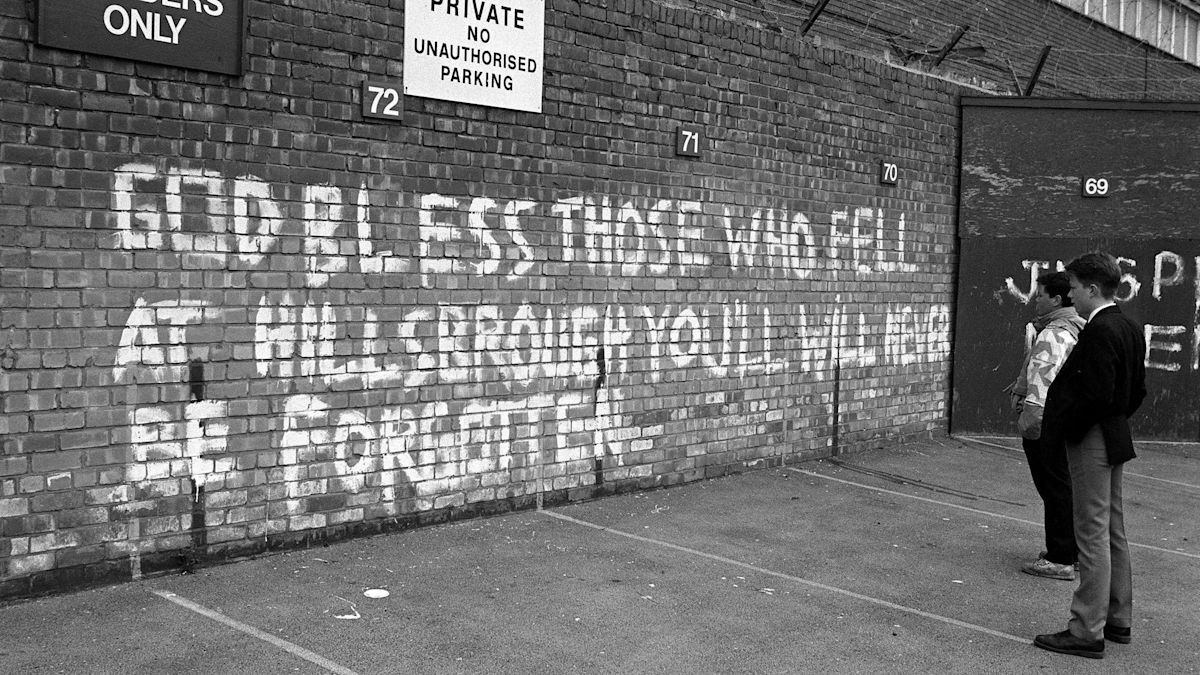
The Hillsborough disaster of 1989 claimed the lives of 97 Liverpool fans and sparked a decades-long campaign for justice [Press Association]
He describes the campaign for justice in the wake of the 1989 disaster that claimed 97 lives at an FA Cup semi-final as "a key part of the complex ecology of political resistance" alive in Liverpool, and a "struggle that has insisted on life's worth in the face of those that attempted to render it disposable".
And he also hones in on some lesser-known incidents and figures whose roles in the city's social history either illuminate how Liverpool responded to external forces in innovative and unorthodox ways, or whose battles against their circumstances - not always successful - were a response to what he describes as the "obsolescence" forced upon them.
'New kinds of movements'
The books tells the story of Pastor Daniels Eckarte, a Nigerian street pastor who ran a home for boys in Toxteth who counted future African statesmen among his friends and who was a key part of an ultimately unsuccessful movement to train the mixed-race children of black US soldiers and British women to become the next generation of leaders of post-colonial Africa.
It also focuses on the innovations of public health figures such as Howard Seymour and John Ashton, whose under-the-radar work to set up the first needle exchanges for addicts were fundamental to how Merseyside, despite some of the highest rates of heroin use, managed to record some of the lowest rates of Aids and HIV deaths in the 1980s.
For Wetherell, it is one of many examples of how Liverpool found ways to respond to the challenges that faced cities whose populations sprung up around particular industries when those industries shrunk and vanished, how they became "obsolete", and then found themselves vilified for it.
Wetherell told the BBC his argument is that Liverpool's history, for all its almost unique moments and characters, "helps us tell a history of Britain that's grounded in new kinds of political movements, that are more universal, that take for granted the kind of the value of all lives, whether or not they're employed, whether or not they're men, whether or not they're women, whether or not they live in Britain themselves, whether or not they're citizens".
"And so for all of these different reasons, I kind of argue that Liverpool helps us tell a history of Britain that is suited to our present moment, even though Liverpool was once quite exceptional," he said.
The Beatles are a part of Liverpool's history that has now become a £200m-a-year economy [Press Association]
For many both inside and outside Liverpool, it is a completely different place to the Liverpool of the 1970s and 1980s. Being named European Capital of Culture in 2008 led to a tourism boom, and major development - such as the Liverpool One shopping complex - has changed the face of the city centre.
By 2022, there were about 35,000 people working in the tourism sector, about the same as worked on the docks in their early-20th Century peak. There was a time, Wetherell writes, when the Beatles' legacy was so under-utilised and underplayed that tourists who managed to find George Harrison's childhood home in Speke would be invited in for tea by his relatives.
Now, each of the Fab Four's childhood homes are on the tourist trail, the Beatles bring in about £200m to the city's economy every year, and in 2027, Apple Corps will take over the running of the Beatles Story museum.
Wetherell's quotation of Russian author Vladamir Nabakov's statement that "the future is but the obsolete in reverse" comes in the context of discussing how the past is increasingly harnessed as a major economic driver, reconfiguring cities' economies.
And in that regard, Liverpool continues to blaze a trail that arguably began with the arrival of 'Minister for Merseyside' Michael Heseltine in the city in the wake of the Toxteth riots, paving the way for the transformation of the waterfront from post-maritime dereliction into a leisure destination for millions of visitors.
But Wetherell said it was important to "warn against the complacency of, rather than maybe necessarily the truth of, the story that Liverpool was rubbish in the 1980s and now all of its problems are solved through the redevelopment of the waterfront, the new kind of service economy, the new kind of tourism".
Liverpool continues, like many other cities, to face the challenges of the cost-of-living, skills gaps, and the quest to attract new industries and sustainable employment. In recent years, many politicians and commentators around the UK have frequently raised concerns about the "gig economy" based around irregular and insecure work.
And those concerns have their roots in other historical periods: as Wetherell points out, the post-war Labour minister Ernest Bevin described the casual nature of life on Liverpool's docks as merely affording workers "the liberty to go home with nothing".
But for Wetherell, the story of Liverpool is a hopeful one. He writes that while "history is frequently taught as a menu of lessons and warnings", there is only "one lesson in the history of Liverpool, exemplified by the radical transformations it has undergone so many times over the last 100 years - "that the future is less certain and more open to possibilities than we can presently imagine".
He told the BBC: "I'm extremely fortunate that, that obviously this book has now and for the rest of my life linked me to Liverpool, even though I have never lived there.
"I think people take my book as being kind of critical of Liverpool, and I really hope that a close reading of a book doesn't give that off at all.
"I absolutely loved spending the time that I spent in Liverpool and got to know a lot of really close friends that lived there, and will continue going back there for the rest of my life.
"There's really, basically no other places in Britain that I want to have that kind of relationship with."
Other books in the running for the 2026 Wolfson Prize are The Boundless Deep by Richard Holmes, Vanished by Sadiah Qureshi, Summer of Fire and Blood by Lyndall Roper, The Library of Ancient Wisdom by Selena Wisnom, and Silence of the Gods by Francis Young. The winner will be announced on 1 December.
Listen to the best of BBC Radio Merseyside on Sounds,watch BBC North West Tonight on BBC iPlayer and follow BBC Merseyside on Facebook, X, and Instagram. You can also send story ideas via Whatsapp to 0808 100 2230.