KNOWN for its famous architecture and world-class restaurants, Lyon is a must-visit for British foodies.
But behind its postcard scenery, the French city is being ravaged by Colombian hitmen hired to kill for as little as £1,250 – and carrying out crippling kneecap assaults on their enemies.
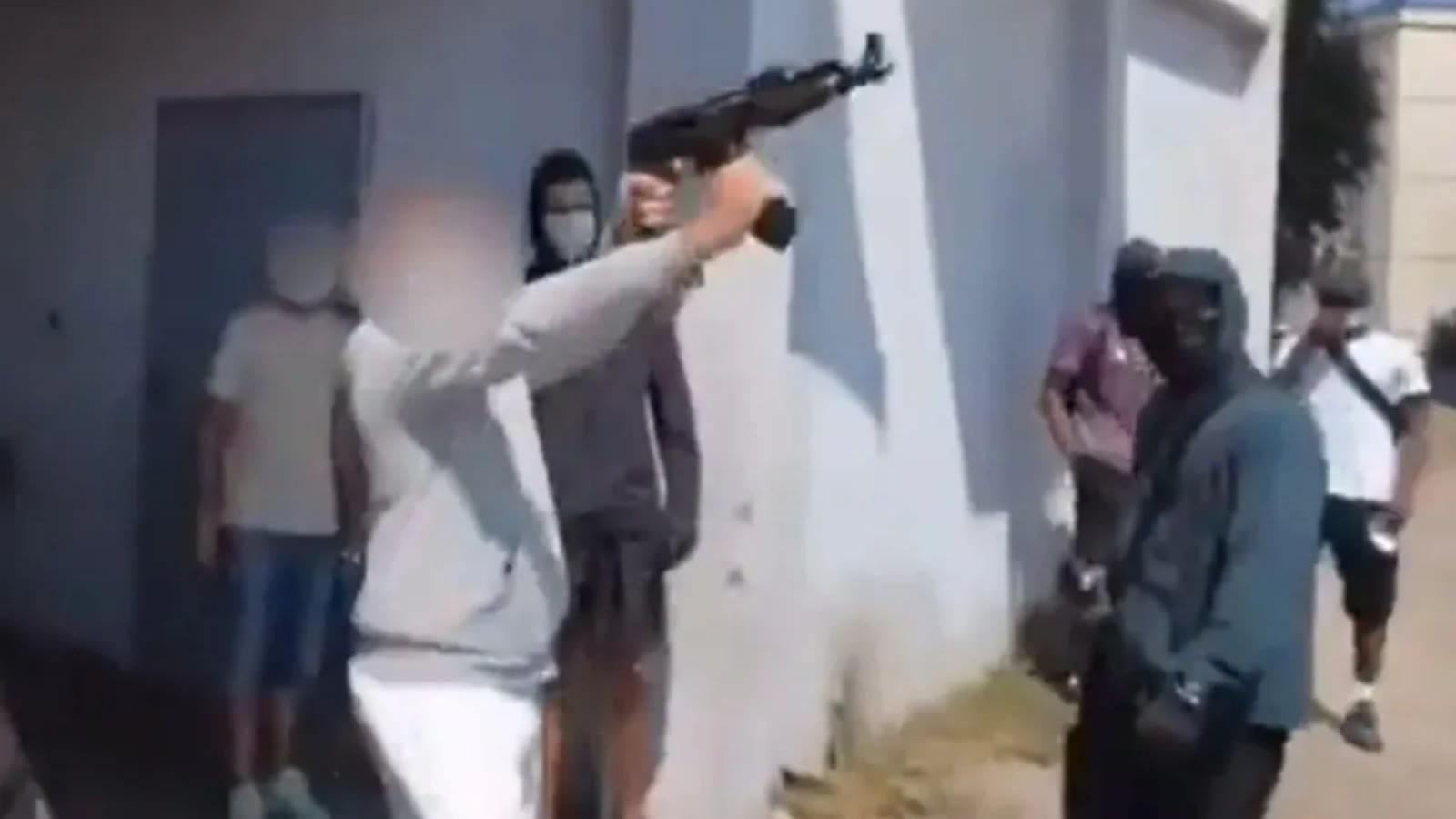
Armed gunmen seen on the streets of Vénissieux in Lyon Source: X
Blood being removed from the crime scene in Lyon where two people were killed in a shooting in 2022 Source: AFP
Officers inspect cracked glass after reports of gunfire in Lyon four years ago Source: AFP
A member of the French National Police stands guard outside the courthouse before the start of the high-security trial of ten defendants for a deadly war between drug traffickers Source: AFP
And, with lax European borders and poor drug enforcement, experts warn the violence could spread to the UK.
Police unionist Sébastien Gendraud, who has lived in Lyon for 25 years, says Lyon’s proximity to Italy and Switzerland has long made it a drug trafficking hotspot.
Sign up for The Sun newsletter
Thank you!
But Gendraud, who worked as a police officer for 18 of them, has battled an explosion of violence in the past two years.
He says the number of murders and attempted murders doubled last year.
Read more in French chaos
Gendraud, who represents UN1TÉ 69, the Rhône branch of France’s national police union, told The Sun: “Lyon is close to Italy and Switzerland and occupies a strategic position, with major road and rail links.
“It is a large metropolitan area that is particularly accessible so it has historically faced significant drug-trafficking activity.
“But what has accelerated considerably over the past two or three years is an explosion in the violence associated with this trade.
“Last year we recorded a doubling in the number of murders and attempted murders across the Lyon metropolitan area.”
Most read in The Sun
A grab from a video shows a gunman opening fire in a neighbourhood in Lyon Source: X
Police officers patrol in La Duchere district of Lyon after a shooting Source: AFP
Gendraud blames the rise on two factors: a rival gang from Marseille and a ruthless, evil Colombia-based drug lord.
Karim Ben Addi, 37, also known as “Fiston”, will be accused of pulling strings from his Colombian prison in a trafficking trial beginning on Monday, reports The Telegraph.
He is originally from Lyon but investigators allege he has been orchestrating a turf war against former lieutenants.
He is among 11 facing charges over a battle for the La Duchère housing estate that resulted in 17 victims with two dead.
But Addi will be absent from trial, with his location making things worse.
Gendraud adds: “Hitmen were allegedly sent from Colombia on Addi’s instructions with the mission of recovering and stabilising the market share he controlled in the Lyon metropolitan area, particularly in the La Duchère district.
“Addi is a well-known figure in Lyon’s drug-trafficking underworld. He is considered an important player in the city’s drug trade.
“He allegedly controlled part of the drug market and several dealing locations in the La Duchère district.
“He is originally from Lyon and has strong local roots, particularly through his family connections in the metropolitan area.
“Investigators have been working on this individual for many years. He has been the subject of several judicial proceedings, including some particularly significant cases involving drug trafficking.
“Investigators from the Lyon police allege that Addi continued to direct his criminal activities from his prison in Colombia.
“He had already moved to Colombia several months before his arrest but even after being imprisoned, he allegedly continued to manage his affairs remotely and to have commissioned a Colombian hit squad to come and carry out gangland killings in the Lyon metropolitan area.
“Unfortunately, his imprisonment does not appear to have put an end to his criminal activities.”
According to reports, police have identified more than 30 Colombians who have arrived in Lyon in suspicious circumstances.
Cleaners remove blood from the steps of a building in Lyon as a local walks past Source: AFP
Bullet hole left in glass after a shooting in Lyon where two people were killed in 2022 Source: AFP
They add eight have been arrested in cases linked to organised crime.
Gendraud says some of the hitmen are being hired to kill for as little as £1,250 because of a terrifying drop in price to hire a murderer.
He added some are also carrying out sickening kneecap assaults in an attempt to leave victims with a limp or disabled.
He said: “Lyon police have observed that young armed men are being recruited for relatively small sums of money, considerably less than the amounts that might have been seen several decades ago.
“This is precisely the principle of criminal subcontracting that I mentioned earlier.
“Today, with relatively easy access to firearms and a worrying evolution in recruitment methods, some networks are managing to recruit vulnerable young people, sometimes from disadvantaged neighbourhoods, by offering them sums of around €1,500 (£1,250) to €3,000 (£2,500).
“The amount depends in particular on the profile of the person being recruited and the task they are being given.
“Unfortunately, the value placed on human life appears to have fallen considerably in this world. There are generally two types of mission and the first is a contract targeting a specific individual.
“It is an order with a clearly identified objective: to physically eliminate a designated person.
“The second is an intimidation contract. The aim is not necessarily to kill, but to retaliate against a rival network, particularly by shooting at drug-dealing locations, in order to send a message and assert territorial control.”
He added: “The practice of kneecapping exists. The aim is not to kill the victim but to deliberately inflict long-lasting injuries.
“Shootings targeting the knees are a known practice in the drug-trafficking world. They may be used, for example, to punish someone believed to have betrayed their network.
“This could be an individual suspected of giving information to the police, acting as an informant or police source, or betraying the interests of their own drug-trafficking network.
“The aim is to leave the victim with permanent physical damage. By deliberately destroying their knee, the perpetrators seek to make them limp for a prolonged period or even leave them disabled.
“It is also a form of marking. In this world, the physical consequences of such violence can identify someone who has been punished for betraying their network.
“It is therefore both a punishment and a warning to other members of the network: any betrayal can result in particularly serious physical retaliation.”
Retired DEA agent Chris Feistl, who was portrayed in the smash hit Netflix show Narcos, says there is a long history of Colombian gangsters moving to Europe.
Feistl moved to Bogota from Miami in 1994, just one year after the death of notorious drug lord Pablo Escobar, and was tasked with taking down the infamous Cali Cartel.
He blamed lax European borders for being attractive to them and poor drug enforcement.
Feistl, who wrote about his experiences in After Escobar: Taking Down the Notorious Cali Godfathers and the Biggest Drug Cartel in History, told The Sun: “With the open borders and the free trade, they can basically go anywhere, cross-border, without any problem.
“So that’s why you started to see a lot of these Colombian groups getting into Europe, and that’s why they remain there. The law enforcement isn’t as prevalent, it’s not as good.
“They’re still making more money there. We had a couple cases.
“We had, back in 1999, a case in France, where they were sending tons of cocaine there. And it’s just continuous over there.”
On the allegations against Addi, he said it was common for criminals to operate from inside prisons because of rife corruption.
He added: “They do the same thing that they can do here or any other place: corruption.
“They’re able to pay off certain people and they’re able to get access to cell phones, laptops, computers and they’re able to have messengers coming in and out.
“So it’s actually pretty easy for them. If you have the resources, you have the finances, and you’re able to corrupt the right people, you can basically operate from anywhere and do anything.
“With the Cali Cartel, we had several cases where they were sending loads to Spain and the UK.
“And in the case I just mentioned, in France, that had cells operating in Paris and they were able to fly the cocaine in on a diplomatic jet.
“So they avoided customs, they were able to do that, introduce the cocaine into France, and then from there, they would be able to distribute it anywhere they wanted.”
Feistl also warned the UK could be next because he forecasts western Europe overall suffering from a spike in drug trafficking.
He said: “I think it’s already there in the UK. With the migration process, you have all of these people coming into the UK, as well as into Europe.
“A lot of these guys have criminal records, they’re not skilled workers and they’re looking for jobs, they’re looking for money.
RECOMMENDED STORIES
“£1,250 to somebody who has nothing… it’s probably quite a bit of money, And if you can parlay that into some kind of steady work, that’s what they’re looking for.
“I think things are going to get progressively worse, not only in the UK, but throughout Europe as you see more of this migration, less of the enforcement going on.”
Comment now