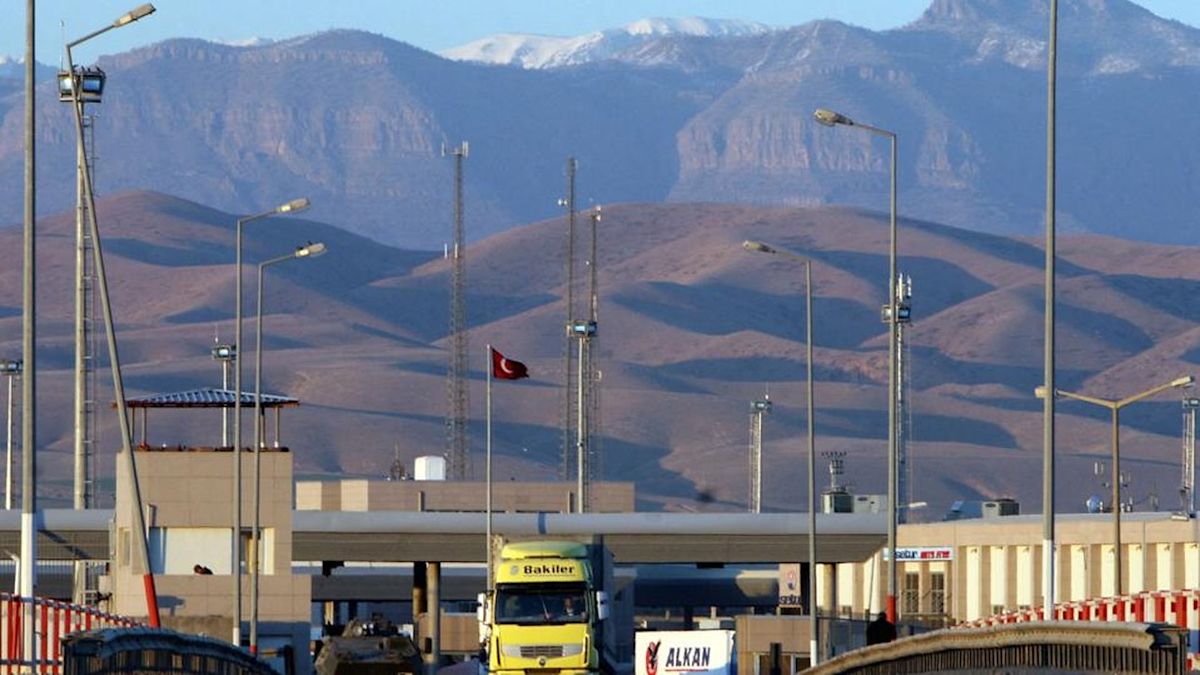
When Kurdish leaders sit down in Baghdad on Tuesday, December 1, for the national dialogue proposed by Faiq Zaidan, head of Iraq's Supreme Judicial Council, the argument will be about border gates: who stamps the trucks at Ibrahim Khalil on the Turkish border, at Haji Omaran, Bashmakh and Parwezkhan on the Iranian one, and at the informal crossings that never made Baghdad's official list. On December 14, Iraq's Federal Supreme Court is set to hear a case on whether the cabinet of the Kurdistan Regional Government (KRG) is only a caretaker. Between those two dates, the working parts of Kurdish autonomy are up for negotiation.
The trigger is Iran. Washington wants Iraq's land routes to Iran shut, and Baghdad cannot shut crossings it does not control. That argument has given Prime Minister Ali al-Zaidi cover to move the Kurdish Region's crossings, oil exports and disputed oilfields toward federal control. But the trend is wider than Iran. From Damascus to Baghdad, the United States now prefers strong central governments to the autonomous arrangements it once protected.
What Changed For Kurdish Autonomy In One Week?
On November 8, Foreign Minister Fuad Hussein said the U.S. Treasury had asked Iraq to close all but two of its crossings with Iran, one of them in the Kurdistan Region. On November 24, after an oil smuggling inquiry, Zaidi removed the head of Iraq's border ports authority and senior Kirkuk security officials. He ordered every crossing in the Region placed under the federal ports authority and all oil exports routed through the federal Oil Ministry, and sent the federal Energy Police to secure fields under Kurdish security control in four provinces.
A day later the Federal Supreme Court backed him. Its ruling makes border protection an exclusively federal power, gives Baghdad supervision of all crossings and limits the Region's jurisdiction to what it administered on March 19, 2003. It also keeps a shared half that has received less attention: customs administration coordinated with the Region, and oil and gas managed together with producing regions. On November 27, President Trump posted his support for Zaidi.
Baghdad's case has merit. The drive began against Iran-aligned networks, and the Kurdish ruling parties carry part of the blame for the smuggling. What makes it a turning point is where it lands: on the Region's money, its borders and the ground it has held since 2003, which together make autonomy work in practice.
Tehran accepts the goal and resists the method. It has long treated the Region as a possible rear base for Iranian Kurdish opposition, so a Baghdad that polices Erbil suits it. Closed land routes do not. On November 28, Mohammad Mokhber, an adviser to Supreme Leader Mojtaba Khamenei, warned Baghdad against becoming Trump's instrument on its borders. However, Tehran objects to the instrument Zaidi is using: control of the crossings, so that they can be shut against Iran.
What Are Oil And Gas Companies, Lenders And Insurers Exposed To?
Companies with contracts signed in Erbil now face a counterparty question: who signs, who pays, who guards the field and who controls the gate. The Khurmala field, run by KAR Group, which is linked to the Kurdistan Democratic Party (KDP), and by one estimate about 40 percent of the Region's output, is the asset Erbil can least afford to lose. The Khor Mor gas field was halted by a drone strike on November 8. Baghdad's 2027 budget asks for at least 445,000 barrels a day from the Region, a figure Erbil says is above its production, and with Baghdad also disputing its OPEC+ capacity assessment, every Kurdish barrel counts.
For operators, the question is whose license holds. For lenders, it is whose receivables are real. For insurers, it is whether a crossing closure or a field transfer counts as a political event under the policy. Most of the answers will be set in the weeks after Tuesday's meeting, and I am preparing a short risk note on that position for companies with Kurdistan exposure.
Is Zaidi A Short-Term Or Long-Term Investment For Washington?
Washington's support for Zaidi has a logic. Trump claims credit for Zaidi's rise after opposing a return by Nouri al-Maliki, and Zaidi has moved against Iran-linked networks faster than his predecessors. Under a deal reached on November 19, federal forces were to enter Jurf al-Sakhr, held by Kataib Hezbollah since 2014.
The question is how long that delivery lasts. Zaidi is strengthening a center that still contains Iran-aligned parties and armed groups. In October 2025 the Treasury sanctioned the Muhandis General Company, which it described as controlled by the chief of staff of Iraq's Popular Mobilization Commission, a state body, who is also the Kataib Hezbollah leader Abu Fadak. The powers Zaidi uses against smuggling today will pass to whoever governs Baghdad after him.
A view of the region sits behind the bet. Tom Barrack, U.S. special presidential envoy for Iraq and Syria as well as ambassador to Turkey, said at the Doha Forum in December 2025 that "decentralization has never really worked anywhere in this region," and dismissed centralization, decentralization and federalism alike as illusions created by governments. Washington's message is not uniform. A State Department spokesperson told Shafaq News that Washington supports a federal Iraq and dialogue under the constitution, and Barrack reportedly urged Zaidi to rule out military action. Both lines restrain the use of force. Neither defends the Region's control of its revenue and borders.
Does The Record Of Kurdish Autonomy Prove Federalism Failed?
Barrack's best evidence is the Kurdistan Region itself. In practice, two parties run two administrations, they fought a civil war in the 1990s, they have not formed a cabinet since the 2024 election, and party-linked networks profit from the informal trade Baghdad now wants to close. That record is real. It shows that a particular party system failed and that a bargain was left half-built. There is still no Federation Council, no national oil and gas law, no agreed budget formula and no court both sides trust. Drawing a general rule against federalism from a design that was never finished goes beyond the evidence.
The alternative has its own record. Iraq's most centralized period produced the Anfal campaign, the invasion of Kuwait and decades of sanctions. For most of the past twenty years the Kurdistan Region was Iraq's most stable part. Shared power can fail, and so can centers that hoard it.
Why Is Kurdish Autonomy A Hedge Against Strong Centers?
When Damascus moved on the Kurdish-led Syrian Democratic Forces (SDF) in January, Washington had placed a bet without a hedge. It backed Ahmed al-Sharaa heavily and let autonomous Kurdish control of the northeast, the structure that gave it leverage if that bet failed, collapse. In my reading, the United States now backs a Syrian government with strong radical roots, in which people whose ideological commitments have not changed still hold important and controlling positions.
Iraq repeats the pattern with a different risk. In January, Damascus asked the SDF for oil and crossings. In November, Baghdad asked Erbil for the same things. In Baghdad, Iran-aligned parties sit in the governing Coordination Framework, which backed Zaidi's measures, and Iran-aligned factions sit inside the Popular Mobilization Forces. The same envoy covers Turkey, Syria and Iraq, and in all three he favors one strong center. A Kurdish Region with its own revenues and borders has been insurance against the center going the wrong way.
The pattern reaches beyond Turkey's own Kurdish settlement. Ankara gains from federal control of the Kirkuk-Ceyhan route, where its state oil company has agreed to take equity in Kirkuk. It also needs Ibrahim Khalil open, Erbil stable and Sulaimani inside its peace process with the Kurdistan Workers' Party (PKK).
Who Is Playing The Long Game Over Kurdish Autonomy?
The actors run on different clocks. Washington is scoring this on a short horizon: crossings closed this quarter, smuggling arrests, a prime minister who delivers. Tehran's is longer. Today it loses some gates and some trade. A centralized Iraq outlasts Zaidi, though. When the government in Baghdad changes, the next one inherits the borders, the oil revenue and the customs that Erbil used to hold, and Iran-aligned parties already sit in the governing coalition. Tehran also sees a possible stepping stone for Kurds in Iran slowly weakened. It can afford to lose a little now to win more later.
The radicals in Damascus work on a similar clock. Today the people who came out of Syria's jihadist movement are pragmatic, because they have a state to build and Western and Gulf support to keep. Tomorrow the same state gives them an army, a treasury, borders and international recognition. Whether those instruments later serve a different agenda is the risk. A pragmatic policy in the short term does not settle the long-term one. Washington judges its partners on what they deliver this year. The actors who gain most from strong centers judge those centers on what they can do in ten.
If Smuggling Is The Problem, Where Does It Run?
Baghdad's figure of $100 billion lost to smuggling since 2008 is an untested government claim, but the informal trade is real, and it runs through federal Iraq too. The Muhandis company and the networks the Treasury has sanctioned operate in provinces Baghdad already controls, and most of Iraq's official crossings with Iran, including Shalamcheh, Zurbatiyah and Mandali, lie outside Kurdish reach.
That matters for the capital Iraq is trying to attract. The European Bank for Reconstruction and Development made Iraq a country of operations in September 2025 and announced its first investment that December, a $100 million trade finance facility with the National Bank of Iraq. For a lender or investor in Iraq, the hard compliance question is rarely whether a counterparty is on a sanctions list. Most are not. It is whether the counterparty is adjacent to the Popular Mobilization Forces, whose factions also run businesses and win state contracts. Moving the Kurdish gates and oilfields under federal management extends that question to the parts of Iraq where investors had found it simplest to answer.
The Treasury request also adds a wedge. If only one Region crossing with Iran survives, it will be either the KDP's Haji Omaran or one of the Patriotic Union of Kurdistan's (PUK) gates at Bashmakh or Parwezkhan. The party that keeps it gains a reason to settle with Baghdad on its own. The two parties agreed a joint position on November 28. One crossing could test that unity faster than any court ruling.
Is It All Bad News For Kurdish Autonomy?
No. The Kurds are being drawn further into each state, and that brings a chance to hold more power at the center. Iraq's president, Nizar Amedi, is a Kurd from the PUK. Two federal border guard brigades on the Region's frontiers are staffed by Kurds affiliated with the KDP and PUK, and the Kurdish plan for Tuesday asks for more federal border guards, joint management of disputed oilfields and the closure of unofficial crossings. The best play for Erbil is to accept the federal half in public, meaning borders, one customs system and federal audit, and demand the shared half in writing: coordinated customs, joint oil management, a budget formula and a Federation Council.
The MIT economist Rudi Dornbusch told PBS Frontline, speaking about Mexico, that "the crisis takes a much longer time coming than you think, and then it happens much faster than you would have thought." Iraqi Kurdistan has been losing ground slowly for years, through budget fights, salary disputes and court rulings. That can turn fast. So can the opposite. Kurdish weight inside federal institutions has also been built slowly, and a dialogue that writes down the shared powers could make it count quickly.
What To Watch For Kurdish Autonomy After December 1
Who staffs Ibrahim Khalil. What happens to Khurmala. Whether salaries are paid. Which Region crossing with Iran survives. Whether the KDP and PUK joint paper survives its first session. And on December 14, whether the court treats the KRG cabinet as a caretaker, which would open a third front after money and borders: the authority of the Region's executive, and with it the core of Kurdish autonomy. Washington wanted fewer crossings into Iran. It may get a different Iraq.
This article was originally published on Forbes.com