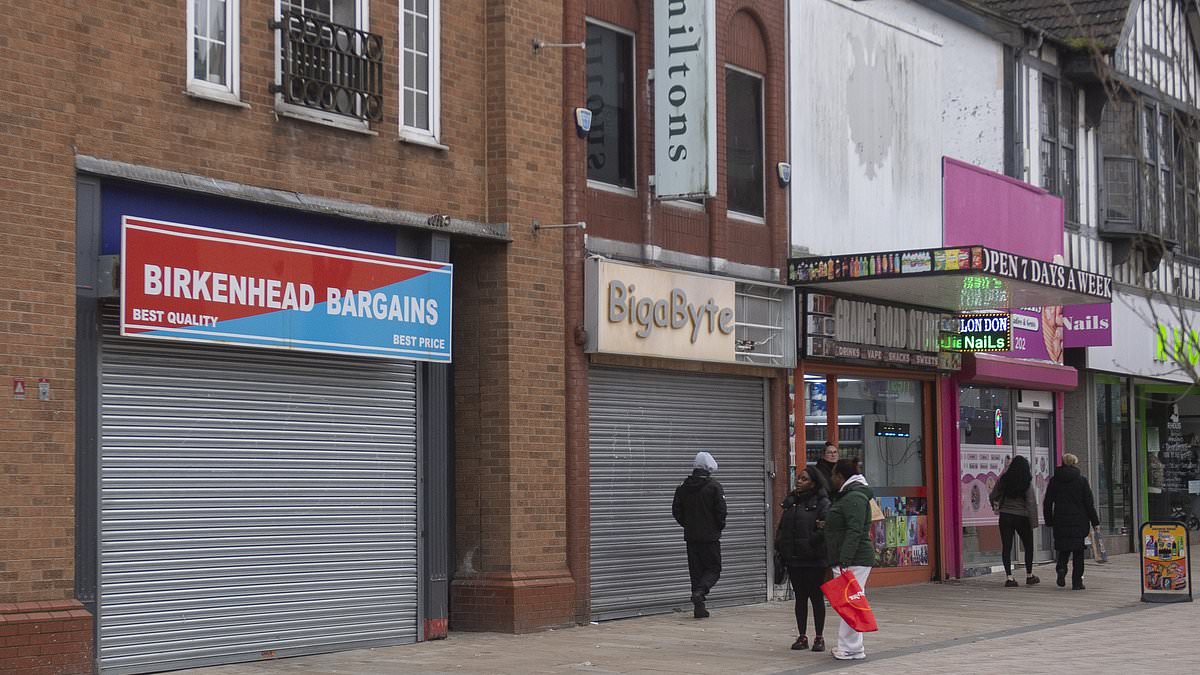
It looks like any other declining high street where failing traditional businesses are replaced by vape stores, betting shops and fast food joints - or boarded up.
On the Wirall, Birkenhead has long been best known as the port where the famous ferry 'crosses the Mersey' from Liverpool docks.
But now it has a more up-to-date reason for national attention - or notoriety - because more people here than anywhere else in Britain claim the Personal Independence Payment (PIP).
This is the disability benefit which can see people receiving up to £800 a month alongside free travel, tax exemptions and a free car which is at the centre of a national debate as it has been spiralling upwards under the Labour government.
More than one in three residents of Birkenhead Central are now on PIP meaning the total monthly bill for that benefit alone is likely to exceed £1million every month.
This is based on the fact that some 5,400 working-age people lived in the neighbourhood according to the last Census - while the most recent national audit by the Office for Budget Responsibility found that PIP recipients receive an average of £6,900 each per year.
There are 5,400 working-age people in Birkenhead according to the last Census - and PIP recipients receive an average of £6,900 each per year, so the industrial port town is costing taxpayers £1.125million per month - or £13.5million over a year
More than half of those living in Birkenhead are out of work and most of those claim unemployment benefit. A third of Birkenhead Central residents are treated for depression
Applying that sum to Birkenhead Central's 1,949 PIP claimants (as of July 2026) suggests an annual bill just shy of £13.5m - or £1,125,000 a month.
But the high number of people on benefits for poor health isn't the area's only bleak statistic: according to that Census more than half of residents (51 per cent) of the town's working age population are also out of work.
And most of those are also thought to be claiming unemployment benefits.
And if all that weren't grim enough, according to a third metric the area's population of 8,100 is also one of the most depressed in the country.
Analysis by the House of Commons library of NHS data found that 29.32% of residents of Birkenhead Central are being treated for this, the second highest figure in the country and more than double the national average of 14 per cent.
As well as mental health, there are physical concerns too: according to recent ONS data, Birkenhead is in the bottom 10 for healthy life expectancy in the whole country, with boys expected to live just 47.8 years in good health and girls 50.5 years on average.
So it was little surprise to find, when the Daily Mail visited the town this week,that there was little visible reason to feel upbeat about Birkenhead's prospects.
Those fast food joints and betting shops were filled with old and young alike, while dozens of homeless people, many apparently struggling with drug addiction, were gathered outside a YMCA building waiting to be let in.
Residents told us again and again that the town's work ethic has disappeared with young people in particular preferring to claim benefits rather than grafting.
Every single person we spoke to was on PIP or had family and friends who claimed it.
But many said the majority were claiming handouts that they didn't really need.
The statistics on Birkenhead paint a grim picture. If you are female living there you can expect to live just 50.5 years in good health. For men it's even lower at 47.8 years
Diane Davies has an autistic daughter but believes even neurodivergent people should do some work rather than simply being given handouts.
'They should be working at least four hours a day and then getting paid after that,' she said. 'They shouldn't just get stuff handed out to them for free.
'People with mental health problems need help, but just getting £700 a month isn't what they need. Pay for them to get therapy, don't just throw money at them.'
She said she knew 'a pair of smackheads' - heroin addicts - who have received thousands of pounds from PIP.
'They bragged about how much they'd got so much that their house got burgled because people knew they had money,' she said.
Diane Davies who has an autistic daughter believes neurodivergent PIP claimants should receive their PIP payments in return for four hours' work per day
Tony Aird, a former care worker, is one of the thousands of residents on PIP. But unlike many of his fellow claimants, he worked full time for years before joining their number.
The 64-year-old is now chronically unwell, suffering from Charcot-Marie-Tooth disease, cataracts, Glycoma, COPD and emphysema. He has also had nine major operations including having to have part of his jaw removed.
When he first requested PIP he was told he was fit to work and struggled to arrange an in person appointment to prove his frailty.
He said: 'I had to go through such a fight to get PIP because there are so many people claiming here. There is no tax coming in because no one is working.
'Genuine people like me are struggling to get it while others - who everyone knows are fit to work, find it easy.
'They just say they have anxiety and 'you don't know what's going on in my head' but you can see they look fit to work. The best thing for anxiety is to get a job.
'I look around me and see people who I think could be working. A lot of them haven't worked a day in their lives. It is so frustrating, it drives me mad.'
He added: 'There's a big problem with people not working here and it comes down to a change of attitude. If they don't have to work they won't and they will claim benefits instead.
'When I was brought up you went to school and then you were told you had to work. You wake up early and rock up at work everyday. For many that no longer exists.'
Former care worker Tony Aird claims PIP after suffering a series of health issues after a long working life. He gets frustrated with the younger generation's benefit claiming culture
Jasmine Cocker, who receives PIP for a neurological condition, also believes it has become too easy to claim for relatively minor mental health conditions.
She says people are abusing the system to claim handouts and avoid working.
She said of a friend's boss boasted about saving up their daughter's payment so they could 'buy something nice' - rather than really needing it.
Jasmine told us: 'I do question whether all people with anxiety or autism really need to be on PIP. They can work. They go to school and college normally so why can't they work?
'That's not what benefits should be used for. It should be for people struggling with proper disabilities. PIP should be signed off by a doctor, not just allowed because people say they have anxiety.'
Ms Cocker said locals have paid unscrupulous 'benefits brokers' £150 for advice on how to fraudulently fill out their form and claim the benefit.
She also said she had struggled personally to get accepted for PIP despite her serious and genuine condition as she wasn't able to secure an in person appointment to prove her disability. Others less deserving haven't faced such problems, she said.
'They don't check it properly when you apply,' she said. 'It's just done over the phone and it's too easy for others. But it was very hard for me, it took months.'
Jasmine Cocker receives PIP for a neurological condition. She says it's too easy for people to claim the benefit and thinks they are abusing the system
Birkenhead's current malaise seems particularly tragic because the once fiercely-proud town was previously renowned for its industry.
Its shipbuilding tradition was particularly thriving with as many as 10,000 dock workers once employed at Cammell Laird, the town's shipyard.
This civilian army helped produce more than 200 of the ships that crucial to the World War II effort including the legendary aircraft carrier HMS Ark Royal.
More recently the docks here built the polar research ship Sir David Attenborough, which was famously so nearly called Boaty McBoatface after a public vote.
But today no more than 600 people work at the shipyard and the proud working spirit and determination which once synonymous with Birkenhead is in short supply.
The industry brought money to the town and its former prosperity is evident in its Hamilton Square, dotted with Georgian townhouses, many of which are Grade I listed.
In the UK's PIP capital, everyone we spoke to was concerned it was too easy to claim.
One who told us this had particular claim to insight: until her retirement Sandra Kelly, worked for the Department for Work and Pensions dealing with PIP applications.
She said she had personally seen the number of people applying the benefit had skyrocketed in the past three years.
Ms Kelly said: 'It was mostly because of young people who wanted PIP for mental health and anxiety.
'When it was older people it was often more visible physical health problems like being in a car accident.'
She said PIP was too easy for people to claim and applications were rarely rejected.
'Whenever people appealed their PIP being rejected, it always seemed to then be accepted. Before Covid people would come in for 'in person' assessment and you could see if someone was genuine, but now it is just done over the phone.
Sandra Kelly, worked for the Department for Work and Pensions dealing with PIP applications and has seen first hand the number of applicants going up significantly
Birkenhead's PIP status is by no means unique in the part of the north west where it's situated: of the top ten areas with the highest proportion of PIP claimants, six are in or close to Merseyside.
Fazakerley South in Liverpool is the second highest, with 33.3 per cent of people claiming the benefit.
Despite a national annual PIP bill of more than £27billion, a Government review into disability benefits this week failed to address a spike in claims for ADHD and autism, which have tripled since the Covid pandemic.
Around 4.1million people in England and Wales are entitled to PIP, roughly double the numbers in 2019.
But the Timms review said PIP must remain 'cash first' and recipients should not face tougher conditions on claims.