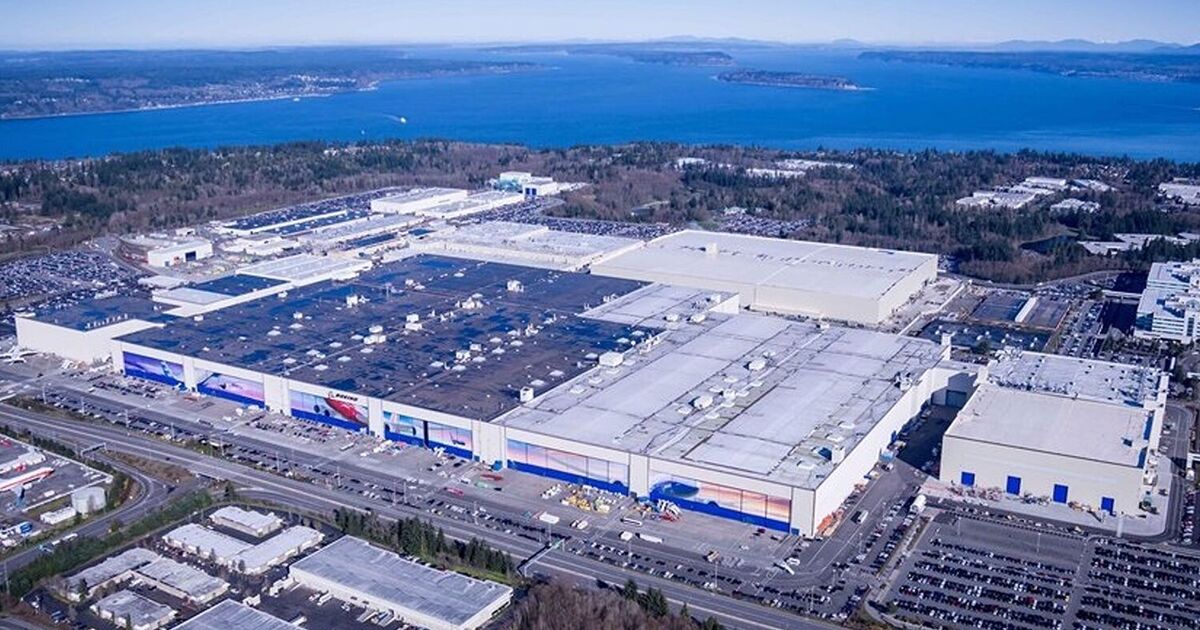
The vast facility occupies 98 acres, making it larger than the original Disneyland park in Anaheim, California.
07:05, Sun, Nov 29, 2026
Boeing’s Everett factory (Image: Boeing)
Stretching over 472 million cubic feet, this is the world’s biggest building that even generates its own microclimate. Located in Everett, Washington, Boeing’s enormous manufacturing site is around a third larger than its nearest rival, the Tesla Gigafactory. Since it began operations in 1967, the plant has produced more than 5,000 wide-body aircraft. The vast facility occupies 98 acres, making it larger than the original Disneyland park in Anaheim, California, which covers about 85 acres.
Meet the adorable dog nobody wants to rehome
The site was developed after Boeing’s former president and chairman, William M. Allen, concluded that a purpose-built production facility was essential for assembling the revolutionary Boeing 747. The Boeing 747, often referred to as the "jumbo jet", was around two and a half times larger than any passenger aircraft operating at the time it was introduced.
Before construction began, Boeing examined a number of possible locations for the huge factory, including a site in California. However, 747 chief engineer Joe Sutter is said to have opposed moving production so far from the company's Seattle base.
In the end, Boeing selected a former military airfield located about 22 miles from its headquarters. The site already had historic links to the aircraft manufacturer, having been used during the Second World War to build the iconic B-17 Flying Fortress bomber.
Get the latest news from around the world and more
I would like to receive emails from the Daily Express featuring our latest products, services, offers, and promotions from across the Reach Plc family.
Invalid email
You agree you are 18 or over. We use your sign-up to provide content in ways you've consented to and to improve our understanding of you. This may include adverts from us and third parties based on our knowledge of you. You can unsubscribe at any time. More Info.
Construction progressed at a remarkable pace, with the entire project completed in little more than a year. The development cost more than $1 billion (£790 million), according to Airways magazine.
The scale of the work was enormous. Boeing had to remove around four million cubic yards of earth to prepare the site, prompting the creation of a dedicated railway system to carry away the vast quantities of excavated soil.
Bonnie Hilory, executive director of the Future of Flight Foundation, told the local Everett Herald the factory was Boeing's "best product."
She said: "I always tell people there's one word to describe it and that's scale. It's just massive, with the biggest building, the biggest manufacturing and with giant aircraft inside of it."
Although already enormous, the Everett plant has undergone two major enlargements over the years. The first expansion came in 1978 to support production of the Boeing 767, while a second was completed in 1992 to make room for the much larger Boeing 777 programme.
The vast facility occupies 98 acres (Image: Boeing)
In recent years, Boeing has added further facilities to the site, including buildings dedicated to robotic assembly of the 777 fuselage and the manufacture of advanced composite wings for the new 777X, the company's latest wide-body aircraft designed to carry around 400 passengers.
By 2024, around 36,000 employees were working at the 98-acre complex each day across three main shifts. The factory can be accessed through 12 powered doors at ground level, with the largest standing 82ft tall and stretching 350ft across.
Supporting operations inside the vast plant is a network of 26 overhead cranes that run along 31 miles of track. These are used to move aircraft through production at a steady rate of roughly 1.5 inches per minute.
Once assembly is complete, aircraft enter the painting stage, a process that can take as long as seven days. A Boeing 747 typically requires about 454 litres of paint, while a 787 uses slightly less at around 370 litres.
The painstaking manufacturing process continues as Boeing prepares for the arrival of the 777X. The company is targeting 2027 for the first deliveries of the aircraft to customers.
By November 2025, Boeing had secured 619 orders for passenger and freighter variants of the 777X from a dozen airline and cargo operators worldwide.