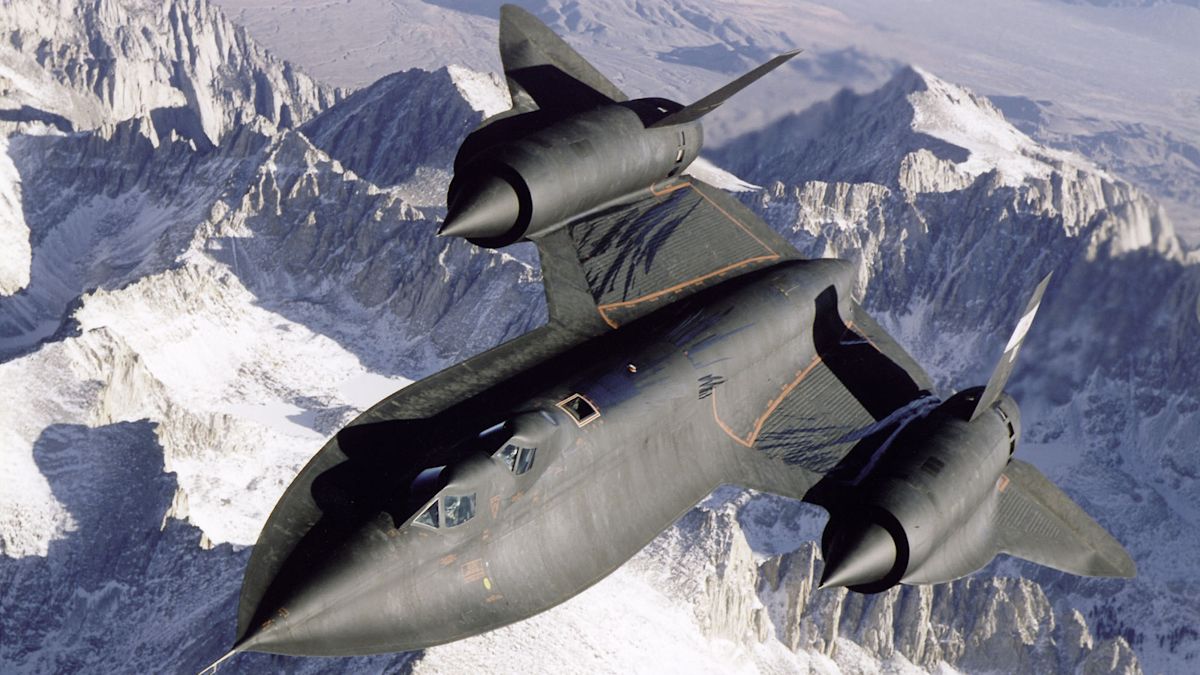
If you've ever been on a modern commercial airliner, you probably know at least some basics of how they operate. For example, a standard passenger jet typically cruises at around 31,000 to 43,000 feet, and its cruising speed will rarely breach 580 mph. At that rate, you can reliably get from John F. Kennedy International Airport in New York to Los Angeles International Airport in California in around 5½ hours, give or take. The Lockheed SR-71 Blackbird, on the other hand, can go a bit faster.
Not only can it fly comfortably at 2,000 mph (Mach 2.61), Lockheed's SR-71 Blackbird stood as one of the most prized, and secretive, high-speed aerial reconnaissance aircraft in the U.S. military's fleet. However, near the end of its service life, the U.S. Navy decided to sink one in the Mariana Trench — the deepest stretch of ocean on the planet.
In 1989, a catastrophic accident led the Navy to sink the SR-71 carrying the nickname "Ichiban." The effort was undertaken to prevent its sensitive and complex equipment from falling into the wrong hands during the Cold War, as much of its tech was still highly classified. Some logistical red tape stood in the way of other possible means of Ichiban's disposal, too, such as a land burial. This left a burial at sea as the only option for the ill-fated aircraft — a rather cold-hearted fate for one of the fastest manned, air-breathing planes ever produced.
Read more: Are Modern Truckers Still Using CB Radios?
With nowhere left to turn, Ichiban was buried at sea
Stahlkocher/Wikimedia Commons
Ichiban, the SR-71 aircraft carrying the serial number "61-7974," took off for its fateful flight on April 21, 1989 from Kadena Air Force base (Kadena AB) in Okinawa, Japan. Shortly after reaching speeds of about Mach 3, the left-engine compressor bearing froze, causing the engine to disintegrate. Once the catastrophe occurred, Ichiban's pilot, Lt. Col Dan House, reduced the aircraft's speed and altitude, allowing him and his reconnaissance systems officer, Blair Bozek, to eject safely.
Ichiban wasn't so lucky. The aircraft crashed into the South China Sea, and once recovered, its remains presented a major issue. The cheapest disposal option was to bury the plane at Kadena AB, but the facility was constantly subject to new-building construction at the time. This meant the SR-71's remains might have to be dug up and reburied in the future. The idea of selling the scrap heap at a public auction via the Defense Reutilization and Marketing Office was pitched, as well.
However, Ichiban's then-still-classified tech finding its way to the wrong people — as the military would have no control over who the buyer would be — was deemed too great a risk. Even with the SR-71 program's shutdown looming due to high operating costs and inferior reconnaissance performance when compared to satellite tech, it was decided to sink the Ichiban in a section of the Mariana Trench several hundred miles from Okinawa, at a depth of approximately 25,597 feet. Instead of being dropped into the ocean unceremoniously, some accounts say Ichiban received "full military honors" as part of its burial. They don't explicitly describe what this meant, however.
The Lockheed SR-71 Blackbird was nothing short of astounding
NASA/Wikimedia Commons
At full throttle, the SR-71 Blackbird reached a maximum speed of Mach 3.2 — roughly 2,193 mph — and its highest-recorded altitude topped out at 85,069 feet. It recorded zero crew losses and only two aircraft losses over its entire service history. Surprising, given the fact that it went into conflicts unarmed. Its experience in battle began in March 1968, during the height of the Vietnam War. It executed roughly 200 missions from Kadena AB between 1968 and the war's end, in 1975.
One of its more unconventional missions during the conflict involved two Blackbirds flying over the North Vietnamese "Hanoi Hilton" prisoner-of-war camp in central Hanoi, Vietnam. The aircraft involved produced one sonic boom each directly over the camp within 15 seconds of each other. This was done in an effort to signal the initiation of Operations Diamond and Thunderhead — a major POW rescue plan. The two coordinated booms served to spell the letter "I" in Morse code, which stood for "initiate." In other words, it was the signal to "initiate" the escape.
Following the Vietnam War's close in 1975, SR-71s continued to fly missions in the Cold War. Once it reached retirement in 1990, the National Aeronautics and Space Administration (NASA) acquired and maintained a fleet of three SR-71s for high-speed research purposes. However, they were retired in 1999. Of the 32 total SR-71s built, 20 survive today. As of now, 19 of them are on public display, but NASA removed one example — carrying the tail number "61-7980" — from its display at Edwards Air Force Base in California's Mojave Desert earlier this year. Its current whereabouts are unknown, so perhaps an SR-71 may fly again one day.
Want more like this? Join the Jalopnik newsletter to get the latest auto news sent straight to your inbox, and follow us or add us as a preferred search source on Google.
Read the original article on Jalopnik.