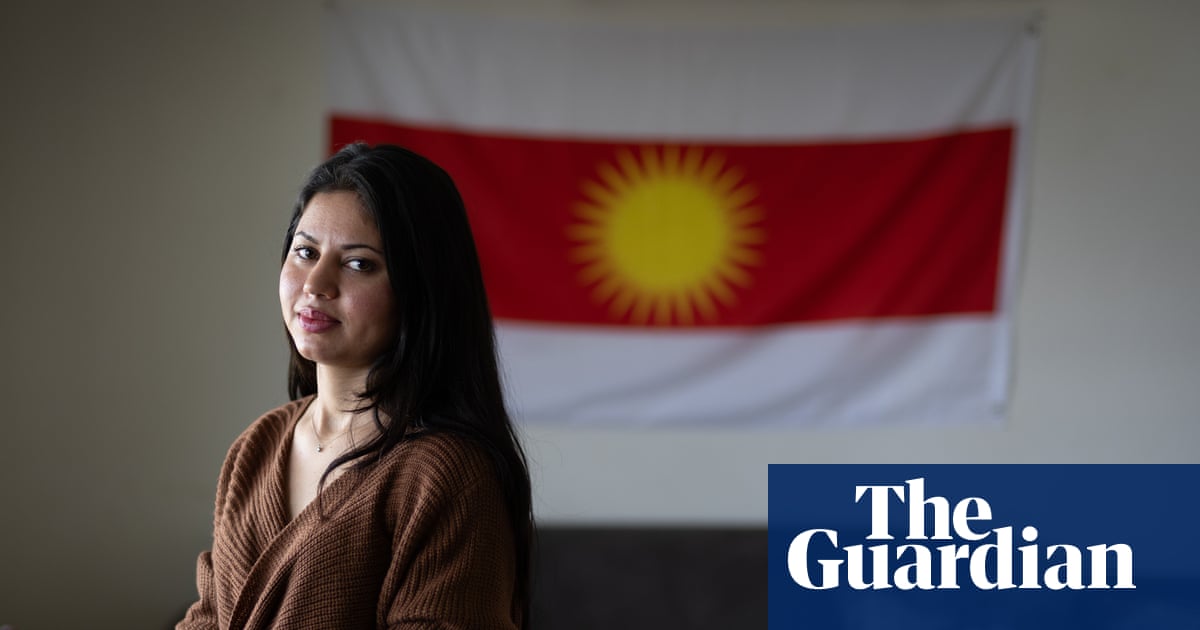
“I built my life here in just three years,” says Kristina Zandinan proudly.
The 19-year-old Yazidi woman has spent less time in Australia than she did under the barbaric captivity of Islamic State after being kidnapped as a six-year-old, when the militant group launched a genocidal campaign in Iraq’s Sinjar district.
Yet in three short years, she has become fluent in English and begun studying a cooking course at Tafe.
“I really appreciate this life. I work, I study … I help my family and I am trying to get my citizenship,” she says.
Zandinan, who lives in Toowoomba, dreams of opening a restaurant in the regional Queensland city and serving traditional Yazidi dishes like dolma alongside Australian cuisine.
While living under IS captivity, food was scarce. Zandinan would rely on the families to whom she was sold for meals.
“They will treat you like a slave. You have to cook for everyone, wash the dishes. They don’t care if you sleep hungry,” she says.
Kristina Zandinan with her medal awarded for second place at the regional WorldSkills Australia cookery competition. The 19-year-old Yazidi dreams of one day opening a restaurant in Toowoomba. Photograph: David Kelly/The Guardian
Zandinan and her family live in one of Australia’s 21 regional locations where newly arrived refugees are settled.
Australian politics has been dominated by an intensifying debate about the country’s migration intake for the past year, including the number of refugees who arrive each year.
The federal Labor government has committed to retaining the refugee intake at 20,000 a year while the Coalition has promised to halve it to 10,000. One Nation, though, has gone even further – announcing a policy earlier this month– to slash the country’s refugee intake by 90% to just 2,000 a year should they hold power after the 2028 election.
Sign up for Guardian Australia’s Politics, really newsletter here
One Nation has risen from the fringes of Australian politics, receiving a primary vote of 6.4% at the May 2025 federal election, as economic worries have pushed some voters further to the right. In the latest Guardian Essential poll last week, One Nation was deadlocked with the Labor government on a primary vote of 26%, while the Coalition’s primary vote was sitting at 25%.
While One Nation has expressed its ambition to form government, it holds just two seats in Australia’s house of representatives and would need 76 to win the next federal election. The party’s rise in opinion polls, though, has coincided with Labor and the Coalition announcing crackdowns on immigration in recent months, amid concern over the number of arrivals to Australia.
Zandinan says One Nation’s policy is disheartening for her and other refugees who have committed to contributing to Australia.
“We are good people. If you come as a refugee and take care of this country, you work, you study, you make the country proud because you live in it and make great things,” Zandinan says.
One Nation’s plan was criticised by political opponents and advocacy groups who labelled the announcement a “predictable and cheap” attack on refugees.
William Simba, a Congolese community leader in Armidale – another regional refugee resettlement location – arrived in Australia as a refugee in 2009. He now helps a new wave of refugees from his home country build their lives in the northern NSW city.
Guardian Australia spoke to Simba in July, when it visited the One Nation-held electorate of New England, which includes Armidale, to investigate how the party’s policies could affect the multicultural city. Barnaby Joyce, the New England MP who defected from the Nationals last year, had been instrumental in advocating for Armidale to become a refugee resettlement area in 2018.
Many of the Congolese women Simba supports have husbands and adult children who remain in refugee camps in countries like Uganda and Zimbabwe after fleeing the decades-long conflict in the Democratic Republic of the Congo (DRC).
Armidale Congolese community leader William Simba says One Nation’s plan to slash the refugee intake dashes the hopes of those with relatives still in camps hoping to also find safety in Australia. Photograph: Blake Sharp-Wiggins/The Guardian
“They are here but their heart is still out there thinking about those people remaining in the refugee camp,” he says.
“You can see they are struggling.”
Simba says One Nation’s plan to slash the refugee intake dashes the hopes of community members that their relatives still in camps will also find safety in Australia.
“Once you are in … a peaceful country like Australia, you want your family to be there with you because they’re still struggling,” he says.
skip past newsletter promotion
after newsletter promotion
“They are very sad.”
One Nation wants to restrict migration. A town in Barnaby Joyce's electorate welcomes it – video
During a July interview with Guardian Australia, Joyce described the reason he advocated for Armidale to be a refugee resettlement area was his belief “we have a role with compassion to reach out to people.” But he added that he did not believe Armidale had the infrastructure or services to cater for the current intake of refugees.
“You’ve got to have real jobs,” he said.
“What I want for the Yazidis is to have their own businesses.”
Asked this week about Simba’s concern, Joyce says One Nation would still have a humanitarian intake, though at a lower level, and it would be “falling into line with other OECD countries”.
Asked about how the proposed policy would impact his own electorate, including the resettlement area, Joyce says it will improve access to housing, hospitals and aged care and “reduce the total taxes all Armidale residents including refugees will have to pay over their lifetime compared to continuing at the current rate”.
Announcing the policy last week, One Nation leader, Pauline Hanson, pointed to Australia ranking second place for the most places per capita offered to refugees processed under the UN refugee agency (UNHCR).
But UNHCR is not the only way the world’s refugees are resettled. A large number of global asylum claims are processed at borders but not in Australia because of its ocean borders.
According to those figures as shown in a government analysis of OECD data, Australia remains in the top 10 countries offering pathways for refugees but ranks below Canada, Germany, France and even New Zealand on a per capita basis.
Migrants from countries on the federal government’s “do not travel” list, including Afghanistan, Iran, Lebanon, Syria and Somalia and the DRC, would be banned from entering the country under One Nation’s immigration policy.
Originally from Iraq and a member of the Yazidi community, Kristina Zandinan has rebuilt her life in regional Queensland town of Toowoomba. The 19-year-old who was taken into IS captivity as a 6-year-old, came to Australia three ago without speaking English and is now fluent. Photograph: David Kelly/The Guardian
The party has previously said the “do not travel” list ban included refugees.
Joyce says it is not an “absolute prohibition on every humanitarian case”.
“A person could still be considered where Australian authorities can positively establish their identity and give the required assurance that there are no security risks associated with the individual,” he says.