A Corvette-styled offshore catamaran called the ZR48, billed at 2,700 horsepower from a pair of Mercury Racing 1,350-hp V8s, keeps circulating online in a clip captioned as the boat outrunning the Coast Guard. The Corvette name sells the clip. The paper trail is empty. No Coast Guard release, no charge tied to the boat. Whoever shot the video never even said when or where, and no U.S. Attorney's announcement exists either.
What the caption gets wrong is the law, and that matters to anyone who owns a boat or tows one to the ramp behind a pickup. Police generally need a reason to pull a car over. The Coast Guard can board a boat with no reason at all, and an operator who runs from that boarding turns a life-jacket check into a federal felony.
The Coast Guard can board without suspicion
Title 14, Section 522 of the U.S. Code lets Coast Guard officers "at any time go on board of any vessel" subject to U.S. jurisdiction, question the people aboard, examine the boat's documents, search it and use necessary force to make the crew comply. The statute requires neither probable cause nor reasonable suspicion.
Drivers get more protection on land. In Delaware v. Prouse, decided in 1979, the Supreme Court ruled 7-1 that police may not stop a car at random just to check a license and registration; they need at least reasonable suspicion of a violation, the same baseline at the center of a recent Wisconsin traffic-stop ruling. Four years later, in United States v. Villamonte-Marquez, a 6-3 Court reached the opposite result on the water. Customs officers had boarded a sailboat in Louisiana's Calcasieu River Ship Channel with no suspicion to check its papers, and Justice William Rehnquist wrote that boats with ready access to the open sea are different enough from highway traffic that land-style alternatives like fixed checkpoints would not work as well. That case involved a Customs statute, but its reasoning sits behind the Coast Guard's own boarding power.
Refusing to heave to carries up to five years
The trouble starts when the operator won't stop. Federal law, 18 U.S.C. 2237, makes it a crime for the operator of a vessel subject to U.S. jurisdiction to knowingly disobey a federal officer's order to heave to, which the statute defines as slowing, stopping or changing course or speed so officers can board. The base penalty is up to five years in prison. If the flight causes serious bodily injury, the maximum is 15 years, and if someone dies, it can be life.
States add their own charges. In Florida, section 843.18 makes it a third-degree felony for a boat operator who knows an officer has ordered him to stop to refuse, or to stop and then flee. That carries up to five years and a $5,000 fine. Any violation also makes the boat contraband that police can seize and the state can forfeit. For the owner of a custom 2,700-hp catamaran, the forfeiture could cost more than the sentence.
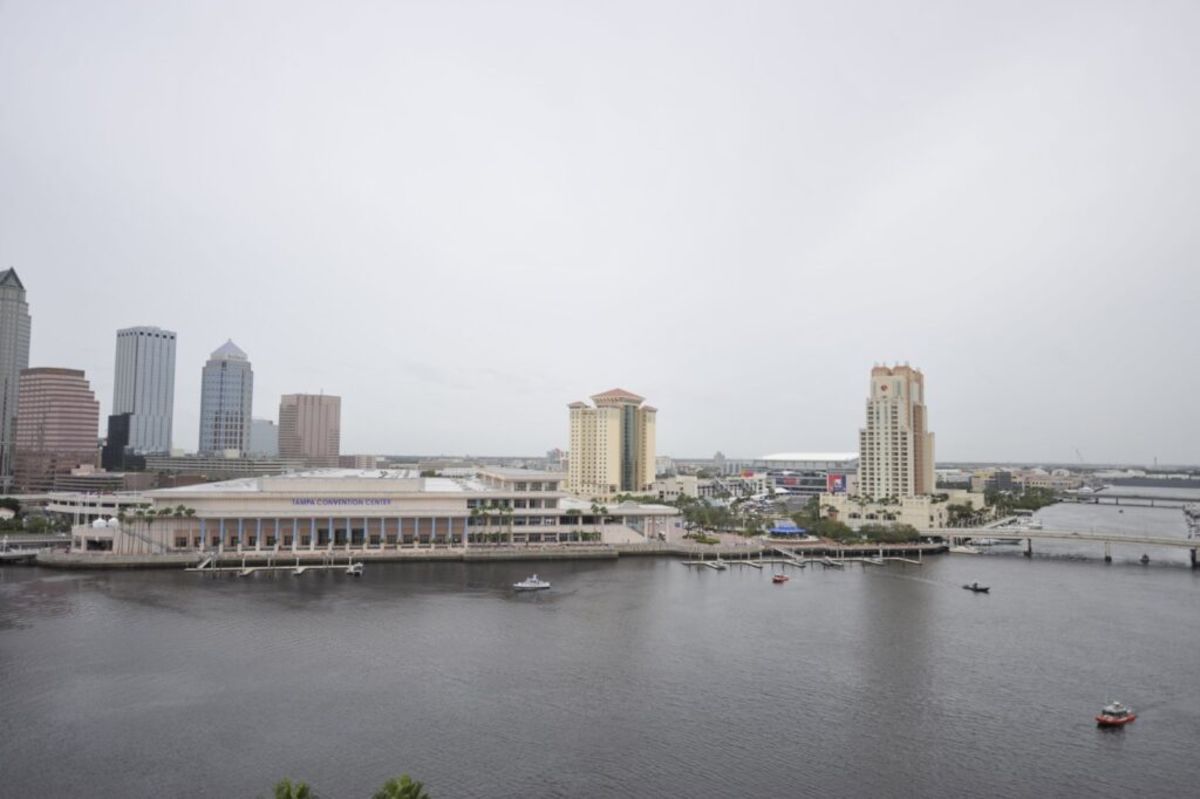
A Coast Guard 25-foot Response Boat-Small crew patrols a waterway outside the Tampa Convention Center in Florida on Aug. 26, 2012. U.S. Coast Guard photo by Petty Officer 1st Class Krys Hannum / public domain
Why the Coast Guard doesn't try to outrun fast boats
The Coast Guard's answer to boats it can't catch is a helicopter. Its Helicopter Interdiction Tactical Squadron in Jacksonville, Florida, flies MH-65 Dolphins with precision marksmen aboard, who fire warning shots and then shoot out the engines of boats that keep running, according to a May 2026 Coast Guard feature. In an Aug. 25, 2025, release, the Coast Guard said the squadron had completed its 1,000th interdiction and credited it with $33.2 billion in illicit drugs since 1999. Those tactics target smuggling go-fasts far offshore, not pleasure boats off a public beach, but the go-fasts follow the ZR48's formula of huge power on a light hull.
What happens to operators who run
Around 9 p.m. on Oct. 31, 2022, federal agents spotted a boat running without navigation lights near Coral Bay, St. John, in the U.S. Virgin Islands. The operator, a 22-year-old from Tortola, kept speeding up and maneuvering despite repeated warnings until agents disabled the boat, and six people aboard were trying to enter the U.S. illegally, the U.S. Attorney's Office said. He was sentenced in June 2023 to eight months for failure to heave to and making a false statement.
The worst of these cases cost a Coast Guardsman his life. In December 2012, near Santa Cruz Island off California, the driver of a smuggling panga rammed a Coast Guard small boat, and its propeller struck Senior Chief Petty Officer Terrell Horne III, 34, who died. The driver was convicted of murder, failure to heave to and assault and sentenced to life without parole, and a second man got 10 years, the U.S. Attorney's Office in Los Angeles announced in May 2014.
What a boater waved over should know
An order to heave to means slow down, stop or change course so a boarding team can come aboard, and Section 522 does not require the officers to explain why first. A routine safety boarding checks registration or documentation, life jackets and a charged fire extinguisher. Running turns that into felony exposure on the water, the same way fleeing a trooper does on land in cases like a Florida motorcycle rider accused of outrunning a cruiser at 147 mph.
Nothing public identifies who was driving the ZR48 in the clip, and neither the Coast Guard nor any prosecutor has tied the video to a case. If the footage shows what its caption claims, the operator's exposure is a federal count carrying up to five years, and in Florida, possibly the boat itself.
On the highway, a trooper needs a reason to pull you over. On the water, the Coast Guard needs nothing. Boat owners: have you been boarded for a "routine" check, and how long did it take?
⚡ Read the full article on The Auto Wire
Sign up for The Auto Wire Newsletter. For the latest news, follow us on Facebook and Instagram.