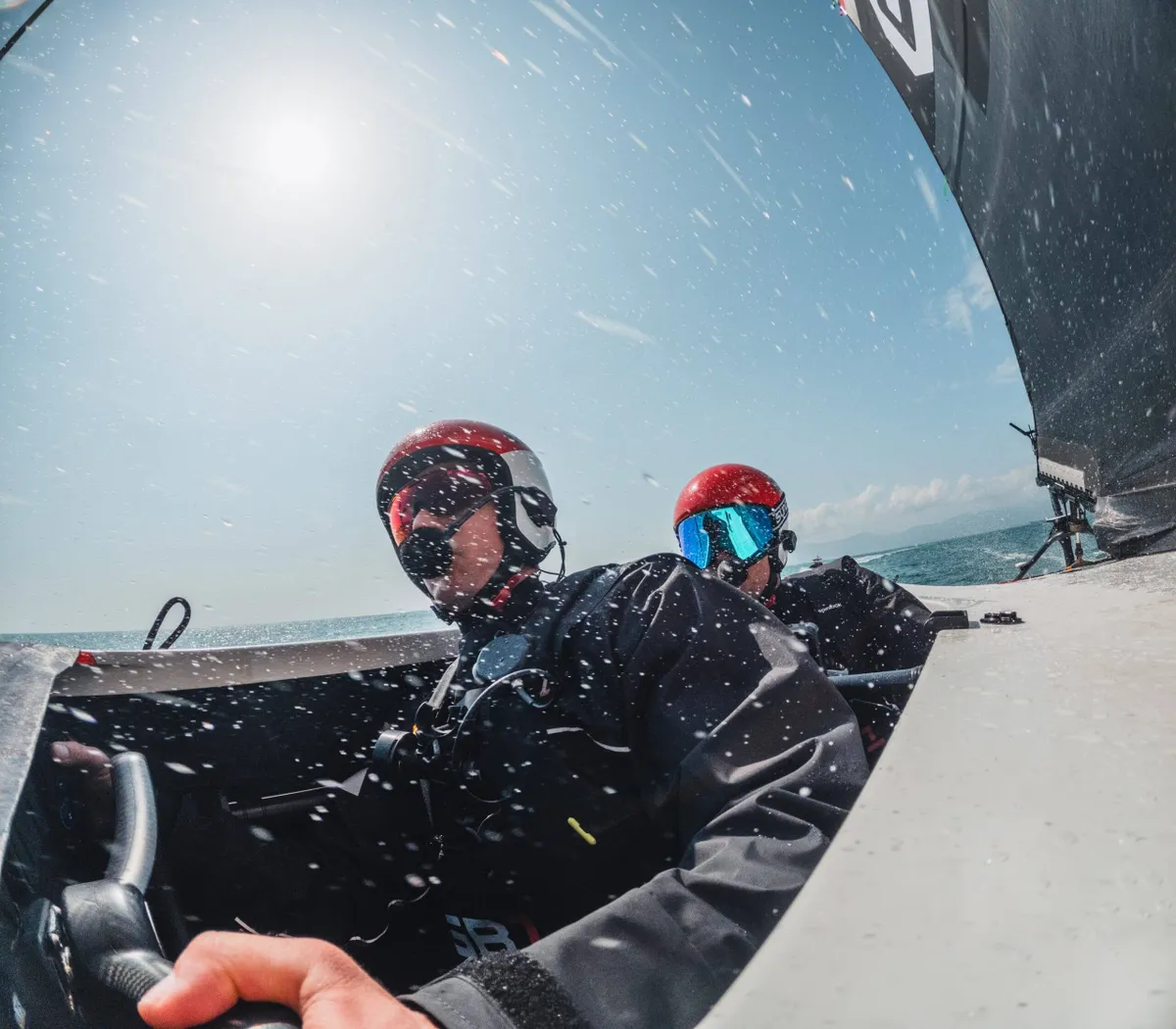
“It’s probably similar to a job in the city,” joked Dylan Fletcher, the leading helmsman for Britain’s America’s Cup challenge.
There may be some parallels between a sailor and an employee working in London’s financial and business district: waking up and checking the weather forecast, grabbing food on the go, performance debriefs, long hours. But there the similarities end.
“People think it probably starts and stops on the water and there’s nothing outside of it,” said Jemima Lines, another member of the British team known as GB1. “The on-water (part) is just a tiny piece.”
The routine is exhausting and exhaustive: Technical briefings, simulator sessions, physiotherapy appointments, checking emergency breathing systems, deciding the optimum time to go to the toilet — all before they even begin racing at over 60 miles per hour (100km/h) on multi-million pound yachts for a chance to win sport’s oldest international trophy.
“The days are long, 13 hours, you’re certainly smoked by the time racing finishes at the end of the America’s Cup,” added Fletcher, who is also a member of Britain’s SailGP team and is competing in the season finale of the close-to-shore 13-team competition in Abu Dhabi this weekend.
The fleet of seven America’s Cup teams have started moving into their bases in Bagnoli, Naples. From next January, Britain’s sailors and their families will be stationed in the Italian host city full time for the next seven months as the team prepares for the 38th edition of what is widely regarded as sailing’s most prestigious international competition.
During the second preliminary regatta in September, The Athletic went behind the scenes with Britain’s team in Naples to understand what life is really like on and off the water for the world’s best sailors.
Cranes scale over the bases in Bagnoli, a neighborhood six miles west of Naples city centre. As they prepare for race day, people bustle in and out of the yard — boat builders, engineers, rescue divers, analysts and more.
Timings all work back from when the yacht docks from the team’s base. “You can’t be late,” said Ellie Aldridge, co-helm of GB2, Britain’s women’s America’s Cup team that will be racing next July in a separate competition that was first introduced in 2024.
After waking up between 6:30 and 7:30 a.m., sailors review team briefings and weather forecasts. The British team is dotted around the city so they commute to the team base on foot, by bike or the metro.
Breakfast is eaten either at base or their accommodation and some, like Fletcher, head straight onto the yacht simulator for around 90 minutes to warm up for the conditions ahead. The sailors will also check in with the shore crew, the land-based team whose mornings starts a lot earlier. Sometimes, they work through the night if needed.
The team’s base houses a gym, including stationary bikes, but Aldridge likes to go for a 3-mile (5km) run along the seafront. “It wakes me up, a nice way to start the day,” she said, cutting a square of black tape to secure her goggles onto her helmet in preparation to race.
Britain has never won the America’s Cup.GB1 America’s Cup Challenger
For the first time in its history, the America’s Cup, which starts in May, has replaced any need for physical human effort with battery power. “Even though we’re athletes, we sit on the boat and don’t move,” Aldridge said. “It’s not that physical. It’s important I do something every day to move my body.”
Others will have their own mobility and stretching routines, which is important given the static position they hold. “It’s almost like when you’re in an office all day, they’re not able to move in and out,” said physiotherapist Kate Richardson, whose work has to be impactful given the sailors may only have 10 minutes to spare in their already packed schedules. The most common niggles are restrictions in the thoracic spine, lower back, neck and sore hips.
The goal is to make the boat go faster, so the team gathers for briefings to discuss key learnings from the previous day, as well as technical items, such as weather conditions and any patterns they have noticed.
Despite this competition not being particularly physically demanding, the sailors, who train five to six days a week with a rest day on Sundays, have to be focused for hours over consecutive days. “There’s a massive mental load because you are really switched on for a significant amount of time,” said Lines, who likened the race to high-speed chess.
Communication on the water is vital. Away from competition, the team, including support staff, works with Mindflick, a performance psychometric platform. With the help of psychologists, they try to build trust and help give the sailors the tools they need to read each other in different scenarios, ensuring they can stay aligned if conditions quickly change.
Technological advancements mean next year’s America’s Cup will not be particularly physically demanding.GB1 America’s Cup Challenger
Deciding when and how to eat on choppy waters presents its own challenge. Hannah Mills, a two-time Olympic champion, is team principal and helm of GB2. She usually eats a chicken wrap, something easy she can eat on the go. During training and competition, sailors can be on the water for around four hours so keeping fueled is important. But it’s down to personal preference whether an individual eats before, during or after a race.
Since September’s regatta, Nick Holt, the team’s chef for the last two America’s Cup editions, has come on board to serve fresh food for the 120-person team. His protein shakes are a hit with Fletcher: “They’re full of all this goodness stuff that keeps us from getting ill. That’s my favourite meal of the day.”
The sailors also have to consider when to go to the toilet. “Always before I go out on the water,” said Mills. “But then on the water you go off the back of the rigid inflatable boat. Not the most glamorous, but it is what it is.”
Lines, meanwhile, is conscious to hydrate, using electrolytes, before and after sailing as much as possible. She then sips water little and often on the boat.
It is the job of Alex Hopson, human performance lead, to ensure everyone is performing at their best. His priority is to reduce the impact of illness or injury so each athlete is available to compete.
“Every sailing day in terms of learning is critical,” said Hopson. This is especially true considering the length of the America’s Cup campaign. Britain will be competing again in May and will hope to be in July’s final of The Louis Vuitton Cup, the winner of which will challenge holders New Zealand in the America’s Cup Match itself that month.
Via the chief medical officer, each athlete has health checks, from blood profiling to physio assessments. Other performance elements, such as nutrition, hydration or mental fatigue, are monitored closely to help understand if further support is needed. Identifying incident patterns early on, such as the increase in the number of colds after a travel period, can help mitigate that risk come the start of competition.
A training day usually ends at around 10 p.m. for Britain’s sailors.GB1 America’s Cup Challenger
While the sailors are on the water, back at base analysts are interpreting a series of live data, which to the uninitiated look like highly complex looping lines on computer screens. They also have access to other yachts’ data and can map how taking a different route affects performance. Sometimes, they will also have to figure where a fault is coming from. Efficient communication to enact change is vital, which is why Mills described a dysfunctional communication kit as a “disaster.”
Once a race is over, the sails come down, boats are towed back to base, sailors travel to the media centre, then have physio if required, before further performance and strategic debriefs.
Some may rinse off with a hose while Aldridge prefers to stay in her kit until she returns to her accommodation. Once she has had a shower and puts clean clothes on, she reviews the day’s footage.
“Everyone’s pretty obsessed with the data and analyzing things for the next day,” Lines said. “That’s what puts this level of sailing above the rest, the day to day analysis chain, it’s what you’re thinking about the entire time.”
“It’s very easy to just be wired all the time,” Mills said. “To look into everything too much because we have so much data and information.”
In the evenings, Aldridge and Lines unwind with a run or swim, followed by dinner with whoever is around. Mills tries not to review a race too close to bedtime, while Fletcher pores over the analysis.
Bedtime arrives at between 10 and 11 p.m., though Fletcher notes that his daughter usually wakes him throughout the night — a grounding reminder amid the intensity of the America’s Cup bubble.