Most Russians think their country is heading in the right direction, yet half expect the hardest times are still to come, according to two Levada Center polls published in November.
Some 57% of respondents said things in Russia were going in the right direction, down from 60% in September and October, the independent pollster's November ratings release showed on November 27. A quarter (26%) said the country was on the wrong track, a share unchanged for four months, and 17% could not say.
In Levada's October survey of living conditions, published on November 19, 51% said the hardest times were still ahead, up eight percentage points from 43% in June 2025 and the highest reading since 58% in June 2023. Another 21% said Russians were living through the hardest times now, and 15% thought they were already over.
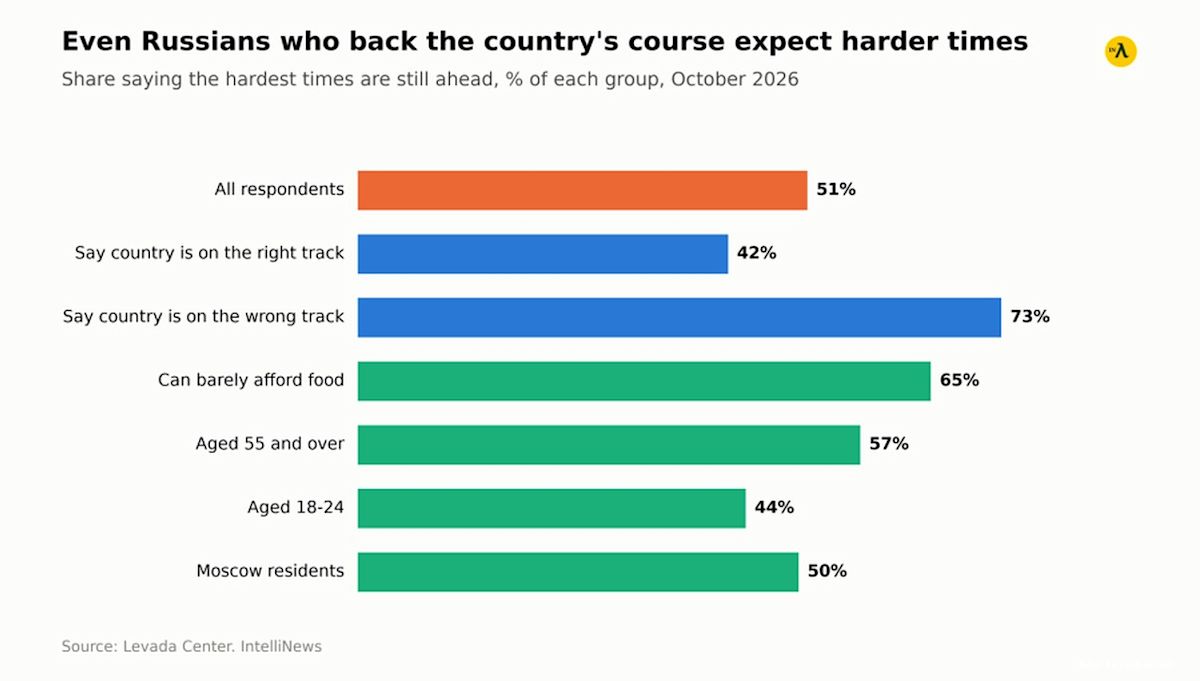
Among people who said the country was on the right track, 42% still expected the hardest times to come, against 73% of those who said it was on the wrong track, according to Levada's breakdown of the October results. Backing the Kremlin's course and bracing for a harder life are, for a large part of the population, the same view.
Share of respondents saying the hardest times are still ahead, by group, October 2026. Source: Levada Center. IntelliNews
Support for the country's direction has slipped from a wartime high. It peaked at 75% in February and June 2024 and stayed between 65% and 74% throughout 2025, before falling to 52% in June 2026, back to its level of February 2022, the month Russia invaded Ukraine. It has since recovered most of that ground. President Vladimir Putin's approval rating rose to 79% in November, from 77% in October, the same release showed.
Answers to Levada's question whether Russia is going in the right direction or on the wrong track, % of respondents, monthly, January 2000 to November 2026. Source: Levada Center. IntelliNews
Respondents who see the country on the right track have in mind social and economic development, rising prosperity and the successes of the 'special military operation', Levada said. Those who see it on the wrong track point to rising prices, tax increases, falling living standards and the drawn-out fighting.
The public mood has recovered since the summer, when it was hit by drone attacks and petrol shortages, according to the pollster. Two-thirds (64%) of respondents described their mood as normal and even in November, up seven points since September, while the share feeling tension, irritation, fear or depression fell to 22%, seven points below June. That recovery faces a new test as Ukrainian drone strikes have cut Russia's oil refining by 45% this month, adding to a long refinery damage ledger.
People's view of their own circumstances has darkened over the past year. Only 14% said everything in their life was fine in October, down 12 points from June 2025, and one in ten said their hardship had become unbearable, up seven points over the same period. Expectations of hard times ahead were highest among people who can barely afford food (65%), those aged 55 and over (57%) and rural residents (56%).
Declared loyalty to the official course appears to work independently of people's own economic expectations, according to Russian Election Monitor, an account on X that tracks Russian politics and flagged the contrast between the two releases. Polling in wartime Russia carries its own caveats: trust in opinion polls has fallen for three years running, and some respondents say people lie to pollsters.
Levada, which the Russian authorities have designated a foreign agent, interviewed 1,625 adults face to face in 137 towns and villages across 50 regions on November 17-25, and 1,601 adults in the same way on October 21-30. The margin of error is no more than 3.4 percentage points.
This article was produced with the help of the IntelliNews Lambda analytical tool