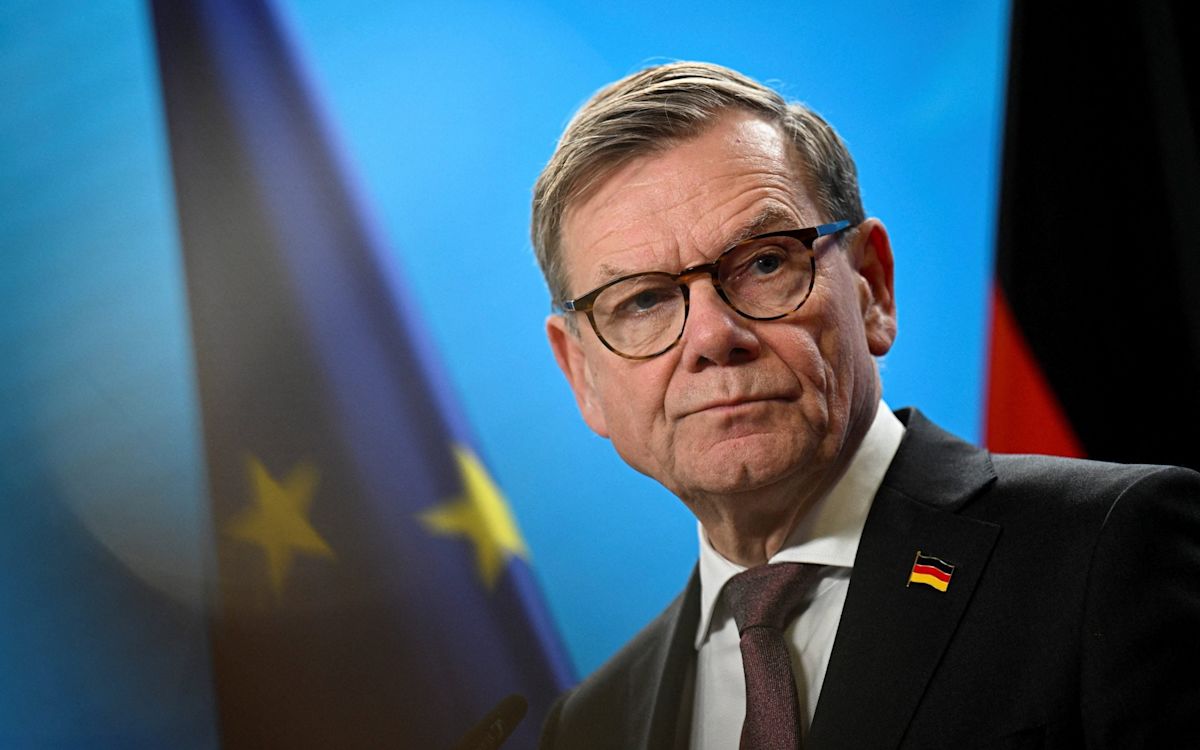
Germany's foreign minister has ordered staff to stop using gender-neutral language in official documents so that they can focus on dealing with the war in Ukraine.
Johann Wadephul has told civil servants to phase out the use of the so-called gender asterisk, which is used to represent non-binary identities in German, in their communications.
For example, some Germans write the plural noun Bürger – which can refer to either male citizens or citizens of both genders – as "Bürger*innen", incorporating the feminine suffix offset by an asterisk, to acknowledge the existence of male, female, transgender and non-binary citizens in a single word.
Mr Wadephul, a member of the centre-Right Christian Democratic Union party, said he wanted staff to focus "on the major conflict zones" of Ukraine and Iran, according to Der Spiegel.
The decision to remove gender asterisks from official communications was made in 2025. But a report in the magazine this week revealed that the foreign ministry was using AI to remove gender asterisks, and phoning civil servants to complain if they continued to use them.
Annalena Baerbock, Johann Wadephul's predecessor, introduced the use of the gender asterisk at the foreign ministry - SOPA Images
Mr Wadephul's edict, which marks a break from the approach of Annalena Baerbock, his liberal Green party predecessor, follows the removal of Ms Baerbock's "feminist foreign policy" guidelines from the ministry's website.
Insiders told Der Spiegel that Mr Wadephul had become fixated on the issue, and that anyone who used a gender asterisk in communications was likely to receive a phone call about it.
"Anyone who talks to employees of the foreign office certainly gets the impression that Wadephul and his loyalists are expending considerable energy enforcing the ban on gender-inclusive language within the ministry," the magazine reported.
The ministry has even resorted to using AI programmes to try to hunt down any surviving instances of the gender asterisk being used in official documents or on website pages.
The use of asterisk pronouns has become a culture-war issue in Germany, where conservatives cite it as an example of creeping "wokeism", which erodes traditional notions of gender.
Supporters of the practice say it is an important step towards acknowledging the existence of transgender and non-binary people, especially in light of Germany's wartime past.
Ms Baerbock, who introduced the gender asterisk at the foreign ministry, served in the previous Ampel (traffic-light) coalition government led by Olaf Scholz, the former chancellor.
The Ampel coalition, which consisted of Mr Scholz's Social Democrats, the Greens, and the liberal Free Democrats, implemented some of the most liberal gender laws in the country's history.
Sven Liebich, a convicted neo-Nazi, is alleged to have changed his gender to avoid serving time in a male prison - Picture Alliance/DPA/Sebastian Willnow
These included reforms that allowed Germans to change their gender once per year by making a simple declaration to the authorities, without the need for a legal process.
The reforms were exploited by Sven Liebich, a convicted neo-Nazi, who allegedly changed his gender to female – having adopted the name Marla-Svenja – in an attempt to avoid serving time in a male prison.
Liebich, who was sent to a women's prison in Germany in July to serve a sentence for incitement to hatred, denied that the change of gender was a stunt intended to mock the liberal reforms.
Try full access to The Telegraph free today. Unlock their award-winning website and essential news app, plus useful tools and expert guides for your money, health and holidays.