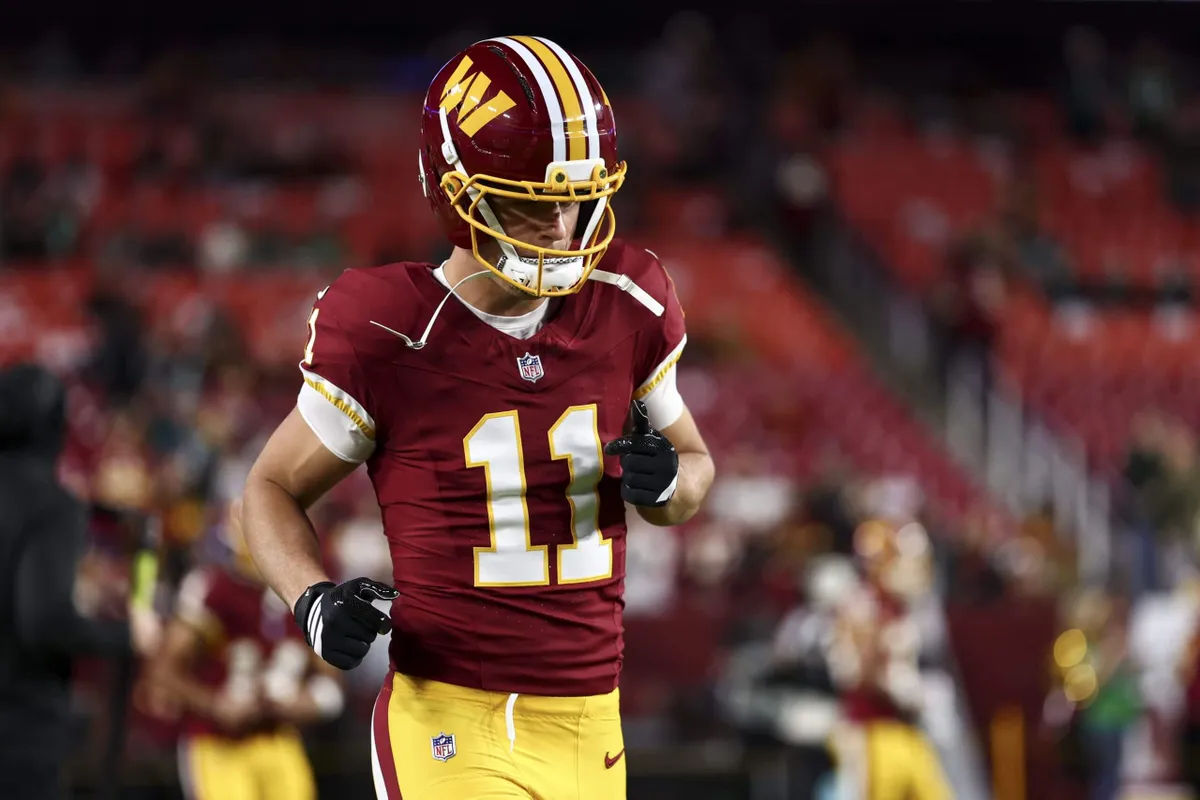
Three minutes into his postgame news conference after Thursday night’s win over the New York Giants, Washington Commanders coach Dan Quinn offered some unprompted credit to kickoff returner Luke McCaffrey.
“I thought Luke McCaffrey made a really smart play that won’t show up on the stat sheet,” Quinn said. “But that’s a difficult play, man. Is it out of bounds, is it not? I was nervous about it. It’s one of those you hold your breath.”
The play Quinn referenced came with just over eight minutes left in the fourth quarter, with the Commanders trailing 21-17 after a 66-yard touchdown pass from Giants quarterback J.J. McCarthy to tight end Isaiah Likely. Giants kicker Dominic Zvada appeared to get off a quality kickoff, with the ball bouncing in the landing zone at the 11-yard line and staying in bounds.
However, the Giants were penalized for a kickoff out of bounds, and the Commanders’ offense started the drive at the 40-yard line.
High IQ play by Luke McCaffrey.
Commanders start at the 40 because the kick went out of bounds (technically).
WASvsNYG on Prime
Stream on @NFLPlus pic.twitter.com/FyOQ4m7Am6
— NFL (@NFL) November 13, 2026
The reason is that McCaffrey willfully went out of bounds, kept his feet planted and lunged forward to corral the ball, which settled just inside the yard-line markers. According to Rule 3, Section 20, Article 1 and Article 3, the ball was considered out of bounds, even though it never crossed the boundary.
Article 1 states: “A player or an official is out of bounds when he touches a boundary line, or when he touches anything that is on or outside a boundary line, except a player, an official, or a pylon.”
By this definition, McCaffrey was clearly out of bounds. That takes it to Article 3, Item 2: Loose Ball.
“A loose ball that is not in player control is out of bounds when it touches a boundary line or anything that is on or outside such line, including a player, an official, or a pylon,” the rulebook states.
Quinn’s nervousness about watching the play unfold is also understandable. Video shows McCaffrey already decided to make this play before the ball’s first bounce on the turf. As he positions himself out of bounds, the ball hits the turf. Fortunately for McCaffrey and the Commanders, the ball bounces softly straight up and comes back down in the same general area McCaffrey hoped for, close enough for him to lunge and corral it. Had the ball taken an awkward bounce and turned sharply inside as the Giants kickoff team sprinted downfield, the result could have been disastrous for the Commanders.
This isn’t the first time this sort of play has happened in the NFL. There have been multiple examples before, including a decade ago when Green Bay Packers wide receiver Ty Montgomery executed the play against the Detroit Lions.
This rule more commonly comes into play when a fumble and a scramble to recover the ball near the sidelines occur. If a player who is out of bounds touches the ball in that scenario, possession doesn’t just go to that player’s team; the ball is considered dead at the spot because that player is an extension of out of bounds with a loose ball in play.
Similarly, McCaffrey was an extension of being out of bounds Thursday, and it worked out in the Commanders’ favor.
Nov 13, 2026
Connections: Sports Edition
Spot the pattern. Connect the terms
Find the hidden link between sports terms