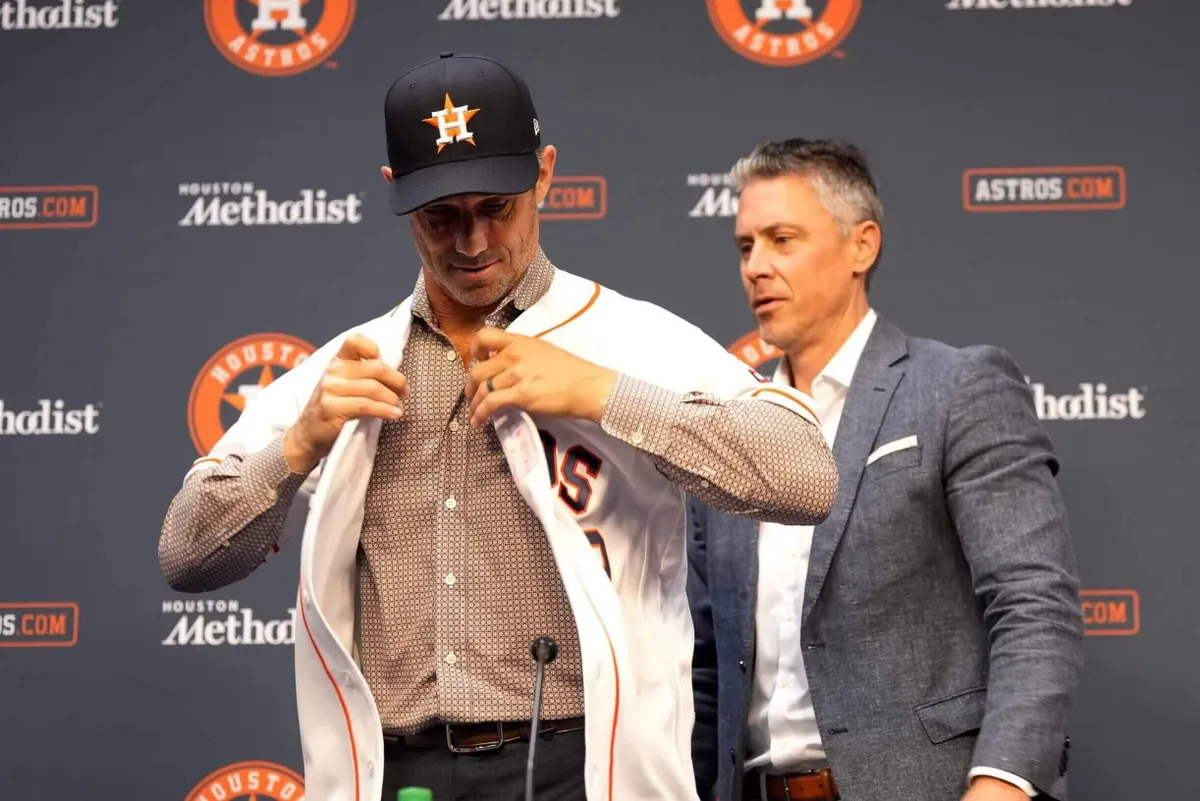
HOUSTON — Brad Ausmus is a native Northeasterner who has found a second home in Houston, where he remains the Astros’ franchise leader in games caught and in the consciousness of the entire fanbase. Ausmus has not hidden his affinity for this place or his desire to return. He interviewed for the manager role in 2020 and, two years later, finished as runner-up in its search for a general manager.
Both positions were vacant when Ausmus arrived in Houston late last month. He intended to interview for the general manager job, even though the franchise already had a front-runner in Milwaukee Brewers executive Matt Kleine. “At some point,” Ausmus recalled, the interview pivoted to the prospect of managing the team he’s long tried to rejoin.
“When I left that evening, I was sure of one thing and kind of sure of a second thing,” Ausmus said on Friday. “I was sure I was not getting the general manager’s job at that point. And I was kinda sure that I might be involved in the manager’s role, but I was not assured I was going to be the manager.”
How, when or from whom Ausmus received his assurance is somewhat ambiguous, a perfect accentuation of the peculiar processes that put him back in a Houston uniform on Friday morning at Daikin Park. The Astros introduced Ausmus as their new manager in a news conference that crystallized his circuitous path.
“In the modern front offices, there’s two very, very important relationships — one is between the owner and the general manager and the next one is between the general manager and the manager,” new GM Randy Flores said. “I just knew I wanted to do this with him by my side.”
Flores, not Kleine, is Houston’s first-year GM. The team rushed to hire him on Oct. 30 after negotiations with Kleine broke down. Multiple league sources not authorized to speak publicly about the hiring process said Flores’ deal came together within 36 hours.
Ausmus’ interview occurred Oct. 29, according to MLB.com. It included owner Jim Crane and senior adviser Jeff Bagwell, one of Ausmus’ closest friends and a former Astros teammate. As Bagwell’s influence within the organization has grown, the Astros have cycled through three general managers and two field managers.
In every search, even those that netted other candidates, Ausmus’ bond with Bagwell had been impossible to ignore.
Asked how influential Bagwell became in his hiring process, Ausmus replied, “That’s probably a better question for Jeff than me, quite frankly. I have interviewed here before when Jeff was not involved at all.”
Bagwell attended Ausmus’ news conference Friday morning, sat in the front row, and hurried out moments after it concluded. In an interview with MLB.com on Thursday, Bagwell said he was “not banging the table for Brad” during the team’s offseason searches.
“For some reason, I get this (narrative) that it’s because he’s my friend,” Bagwell said. “Most people who get jobs in the game are friends with somebody. That’s how it works. How do you think you find people? They just don’t show up. You’ve got to find people and, generally, they’re acquaintances you have throughout the game.”
Flores reiterated Friday that he included Ausmus on a list of potential managerial candidates he presented to Crane during his first interview in early October. Upon being hired, Flores said Crane told him “it’s your decision” who to hire as manager.
“At that point,” Ausmus said, “I’m waiting, hoping, I get a call from them.”
That Ausmus had already interviewed for the job and ended up with it creates optics that are difficult to overlook. Flores and Ausmus acknowledged they didn’t know each other beforehand, but reached out to friends in the game who did to understand each other better.
“I actually got sterling reports back,” Ausmus said of Flores. “Things like, ‘great guy, hard worker, you’ll really enjoy working with him if you get the job.’ I went in thinking, all right, it sounds like we might vibe a little bit.”
Last weekend, Flores flew to San Diego and interviewed Ausmus for more than four hours. Their shared past as major-league players produced a “built-in rapport,” Ausmus said. Flores said he found Ausmus had evolved since he last managed in 2019 — in everything from how he treats the media to how he married data into his day-to-day operations.
“I’ve kind of grown my knowledge in the data side of the game,” said Ausmus, who credited his time as a special assistant in the Los Angeles Angels and San Diego Padres front offices for opening his eyes.
“I know a lot of times it’s old school versus new school when it comes to data, but it’s very valuable. You don’t necessarily have to live and die by data in every single instance, but it’s extremely valuable in making decisions and putting together a roster.
“That’s the part of me that has probably grown the most over the past 10 years, truthfully. And it was intentional. I wanted to learn that side of it.”
In a place pilloried for some past comments by Bagwell — “There are certain things that go on that the numbers can’t explain,” he said in 2022. “This game is played by humans, man. It’s not played by computers.” — Ausmus’ acknowledgment struck the right chord.
So did subtle hints of nostalgia and a strict focus on what is ahead. Ausmus said he received text messages from many former Houston teammates — Lance Berkman, Roy Oswalt and Wade Miller among them — but looked more forward to connecting with his current roster. Doing so before the expected lockout on Dec. 1 is mandatory.
“I’m not here to talk about the glory days,” Ausmus said. “I’m here to talk about the Houston Astros today and going into 2027, which is now my main focus, and certainly (the) goal is to win the World Series.”
In reality, there is little Bagwell, Ausmus or Flores can say that will alter the public perception of how this offseason unfolded. It feels unfair to all involved, but such is life as public figures.
That Houston has seen its regular-season win total decrease each of the past four seasons, snapped a streak of eight consecutive postseason appearances in 2025 and lost nine consecutive home playoff games only intensifies the fury.
Altering any of those three things can lessen it, a fact Ausmus knows firsthand.
“We need to win the World Series,” Ausmus said. “That’s what we’re here to do. I think that should be the goal every single year. It’s very difficult to win the World Series, but that should be the goal.
“Making the playoffs, great step. Winning the division, great step. But the goal is, and should be every single year, to win the World Series.”