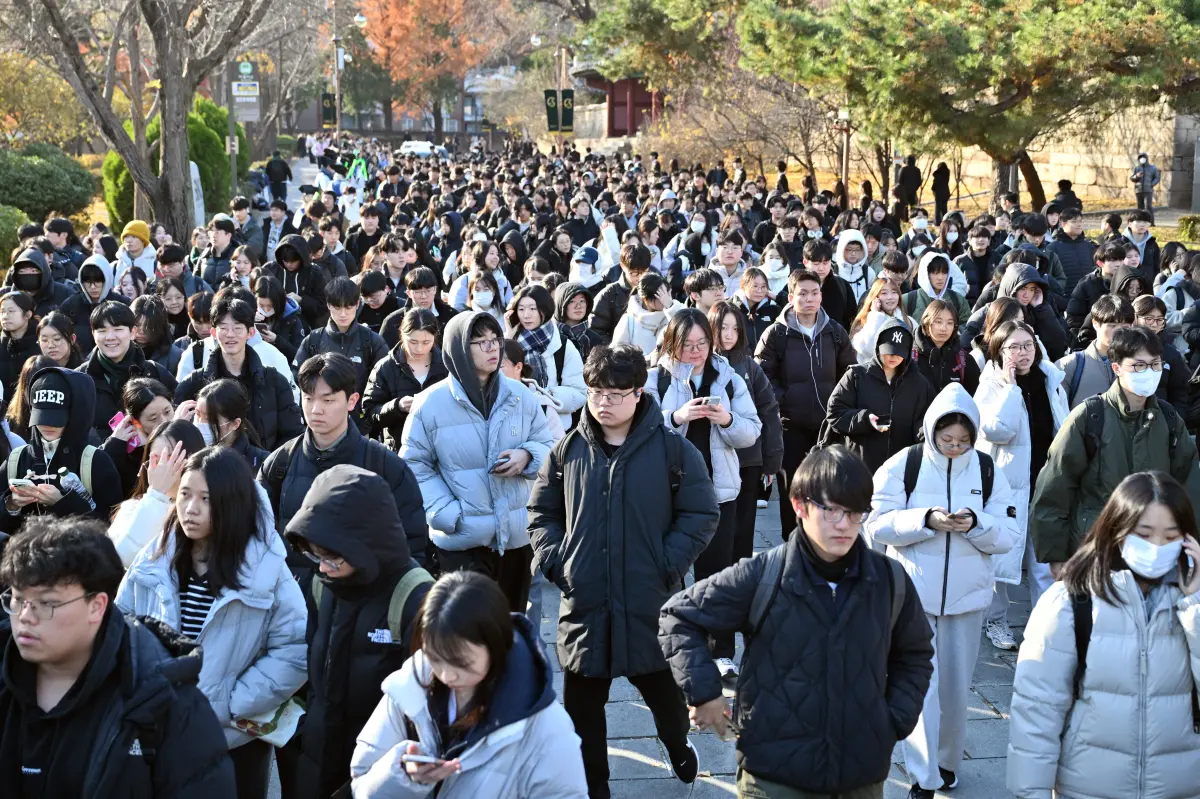
While the American education system is scrambling to respond to the challenges posed by AI, South Korea is leading the way with a top-down approach to protecting academic integrity against cheating and laziness.
This month, the entire nation cooperated in efforts to root out AI-aided cheating and minimize distractions during their national college entry exam — to the extent that aircraft were temporarily prevented from taking off and cheaters were threatened with jail time by national politicians.
It’s yet another way the American education system is being left in the dust by peer nations with a clearer dedication to excellence and meritocracy.
“This is the result of a highly centralized education system [in Korea],” Korea historian and James Madison University professor Michael J. Seth told The Post. “The stress on academics is important. All things being considered, I think it’s not the worst obsession to have.”
South Korea imposed strict new anti-cheating measures during their national college placement exam on Nov. 19. AFP via Getty Images
Korea administered its annual high-stakes college entrance exams with an intense new anti-cheating protocol this year, after a test taker admitted to cheating last year by sending photos of exam questions via a hidden camera to an AI app which sent answers to his phone.
At a random point in the nine-hour exam period, every single phone in the country got the highest-level emergency alert, similar to an American Amber alert, causing devices to blare at top volume for 10.5 seconds. It reportedly rooted out 22 student cheaters across the country.
The nation also invested in an additional 8,400 test proctors this year and suspended all aircraft takeoffs for 35 minutes to minimize noise distractions while they administered an English listening portion of the exam. President Lee Jae Myung declared that cheating with artificial intelligence could result in up to five years’ prison time, or the equivalent of a $7,500 fine.
Meanwhile, Korea is taking a merciless approach to cheating across the educational system. On Nov. 24, acting education minister Choi Eun-ok declared that students as young as middle school will be given zeros on every single exam taken in a given day if they are caught with a device during a test.
Lee Jae Myung, president of the Republic of Korea, said students who cheat on national exams could face jail time. Xinhua/Shutterstock
It’s all part of a far more aggressive, centralized approach to academic integrity compared with the United States, where a May Gallup survey found that 82% of K-12 teachers said they have not received formal guidance on how to handle AI from administrators and two-thirds of teachers have caught students cheating with AI.
Even our most elite universities are being caught flat-footed in their response to cheating in the age of AI. Roberto Serrano, professor of economics at Brown University, recently blew the whistle on his own students for suspected mass dishonesty. “I think what AI has done, among other things, is to lower the costs of cheating to essentially zero,” he told The Post.
Serrano says that the take-home midterm he administers every year resulted in a 96% average this March, compared with a typical average of 65% to 80% year to year. When he switched to an in-person exam, the average was just 48.6%. The result, he says, is indicative of a deflation of educational values: “One of the solutions we need to work on is to bring back an ethical culture that emphasizes effort and hard work as necessary steps towards true learning.”
Experts who work closely with both American and international students say the difference in the cultural commitment to academic excellence can be stark. Chris Rim, founder and CEO of the college admissions consultancy Command Education, says the American students he works with are often more casual than students from Korea, Japan, and China. The difference is that, in East Asia, academics are “a commitment that begins early,” versus something kids “suddenly need to start worrying about in their junior year of high school.”
Brown professor Roberto Serrano called his own students out publicly for suspected mass cheating with AI.
“I think we’ve become too lax in the United States when it comes to academic expectations,” he said. “We’ve become so concerned about putting too much pressure on students that we’ve sometimes forgotten that a little pressure is exactly what helps young people grow and succeed.”
In recent years, the United States has put more emphasis on equity than excellence, causing grades to rise while objective achievement lagged. GPAs have risen over the past 15 years, while NAEP scores have fallen. American high school seniors are hitting historic low achievement; almost half (45%) scored below the basic level in math in the 2024 NAEP exams.
School districts have taken to delaying or even scrapping advanced courses and closing elite magnet schools, all in an effort to make sure that students are on the same footing. Meanwhile, in Korea, there’s no expectation that economic disadvantage means academic disadvantage; in fact, in 2022, the OECD found that it was one of only four nations in the world where less wealthy schools tended to be more academically selective.
“One important lesson [for America] from South Korea is that students should not be held to lower academic expectations simply because they come from disadvantaged backgrounds,” Soo-yong Byun, professor of Asian Studies at Penn State, told The Post. “Having high expectations for all students, regardless of their family circumstances, can help promote educational opportunity and social mobility.”
South Korea hired thousands of additional proctors to ensure students followed the rules during their national college placement exam. ZUMAPRESS.com
That may be part of why America is in the middle of the pack among developed nations in student achievement. Korea substantially outstrips us in PISA results, especially in math where Korean teens are three times more likely to be top performers than American teens.
For all our talk about equity, students in Korea also had a narrower gap in test score results between the most and least economically advantaged kids, compared with America. Seth says that’s in part because Koreans approach educational equity as a project that means making education better for everyone, rather than a reason to hold certain students back.
“Koreans have made a greater effort at uniform standards of education, which makes equal opportunity greater than in our own country,” Seth, author of Education Fever: Society, Politics, and the Pursuit of Schooling in South Korea, said. “Teachers get rotated around from school to school; students have been bussed… They’ve done much to standardize teaching, training, salaries… It’s fairer.”
Byun agreed. “High academic expectations are more broadly shared across different segments of society, and resources within the public school system tend to be more evenly distributed,” he said, adding that the attitude is “deeply rooted belief in Korean society that educational achievement is a major pathway to upward social mobility.”
South Korean students report high levels of stress and anxiety. KIM HONG-JI/POOL/EPA/Shutterstock
The vast majority (80%) of families across the economic spectrum invest in private tutoring, and a whopping 1.1% of GDP is spent on private tuition. The average Korean student spends an additional 7.6 hours a week — roughly an entire additional school day — in tutoring outside of class.
“For some students, returning home around 10 p.m. and continuing to study afterward is not unusual,” Byun noted.
Get opinions and commentary from our columnists
Subscribe to our daily Post Opinion newsletter!
Thanks for signing up!
This high-achieving culture has resulted in the highest tertiary education rate of any nation in the world, with nearly three quarters of young Koreans finishing college, and, according to the OECD, a dedication to education has helped fuel South Korea’s rapid economic development.
Every expert who spoke with The Post agreed that America should take notes from Korea — but only to an extent. A culture that prizes academics over all else can be at odds with youth well-being; 42% of Korean middle and high school students said in 2024 that they feel stress in daily life, and generalized anxiety symptoms were present in 19% of girls and 10% of boys.
College admissions consultant Chris Rim says that his East Asian clients tend to prioritize education the most. Courtesy of Christopher Rim
Rim said he “definitely” does not want to see the United States “replicate” the “high-pressure testing culture” found in some East Asian countries, which he’s observed creates “enormous stress for students” and can be “incredibly unhealthy.”
But he thinks we’d do well to take one important lesson from Korea: that a meritocracy based on raising the bar for everyone is preferable to a purely equity-based approach.
“We’ve confused making education accessible with making it easy. Those are two very different things,” he said. “The US doesn’t have a shortage of intelligent students. We have a shortage of willingness to challenge them… We’ve become so afraid of making students uncomfortable that we risk making them unprepared.”