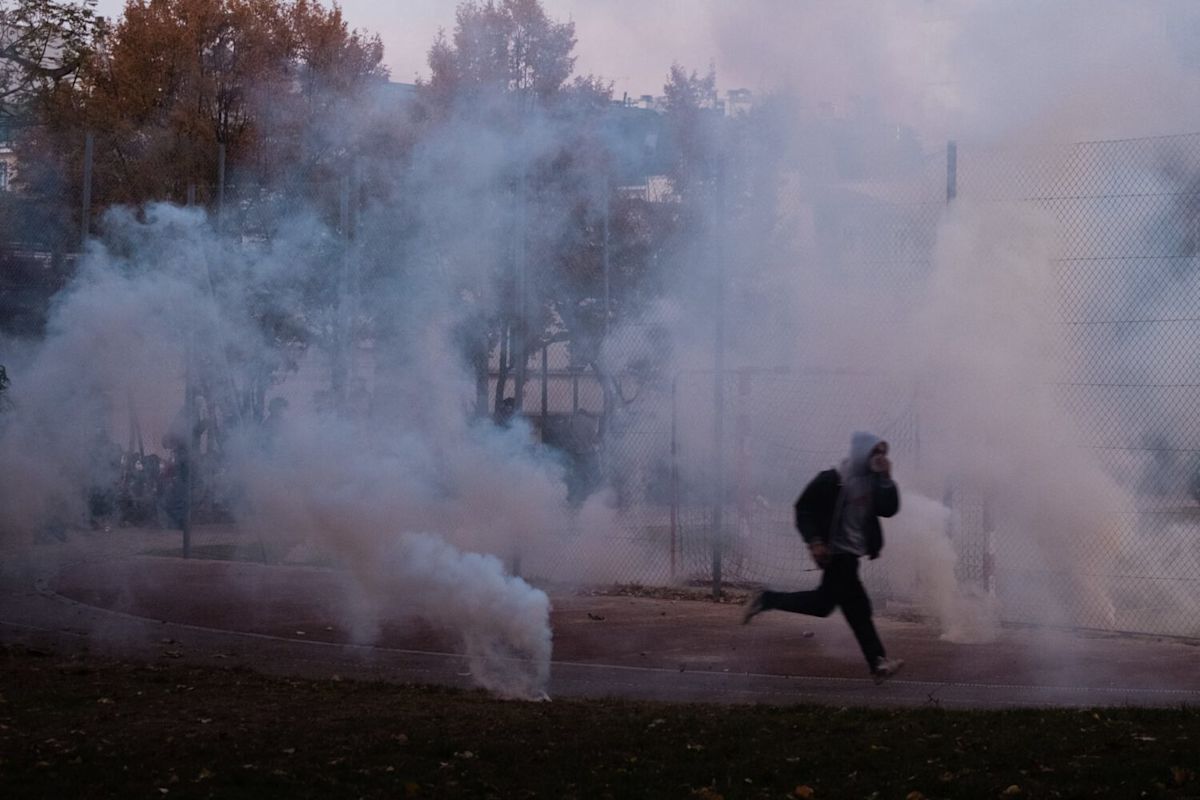
Some people couldn't walk the next day. Not because of bruises or broken bones, but because the bleeding wouldn't stop and the cramps were severe enough to put them on the floor. Two people ended up in the hospital with anemia from blood loss. Among 47 pregnant respondents who reported tear-gas exposure during France's October 2026 protests, 15 said they lost their pregnancies. These are reported experiences, gathered through testimony, not confirmed clinical diagnoses.
The scale is what makes the reports difficult to set aside. The feminist collective Lacrymos de Sang gathered those accounts in the weeks following the protests, with questionnaires distributed from October 8 to October 31. Of the more than 9,200 respondents, 94% reported gynecological symptoms: heavy or unusual bleeding, severe uterine cramps, disrupted or absent periods, and prolonged bleeding that stretched well beyond what any of them considered normal. The symptoms appeared across age groups, including secondary-school students who had been among the protesters.
The methodology here matters, and it should be stated plainly. This is voluntary, self-reported testimony, not a peer-reviewed epidemiological study. It cannot calculate population-wide risk, verify individual exposure levels, establish medical diagnoses, or rule out other contributing factors. What it can do is demonstrate that an unusually large number of people reported strikingly similar experiences after a comparable exposure, which constitutes a serious public-health signal warranting independent research. It is not enough to establish cause.
What CS Is, and What We Don't Know About It
The toxicology of this chemical and its effects on reproductive health is built largely on 1980s research conducted on male subjects, leaving critical gaps for the people most affected.
French police fired approximately 22,000 tear-gas grenades on 17 October alone, a figure attributed to Interior Minister Laurent Nuñez in secondary reporting from a parliamentary inquiry. The active compound in those grenades is CS, also known as 2-chlorobenzylidene malononitrile. Most toxicological research on CS dates to the 1980s and was conducted on male animals, leaving substantial gaps in what researchers know about its effects on menstrual cycles, pregnancy, uterine tissue, and people with pre-existing conditions like endometriosis.
Researchers have proposed one possible mechanism. CS may activate TRPA1 receptors, proteins involved in pain and irritation signaling that may also be present in uterine tissue. This is a hypothesis, not a confirmed pathway. Dr. Maha Eid, an obstetrician-gynecologist at Paris's Port-Royal maternity hospital, reported seeing patients with debilitating menstrual pain and endometriosis flare-ups in the aftermath of the protests and said further research was needed before drawing firm conclusions.
Similar clusters of reported menstrual disruption followed tear-gas deployments in Hong Kong in 2019 and the United States in 2020, according to secondary reporting reviewed for this article. Neither situation produced definitive causal findings. The pattern across different countries and protest contexts has prompted researchers and advocacy groups to call for more rigorous, independent study.
The Government's Answer, and Why Researchers Aren't Satisfied
France has cited internal studies it says cleared CS of specific health risks, but those studies were not publicly available in the reporting reviewed, leaving independent researchers unable to assess them.
The French Interior Ministry has not moved toward suspending tear-gas use. It has pointed to internal studies conducted in 2021 and 2022 that it says found no breaches of occupational exposure limits among security-force personnel, and stated that proposed effects from CS metabolites have not been scientifically demonstrated. According to the reporting reviewed, those studies have not been made public. The Ministry has also suggested that stress may contribute to menstrual disruption.
Researchers and activists have pushed back on the stress explanation. It does not easily account for reports of heavy bleeding among people who had already gone through menopause. It also struggles to explain pregnancy loss in the first trimester or the concentration of similar symptoms across thousands of people after comparable exposures in multiple locations. These are arguments for further investigation, not proof that CS caused what was reported, and they should be understood as such.
What a Real Investigation Would Require
Accountability here is specific: independent access, transparent data, and particular attention to the groups for whom the existing evidence base is thinnest.
A rigorous inquiry would require medical records, verified exposure histories, comparison groups of unexposed protesters, and chemical-dose estimates for different crowd locations. It would also need reproductive and menstrual histories and follow-up over time. Physicians for Human Rights, through researcher Rohini Haar, has engaged publicly with the harms of tear gas and the rights of people in protest environments, though the precise scope of any formal research call should be confirmed through the organization's published statements.
Releasing the 2021 and 2022 government studies would allow independent researchers to assess the methods used and the populations studied. It would also allow them to evaluate whether the exposure conditions modeled resemble what happened on 17 October in dense urban crowds. The groups with the most at stake in that transparency are those for whom the existing evidence base is thinnest: children, adolescents, pregnant people, and people with endometriosis or other gynecological conditions. The studies were not publicly available in the reporting reviewed, which means neither researchers nor the public can evaluate the government's conclusions.