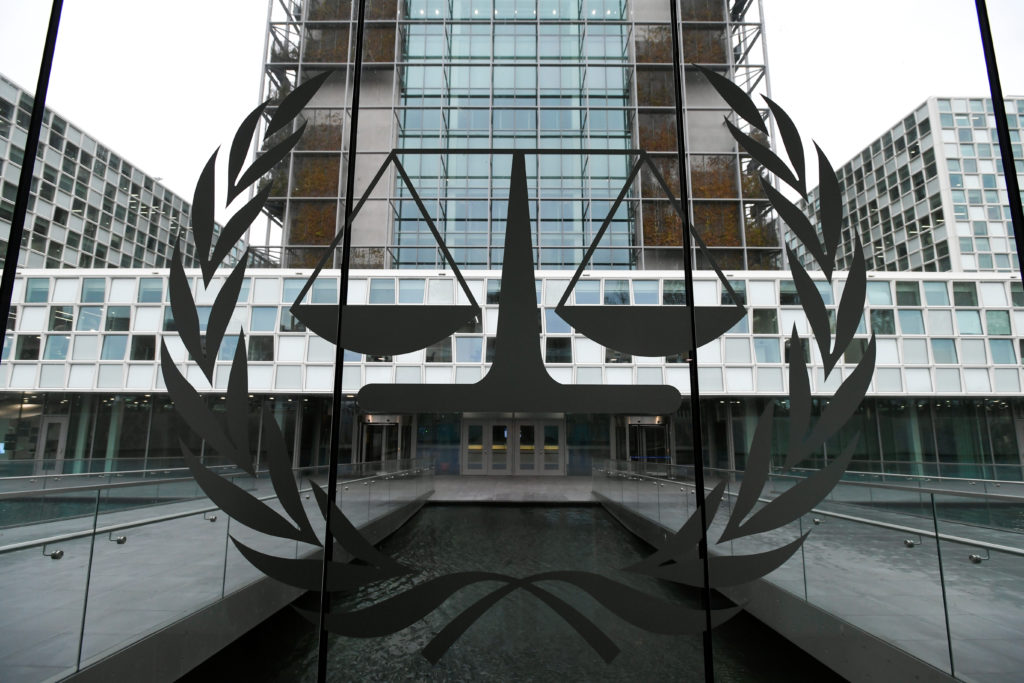
THE HAGUE, Netherlands (AP) — One candidate to be a judge on the International Criminal Court was accused of bullying in the workplace and other inappropriate behavior. Another was accused of touching a colleague and then threatening to retaliate if reported.
The court received the complaints as part of a new process to vet nominees to the bench. But it failed to fully investigate the accusations — and hasn't passed them along to nations voting on the nominations — saying it could not look into them without revealing the identities of the complainants, according to exclusive reporting by The Associated Press.
READ MORE: As Trump squeezes the International Criminal Court, more countries are leaving
Yet an AP reporter was able to uncover substantial new information about one of the accused candidates. The gaps in vetting the two potential new judges occurred despite the reputational damage the court has already suffered after the removal of its former chief prosecutor over accusations of workplace misconduct.
In total, the court received complaints about seven of the 14 nominees for a judicial election that will be held in the coming days. It examined the other complaints more fully — but still not in time for the committee assessing the candidates to consider the findings.
The election comes as the court — responsible for prosecuting the world's gravest atrocities, including war crimes and genocide — is facing an existential threat from the Trump administration, which is engaged in a campaign to dismantle the institution over investigations into the United States and Israel. Washington has imposed sanctions on more than a dozen current and former staff members and the institution itself.
The watchdog said it couldn't evaluate some complaints
Civil society groups have long said the court wasn't sufficiently vetting applicants for senior positions, and that criticism took on new urgency in the wake of sexual misconduct allegations against Karim Khan. The former chief prosecutor denies the accusations.
So the court adopted a new process, used for the first time in this year's election.
Anyone with concerns about the contenders, whose names are public, had 60 days to file a complaint, which would be evaluated by the court's internal watchdog, the Independent Oversight Mechanism.
The court received complaints that included accusations of bribery, misrepresenting professional credentials and other misconduct, according to documents seen by AP.
The AP has learned the names of the candidates who faced formal complaints but was only able to investigate some of the allegations and so has chosen to not name any of the nominees.
Accusations against four of the candidates focused on issues that had been reported in the media or that had been looked into by other institutions — and, in these cases, the IOM said it was able to substantiate them.
READ MORE: ICC chief prosecutor Karim Khan removed from post over sexual misconduct allegations
But the complaints that alleged inappropriate behavior by two of the nominees had not been aired publicly before.
In one case, three women alleged the candidate berated them until they cried, or made them uncomfortable by inviting them for late-night drinks or to travel together, the documents show.
The AP spoke to 13 people who have worked with or had professional contact with the nominee. Four of them said they had experienced behavior similar to what was alleged in the formal complaints — but had not themselves submitted complaints. Two had witnessed similar behavior. All of them said they had not been contacted by investigators — and all spoke on condition of anonymity because they feared retaliation.
The nominating country said it looked into the allegations and couldn't substantiate them. But a senior diplomat, who also spoke on condition of anonymity because he wasn't authorized to discuss the matter publicly, told AP that the country didn't interview any of the candidate's current or former staff because it "didn't have the resources" to conduct such an investigation.
In the other case, a woman said the nominee touched her inappropriately during a work event and threatened retaliation if she reported the behavior, according to the documents.
The IOM said in its annual report that it was unable to reach its own conclusions about the accusations since the women didn't want their identities disclosed and that "limited the IOM's ability to ensure the due process rights of the candidates."
The IOM didn't reply to a request for comment.
Repeated deadline extensions meant the vetting process was incomplete
After nominations for the bench opened in January, the court struggled to get a sufficient number of nominations, a problem it has encountered before. The deadline for countries to submit candidates was pushed back three times, and, in turn, the cutoff for grievances was also extended.
Of the 14 candidates nominated, three subsequently withdrew.
The delays left the IOM just two weeks to compile evaluations for candidates from across the world on their "high moral character" — the standard required for top staff in the court's founding treaty, the Rome Statute — before the committee of legal experts tasked with assessing the nominees began its interviews.
In fact, the IOM didn't complete that vetting before the committee met. Instead, the IOM provided the committee with a preliminary report on the candidates just three days before interviews started. It's not clear what information that report contained.
READ MORE: Niger becomes the third country to leave the International Criminal Court
"There was insufficient time to do any proper vetting," Ezequiel Jimenez, an international legal expert who has written a book on ICC governance, told AP.
The IOM eventually finished the vetting — but the committee did not take it into account since it had already wrapped up its meeting. The committee's own public report said that meant it "could not make a conclusive determination regarding the criterion of 'high moral character'" for any of the candidates.
The committee and the ICC spokesperson directed requests for comment to the court's oversight body, the Assembly of States Parties. In response to a question from AP at a news conference, the assembly's president, Päivi Kaukoranta, said the process was confidential and meant to ensure the people "in those high positions would have the high moral character that we would expect."
The assembly also told AP that it was reviewing its procedures for possible improvements.
Countries were informed of complaints against only three nominees
Diplomats from around the world are gathering in The Hague starting Monday for the court's annual meeting, where the judicial election will take place.
Earlier this month, the court's oversight body provided "relevant extracts" of the IOM's report on the complaints to member states, including a summary of the accusations and responses from candidates, the body told AP. Documents seen by AP show that information was sent only about the three remaining candidates for whom the IOM said it could substantiate the allegations.
Immediately following the judicial elections, the court will move on to selecting a new chief prosecutor to replace Khan — and the court is using the same process to vet the candidates.
Associated Press writers Mike Corder in The Hague, Netherlands, and Lorne Cook in Brussels contributed to this report.
A free press is a cornerstone of a healthy democracy.
Support trusted journalism and civil dialogue.