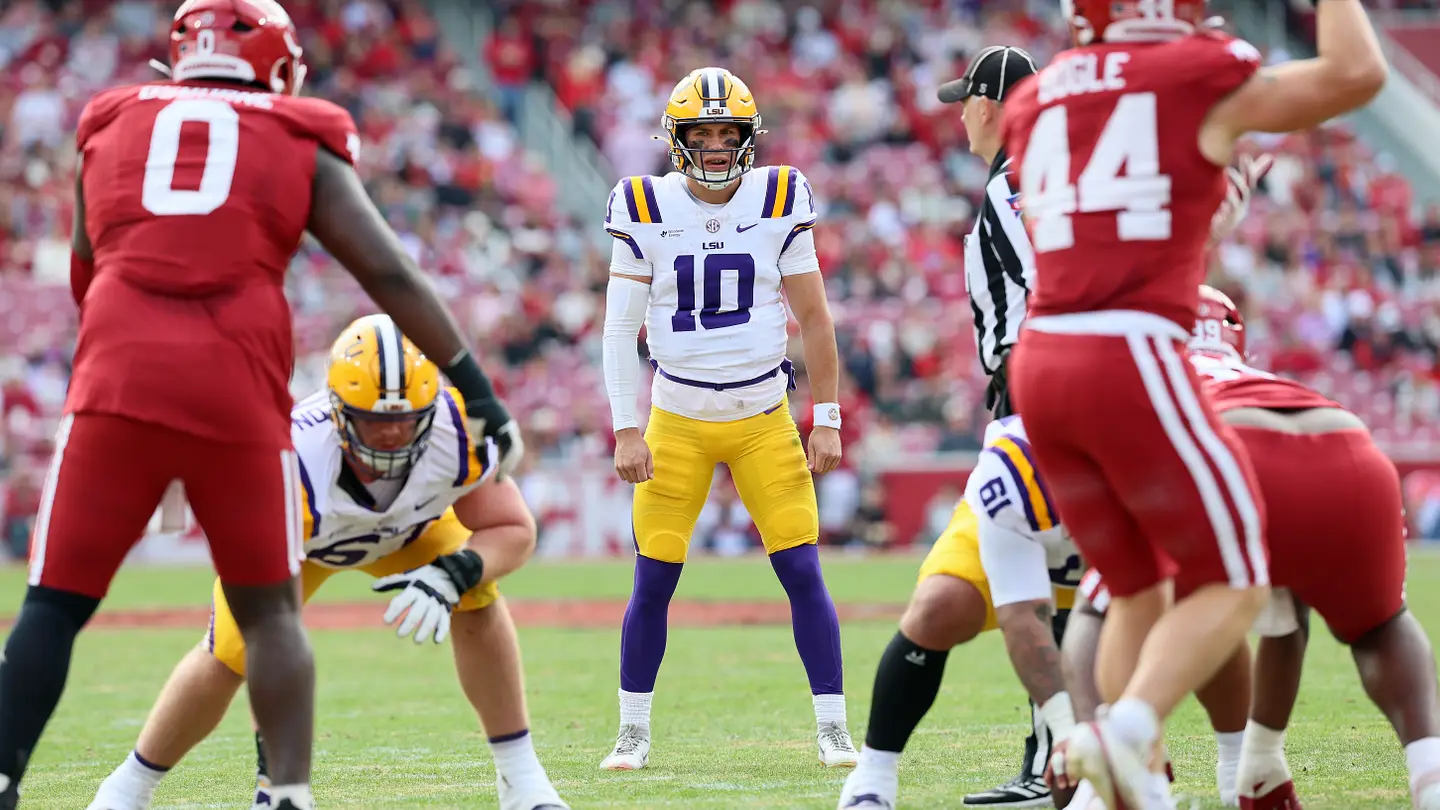
On Saturday afternoon in Fayetteville, LSU concluded one of the most expensive and underwhelming regular seasons in program history.
The Tigers defeated Arkansas 25-10, retaining the Golden Boot and finishing Lane Kiffin's inaugural regular season in Baton Rouge with a 7-5 record.
Sam Leavitt delivered a sufficient performance against a four-win Arkansas team, but hardly the type of performance LSU envisioned when it acquired the quarterback last offseason.
The Increasing Cost of Being Average
Nov 28, 2026; Fayetteville, Arkansas, USA; LSU Tigers head coach Lane Kiffin during the first quarter against the Arkansas Razorbacks at Donald W. Reynolds Razorback Stadium. Mandatory Credit: Nelson Chenault-Imagn Images | IMAGN IMAGES via Reuters Connect
There was something fitting about the way LSU's regular season concluded. A program that invested extraordinary financial resources into its roster spent the final weekend of November competing for a marginally better bowl destination.
And perhaps no individual better encapsulates the concerning direction of college athletics than Leavitt.
Leavitt arrived in Baton Rouge as one of the most coveted players in the transfer portal, receiving a reported multimillion-dollar deal to become the face of Kiffin's first LSU team.
Less than a year later, his future with the program remains uncertain, and retaining his services could require an even greater financial commitment.
Despite an inconsistent season that failed to meet the expectations surrounding his arrival, speculation surrounding Leavitt's market value suggests LSU could be forced to spend even more money on the quarterback next season.
Whether LSU should entertain that possibility is an entirely different conversation. The more concerning development is that the market has reached a point where such a conversation is reasonable.
And that isn't Leavitt's fault.
College athletes spent decades watching universities, coaches and television networks capitalize financially on their abilities. They deserve the opportunity to do the same, and Leavitt would be foolish not to maximize his earning potential.
The problem lies within a system in which the cost of retaining a player can increase substantially regardless of whether the initial investment produced the desired results.
From a business perspective, how does that make sense?
Where Does It Stop?
During a recent appearance on Matt Moscona's radio show, LSU athletic director Verge Ausberry discussed the possibility of annual roster expenditures reaching $70 million across all sports.
The frightening aspect of that conversation isn't necessarily the figure itself, but rather the possibility that it could eventually become the cost of remaining competitive.
What happens when $70 million is no longer enough?
One of the fundamental flaws in college athletics' current financial structure is that increased spending doesn't necessarily provide a lasting competitive advantage. Instead, it raises the price of maintaining an institution's existing competitive position.
If LSU commits an additional $10 million to its football roster next offseason, Texas, Texas A&M and Georgia have every incentive to respond accordingly.
Those institutions could find themselves in relatively the same competitive position a year later, only with substantially greater expenses.
No purchase necessary. 50 U.S./D.C. 18+. Entry opens 3PM ET Dec 6, 2026 and closes 8PM ET Dec 18, 2026. Void where prohibited.See for complete details. The College Football Playoff (CFP) is not a sponsor or administrator of this contest.
Someone still has to finish 7-5.
Even if every SEC institution could afford a $50 million football roster, there wouldn't suddenly be 16 national championship contenders. There are only so many games to win, playoff spots to occupy and championships to distribute.
Yet the financial demands associated with pursuing those accomplishments continue to grow.
Unlike professional sports franchises, collegiate athletic departments are also responsible for supporting numerous programs that don't independently generate enough revenue to sustain themselves.
What happens when maintaining an entire athletic program becomes less financially attractive than acquiring a single quarterback?
The irony is that an era intended to provide greater financial opportunities for student-athletes could eventually contribute to fewer athletic opportunities altogether.
College Athletics Needs Structure
Oct 14, 2026; Birmingham, AL, USA; SEC Commissioner Greg Sankey speaks during the SEC Basketball Tipoff at Grand Bohemian Hotel Mountain Brook. Mandatory Credit: Butch Dill-Imagn Images | IMAGN IMAGES via Reuters Connect
College athletics has adopted many of the financial characteristics of professional sports without implementing the mechanisms that make professional sports sustainable.
The NFL operates under a collectively bargained salary cap. Organizations negotiate multiyear contracts, strategically allocate resources and construct rosters with an understanding of their future financial obligations.
There are consequences for poor personnel decisions and incentives for developing talent internally.
College football, meanwhile, has essentially established an annual free agency period in which players can reassess their market value and explore alternative opportunities.
Perhaps a collectively bargained salary cap is the answer. Perhaps it's a luxury tax, standardized multiyear contracts or a more comprehensive revenue-sharing structure.
Whatever the solution, there needs to be a system that rewards player development, encourages roster continuity and allows athletic departments to make financially responsible decisions without sacrificing their ability to compete.
Leavitt could return to Baton Rouge next season and become everything LSU anticipated when it acquired him. Another offseason under Kiffin could produce a quarterback capable of leading the Tigers to an SEC championship.
Even if that happens, the underlying issue remains.
The solution isn't to stop paying players. That ship has sailed, and rightfully so.
But college athletics cannot continue operating under the assumption that every competitive shortcoming can be addressed by writing a bigger check.
LSU spent millions of dollars last offseason chasing a national championship.
On Saturday, it secured its seventh win against Arkansas.
Now, it may have to spend even more money just to try again.
That is not a sustainable business model.
Sign up to our free newsletter and follow us on Facebook and X for the latest news.
Add us as a preferred source on Google
Follow