Pedro Sánchez’s future as Spain’s prime minister hung in the balance on Sunday night as preliminary results and polls in the country’s snap general election suggested the far right could be on the verge of entering government for the first time since the death of Gen Francisco Franco in 1975.
Voting in the electionsaw a 40-year record turnout of more than 78%, ended in most of Spain at 8pm. By 9.30pm, with more than 26% of the votes counted, preliminary results projected the PP at 133 seats, the PSOE at 115, Vox at 48 and Broad Front 11.
A poll, conducted in the last days of the election campaign for the state broadcaster RTVE, pointed towards a joint majority between the conservative People’s party (PP) and its allies in the far-right Vox party.
The poll gave the PP 131-136 seats, Sánchez’s Spanish Socialist Workers’ party (PSOE) 119-124, Vox 44-48, and the leftwing Broad Front alliance 10-11.
According to the poll, the PP and Vox would between them win 175 and 184 seats in Spain’s 350-seat congress, where a majority of 176 seats is needed. Its findings also suggest that the PSOE, Broad Front and other, smaller leftwing and regional nationalist parties would together fall just short of a majority. Two other polls gave the PP and Vox very comfortable majorities of 187-190 seats.
Sánchez, who had sought to depict the election as a momentous choice between progressive forces and reactionary ones, called the vote in October after the PP, Vox and the rightwing Catalan separatist Junts party voted down the emergency legislation his government had proposed to tackle the country’s housing crisis.
Public anger over soaring rents had boiled over in September after the eviction of María del Carmen Abascal, an 87-year-old woman who was removed from her home in Madrid because she could not afford the 230% rent increase demanded by the investment fund that had bought her apartment.
Sánchez’s coalition minority government responded to the subsequent nationwide protests by proposing a raft of measures aimed at improving access to housing, from a ban on evictions until 2030 to the regulation of temporary lettings and lettings by room.
When the proposals were defeated by the right, the prime minister – a habitual risk-taker whose penchant for high-stakes gambles has been key to his political survival – announced the early election, calculating his opponents’ decision to block the housing overhauls could work in his favour.
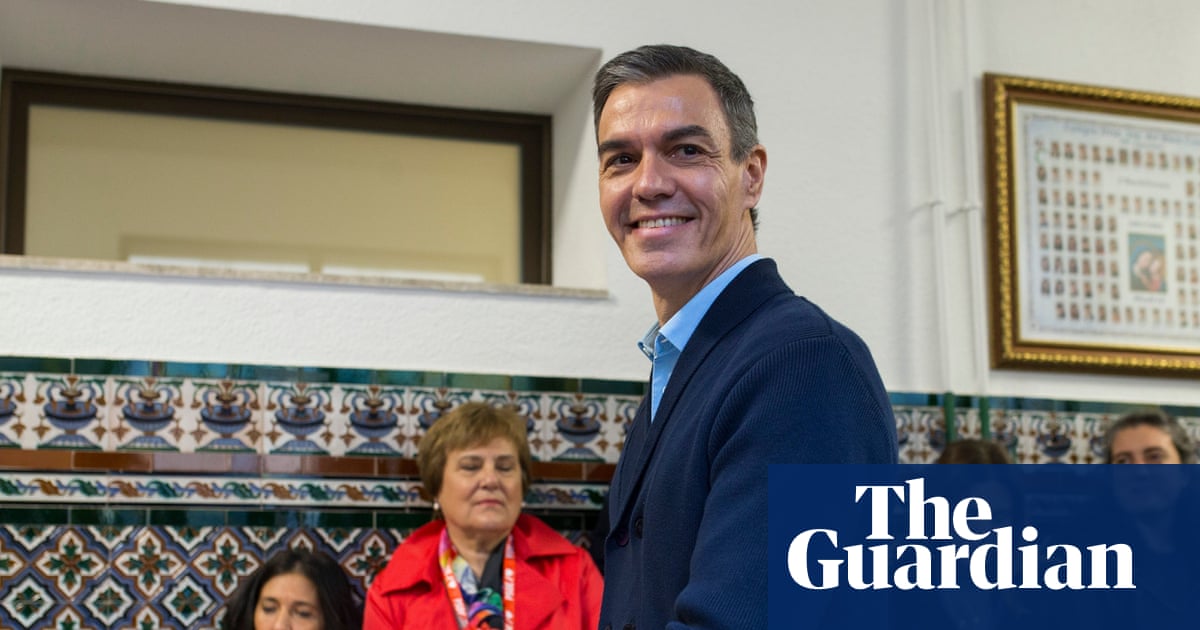
Sánchez, whose party had managed to narrow the PP’s lead as the campaign drew to a close, said he had “a good feeling” as he cast his vote on Sunday morning, adding that he was seeing “a historic mobilisation” of voters.
The PP leader, Alberto Núñez Feijóo, said the election would “shape the destiny and direction of Spain not just for the next four years but for the next decade”.
Santiago Abascal, the leader of Vox, called for a huge turnout, urging Spaniards to vote “without fear and with all the bravery and hope that Spain deserves”.
Ada Colau, who leads the Broad Front coalition, said voters knew exactly what was at stake in the election. She called on them to turn out to “defend democracy, to defend public services [and] to defend the right to housing, pensions and decent salaries”.
Poll after poll had predicted that conservatives would finish first but fall short of a majority, leaving them dependent on a deal with Vox. Although Sánchez had claimed that a turnout of 75% or above could deliver progressive parties – led by the PSOE – 176 seats, the polls had consistently suggested that such an outcome was unlikely.
The focus on the housing crisis had allowed Sánchez to attempt to move past the corruption allegations facing his inner circle. It had also served to distract from his government’s much criticised response to the events of the summer in Spain’s north African territory of Ceuta, where about 80,000 crossed over the border from neighbouring Morocco in a matter of days.
But the bitterly-fought campaign was inevitably overshadowed when 69 people were killed at the end of October in Spain’s second deadly rail crash in just nine months.
The PP and Vox had used the two crashes to accuse the government of failing in its basic duty to keep Spaniards safe and maintain essential infrastructure. The two parties had also portrayed the poll as a referendum on what they disdainfully refer to as “sanchismo”, arguing the style of government favoured by the prime minister and his allies is cynical, corrupt, opportunistic and self-serving.
Both parties had also attempted to call into question the fairness and transparency of the election, making baseless claims that the government might seek to rig postal votes. Abascal had suggested, without providing evidence, that Sánchez was working to undermine democracy and change the country’s demographic makeup.
“Spain deserves a decent prime minister and [Sánchez] isn’t one,” Feijóo told viewers during a head-to-head debate between the two men last week.
Sánchez, however, insisted that while he had made errors, Spain was in better shape than it had been when he took office in 2018. “My government hasn’t been perfect; I’ve made mistakes,” he said. “But I’m also fully aware that we have always governed in the right direction.”
Over recent days, the government had tried to underline its commitment to social justice and equality by proposing a new tax on fortunes of more than €100m (£84m) that would help fund housing, public services and childcare.
The PP had promised to lower taxes, build 1m homes, and “restore the country’s ambition and self-esteem”. Vox’s manifesto, which focused on deregulation, “remigration” and on giving Spanish-born people priority over those born abroad for housing and public services, also included plans to have Sánchez and his government prosecuted “for treason and crimes against the security of the state” over the Ceuta mass crossing.
Despite the fact that the PP’s previous leader, Pablo Casado, publicly excoriated Vox and its ideology six years ago, accusing the party of peddling a politics based on “fear, anger, resentment and revenge”, the PP has repeatedly formed regional coalition governments with Vox and currently runs four of Spain’s autonomous regions with the party.