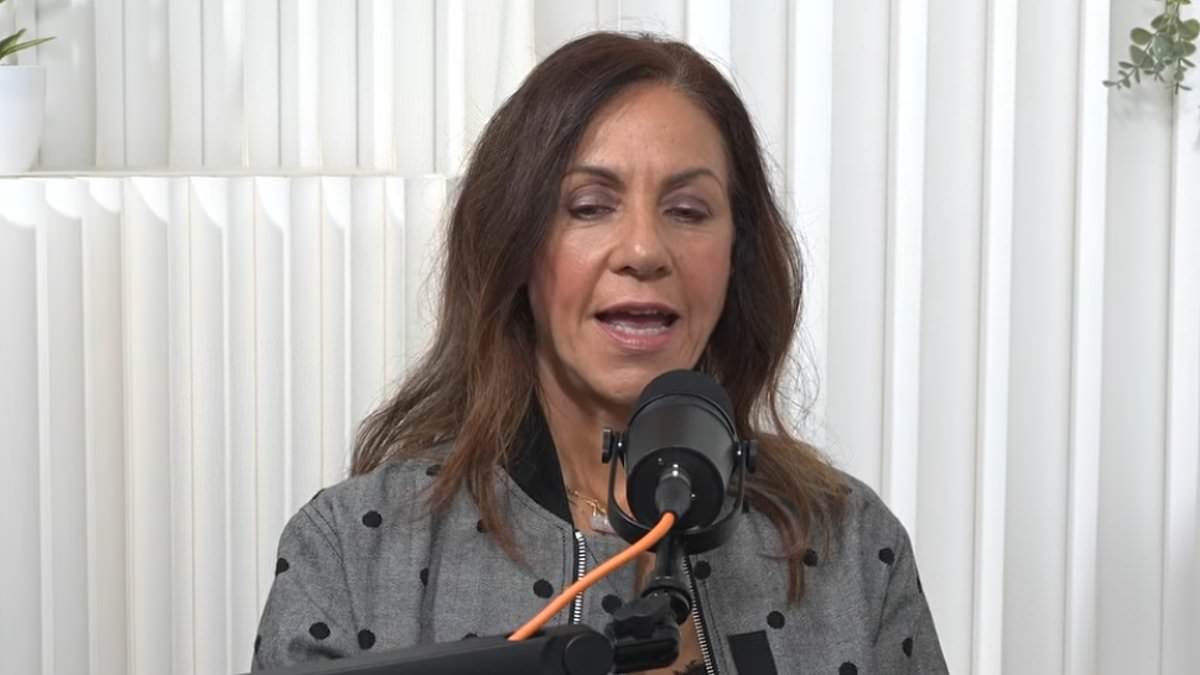
Julia Bradbury has revealed her children have undergone DNA testing following her 'petrifying' battle with breast cancer.
The Countryfile host, 56, shares son Zephyr, 15 and 11-year-old twin daughters Xanthe and Zena with her long-term partner Gerard Cunningham.
Julia was diagnosed with breast cancer in September 2021 and underwent a mastectomy last year to have her 6 cm tumour removed.
Speaking to Ateh Jewel in this week's Second Act podcast, Julia said she has put her children through DNA tests as she believes 'tracking ourselves is immensely powerful'.
Listing her top three life hacks, Julia explained: 'In my top three, if you're the right person, as in you won't get anxious. I would say if you can get your DNA tested earlier rather than later.
'I've done this for my children so I know how they're wired in terms of their hormones, their brains. So dopamine and things like that. I know what foods may or may not be more advantageous for them. I want to be more informed than I ever was.'
Julia Bradbury has revealed her children have undergone DNA testing following her 'petrifying' battle with breast cancer (source: Second Act/ YouTube)
The Countryfile host, 56, shares son Zephyr, 15 and 11-year-old twin daughters Xanthe and Zena with her long-term partner Gerard Cunningham
Julia, who is an advocate for making PRS and SNP testing available on the NHS, also emphasised how important it is for women to start tracking their hormones as early as possible as well as getting outside in the fresh air.
Since her breast cancer scare, Julia has undergone a variety of testing on her body in order to prevent or act fast with anything she comes across.
She said: 'Take control, because I think so many people think if you don't look, it doesn't happen.
'It’s still going to happen. It ain't going anywhere. But you're going to be more prepared if you deal with it.'
Later in the interview, Julia explained how her cancer diagnosis 'saved her life' and insisted she is 'very grateful'.
She said: 'Facing a cancer diagnosis is the most petrifying thing I think anybody can go through. Because when you hear those words, you've got cancer, Most people leap straight to, I'm going to die, I'm going to die, I'm going to die.
'Cancer is a very serious thing. And lots of people do die. So that is a very interesting place to find yourself, because you have to dig yourself out of that pretty quickly.
'I straight away turned research into me search. I was like, right, what can I do to help myself through this? I knew what the treatment plan was going to be. I knew that it was early stage, so there were lots of positives about my cancer diagnosis.
'And then I wanted to make sure that I could support myself on top of everything, on top of the treatment that was happening that other people were doing to me, what could I do?
Julia was diagnosed with breast cancer in September 2021 and underwent a mastectomy last year to have her 6 cm tumour removed
'And that's when I really began to feel empowered and learn all of this stuff about self-care and nutrition and healing and biology and cells, and why being outside and hugging trees is important and why being connected to your family is so important.
'All of these things and sleep. What sleep does and how it repairs you at night and is the most valuable part of your day. All of this came about because I went through a cancer diagnosis.
'I've said this before and some people get a little bit upset by it, but I'm very grateful. I mean, it saved my life. It really made me look not at cancer in a new way, it made me look at health in a new way, and it made me take my health seriously in as much as what can we all do to support ourselves?
'It might be bad luck because you might be in a very toxic environment. You might have gone through massive stress and trauma.
'And I think that we can't discount that as a reason for us getting ill, whatever the illness might be. But I don’t buy it is all bad luck.
'What can we do to protect ourselves? And I think eat as clean as you can, live as clean as you can, love as hard as you can, connect as hard as you can, and sleep as hard as you can.'
Listen to the Second Act podcast, now on Apple Podcasts, Spotify, Amazon Podcasts and YouTube.
Breast cancer is one of the most common cancers in the world and affects more than two MILLION women a year
Breast cancer is one of the most common cancers in the world. Each year in the UK there are more than 55,000 new cases, and the disease claims the lives of 11,500 women. In the US, it strikes 266,000 each year and kills 40,000. But what causes it and how can it be treated?
What is breast cancer?
It comes from a cancerous cell which develops in the lining of a duct or lobule in one of the breasts.
When the breast cancer has spread into surrounding tissue it is called 'invasive'. Some people are diagnosed with 'carcinoma in situ', where no cancer cells have grown beyond the duct or lobule.
Most cases develop in those over the age of 50 but younger women are sometimes affected. Breast cancer can develop in men, though this is rare.
Staging indicates how big the cancer is and whether it has spread. Stage 1 is the earliest stage and stage 4 means the cancer has spread to another part of the body.
The cancerous cells are graded from low, which means a slow growth, to high, which is fast-growing. High-grade cancers are more likely to come back after they have first been treated.
What causes breast cancer?
A cancerous tumour starts from one abnormal cell. The exact reason why a cell becomes cancerous is unclear. It is thought that something damages or alters certain genes in the cell. This makes the cell abnormal and multiply 'out of control'.
Although breast cancer can develop for no apparent reason, there are some risk factors that can increase the chance, such as genetics.
What are the symptoms of breast cancer?
The usual first symptom is a painless lump in the breast, although most are not cancerous and are fluid-filled cysts, which are benign.
The first place that breast cancer usually spreads to is the lymph nodes in the armpit. If this occurs you will develop a swelling or lump in an armpit.
How is breast cancer diagnosed?
Initial assessment: A doctor examines the breasts and armpits. They may do tests such as a mammogram, a special X-ray of the breast tissue which can indicate the possibility of tumours.Biopsy: A small sample of tissue is removed from a part of the body. The sample is then examined under a microscope to look for abnormal cells. The sample can confirm or rule out cancer.
If you are confirmed to have breast cancer, further tests may be needed to assess if it has spread. For example, blood tests, an ultrasound scan of the liver or a chest X-ray.
How is breast cancer treated?
Treatment options which may be considered include surgery, chemotherapy, radiotherapy and hormone treatment. Often a combination of two or more of these treatments are used.
Surgery: Breast-conserving surgery or the removal of the affected breast depending on the size of the tumour.Radiotherapy: A treatment which uses high energy beams of radiation focused on cancerous tissue. This kills cancer cells, or stops them from multiplying. It is mainly used in addition to surgery.Chemotherapy: A treatment of cancer by using anti-cancer drugs which kill cancer cells, or stop them from multiplying.Hormone treatments: Some types of breast cancer are affected by the 'female' hormone oestrogen, which can stimulate the cancer cells to divide and multiply. Treatments which reduce the level of these hormones, or prevent them from working, are commonly used in people with breast cancer.
How successful is treatment?
The outlook is best in those who are diagnosed when the cancer is still small, and has not spread. Surgical removal of a tumour in an early stage may then give a good chance of cure.
The routine mammography offered to women between the ages of 50 and 71 means more breast cancers are being diagnosed and treated at an early stage.
For more information visit breastcancernow.org or call its free helpline on 0808 800 6000