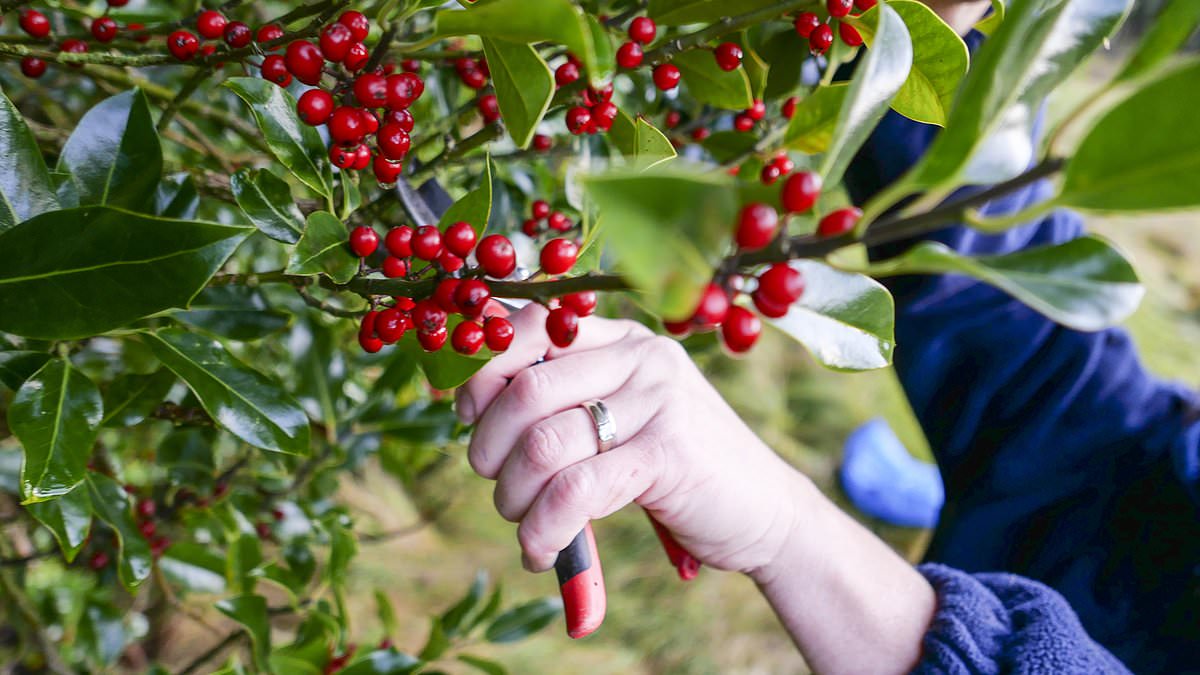
Decking the halls with boughs of berried holly will be no mean feat this Christmas.
The red-berried sprigs which traditionally adorn mantelpieces, wreaths and garlands, are in such short supply that prices have spiked more pointedly than their leaves.
Extreme temperatures and dry weather in the summer caused berries to ripen early – and hungry birds, who usually feed on them in late winter, have been stripping branches bare.
Experts said the untimely scavenging has now led to a widespread shortage in the UK ahead of the festive season, as well as the biggest price increases in years.
Auctioneer Nick Champion, who has run the country's biggest holly and mistletoe sale in Tenbury Wells, Worcestershire, for over 30 years, said: 'From what I have seen locally there is virtually no berried holly as the birds took it about three weeks ago.
'The shortage of holly resulted in a tremendous trade.'
At the first of two pre-Christmas sales this week, he said berried holly was in such short supply that prices hit £175 a bundle.
His figures comparing prices between this year and 2025 show how first quality berried holly has reached £15 per kilogramme and sold at an average of £12, up from top prices of £3.50/kg and an average of £2.50/kg last year.
Prices of berried holly have soared amid a shortage caused by heatwaves and foraging birds
Second quality is averaging £5 per kg, compared with 50 pence last year, Mr Champion's figures showed.
Dozens of twitchers in the British Birdwatching group reported their bushes have been devoured of the festive fruit in the last few weeks.
A shocked member of the UK Bird Lovers group told fellow followers on social media she 'had never seen anything like it' in 50 years after her tree was stripped of 'hundreds' of berries in 48 hours last month.
Birds usually eat softer, sweeter fruits such as rowan, hawthorn, and ivy berries first, saving tougher holly berries for January or February.
But Bethany Dean, from the Royal Society for the Protection of Birds, said this year's hot and dry weather had caused them to ripen earlier and in lesser quantities than usual.
She said: 'Heatwaves and the lack of rain can put a lot of stress on our trees, hedges and shrubs which does cause berries to ripen earlier than usual whilst often not producing the same yield.
'Winter is a challenging time for wild birds due to the lack of invertebrates and the need to consume high-energy foods to maintain body temperature to survive.
'If their autumn and winter food sources are readily available sooner than expected, they will make the most of that.'
Auctioneer Nick Champion, with clipboard, says while there's a holly shortage, lower grade mistletoe (pictured) is plentiful
Ms Dean urged people to create 'wildlife-friendly gardens' so birds still have 'an abundance of natural food sources'.
These can include ivy, wild privet, honeysuckle, and burnet rose, which all produce berries, plus alder and birch catkins.
She added: 'Plants such as verbena, cardoon, fennel, lavender, thistles, and coneflower all provide seeds during the winter and can be grown in gardens and balconies.'
However, there is good news for anyone who wants to share a kiss under the mistletoe – with the berries growing in abundance.
Mr Champion said that whilst the top-quality specimens are 'in short supply and dear', selling for around £105, 'second quality is plentiful and cheap.'
Prices at the auction - the country's biggest holly and mistletoe sales - are used as a barometer for those throughout Britain
Many buyers are florists, wreathmakers or are purchasers for garden centres and farm shops.
Wildlife experts say migratory birds including fieldfares and redwings arrived sooner than usual from Scandinavia and Russia and there is a general lack of hedgerow berries, such as hawthorn, or acorns after a bonanza crop last year.
Helen Bostock, Royal Horticultural Society senior wildlife expert, said the shortage of holly berries was 'not unexpected after such a hot dry summer'.
She said: 'The redwings have stripped my very large holly tree of berries, plus what remained of the unpicked (undersized) apples in my Warwickshire garden already this year.'
Ms Bostock added that 'berry/fruit availability in the surrounding countryside' has become 'on the low side this year'... 'a bit earlier than normal'.
The last time holly berries were in short supply was in 2024, when some producers reported just '20 per cent' of their normal crop after a glut the previous year.