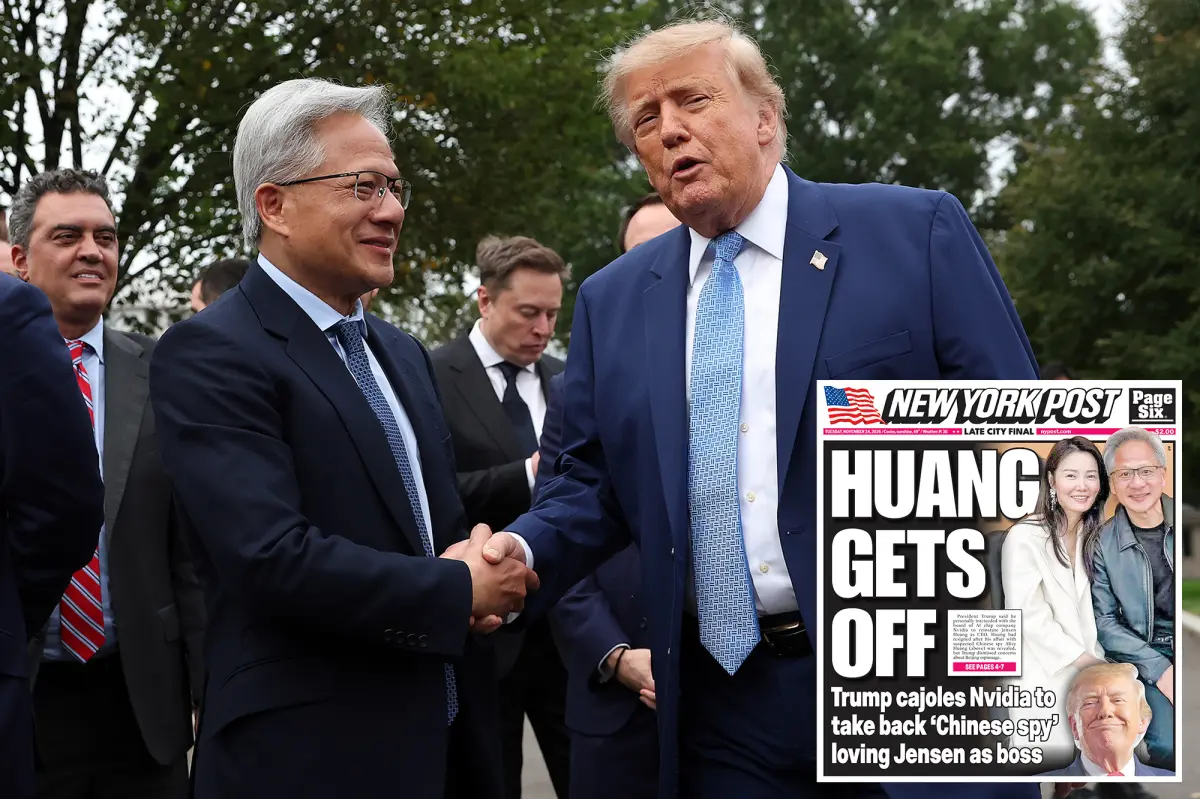
President Trump’s rescue of Nvidia boss Jensen Huang has set off a GOP rebellion, with 13 congressional Republicans questioning — and several flatly opposing — the chip titan’s reinstatement ahead of his Capitol Hill grilling this week.
Rep. Michael McCaul of Texas blasted the president’s intervention, calling it “unprecedented,” on ABC’s “This Week.”
“I know the president intervened, which is unprecedented, to put [Huang] back in that position,” the GOPer said. “So I understand, maybe, why he did that, but I think what he did was a national security risk.”
Huang’s fall — and rapid resurrection — unfolded in fewer than two weeks.
Nvidia CEO Jensen Huang embraces Alice Huang, no relation, after his keynote speech at COMPUTEX 2024 in Taipei, Taiwan, on June 2, 2024. REUTERS
President Trump got Nvidia to reinstate Jensen Huang as CEO. Getty Images
He quit Nvidia on Nov. 12 under intense pressure over reports of his extramarital affairs, including one with Alice Huang, a former executive at the Singapore-based firm Megaspeed and who US intelligence suspected of spying on Beijing’s behalf.
Federal investigators have reportedly been probing Megaspeed since 2024 over allegations that Nvidia’s advanced chips ended up in China.
Just 11 days later, Nvidia’s board welcomed him back into the fold, citing input from “senior levels of the United States government.”
President Trump posted this edited photo showing Jensen Huang holding a bra aloft — a nod to the snapshot of Trump after an assassination attempt in Butler, Pennsylvania, in 2024.
Trump made no secret of who muscled the board into reversing its stance on Huang.
“I convinced them,” he told CNBC. “I made the deal.”
To McCaul, a former federal prosecutor, Alice Huang’s dealings with Jensen Huang, no relation, amounted to “borderline espionage.
How The Post told the story of Jensen Huang returning to power at Nvidia.
“For God’s sakes, what more evidence do you need, right, to open an investigation into this, and to not intervene and put him back in power where he is today?” he said.
Rep. Don Bacon (R-Neb.), who is retiring, didn’t mince words, either.
“Trump made himself a target here, and it defies wisdom,” Bacon said.
Other House Republicans piled on, too.
Rep. Pat Harrigan of North Carolina argued that the “coordinated action between the company and this administration” was likely “to whitewash this risk.”
Rep. Bill Huizenga (R-Mich.), freshly defeated in November’s election, brushed aside any doubt about Alice Huang not working for Beijing.
“Ummm… she was, and is, a spy,” Huizenga said.
Rep. Brian Fitzpatrick (R-Pa.), a former FBI agent, slammed the whole mess as “a counterintelligence embarrassment” on CBS’s “Face the Nation.”
Huang, a married dad of two, attends dinner with Alice Huang in Taipei on May 22, 2025. CTI/AFPTV/AFP via Getty Images
The House chairmen of Intelligence, Foreign Affairs and China committees — Reps. Rick Crawford (R-Ark.), Brian Mast (R-Fla.) and John Moolenaar (R-Mich.) — made clear the matter isn’t closed, saying Nvidia’s “brief internal investigation” and Huang’s reinstatement “do not erase the national security threats and questions that must be addressed.”
Other Senate Republicans were more careful not to draw Trump’s ire, taking aim at Nvidia’s board instead.
“No national security risk? Based on what?” lame-duck Sen. John Cornyn (R-Texas) wrote of the board’s decision to welcome back Jensen Huang.
Sen. Pete Ricketts (R-Neb.) argued Jensen Huang’s “behavior does not support reinstatement.”
Sen. Kevin Cramer (R-ND), who sits on the Senate Banking Committee with Ricketts, has already signaled he’s in no mood to let Jensen Huang slide.
Tech leaders and officials attend a luncheon hosted by Trump at the White House on Sept. 29, 2026. REUTERS
He wrote that Nvidia’s board had taken on the legal risk of rehiring Huang while “the national security risk is passed along to the United States military and its citizens.”
Sen. John Curtis (R-Utah) also demanded answers.
“Who in our government weighed in? What did they tell the board? And on what basis did the board conclude there was no risk?” he wrote.
Sen. Tom Cotton (R-Ark.), the outgoing Senate Intelligence Committee chairman, warned the fight is only starting.
“The controversy with Nvidia and Megaspeed is just the tip of the iceberg, and it’s not resolved because Jensen Huang has his job back,” Cotton said.
The White House was unmoved.
“I can tell you, the bigger threat would be losing the brain power of somebody like Jensen,” Trump told CNBC.
Kevin Hassett, director of the White House National Economic Council, struck a more measured tone on CBS.
“You don’t want the government telling everybody who should be CEO, but you also don’t want people getting fired because they have the wrong facts,” he said.
On CNN, though, he allowed that if Nvidia’s top chips did reach China, export rules have “to be tightened up.”
What the government actually knew about the situation and when is still an open question.
US officials are divided over how solid the evidence is that Alice Huang was recruited by China’s Ministry of State Security — Beijing’s equivalent of the CIA.
Huang gets his first face-to-face congressional reckoning with the backlash Tuesday in a closed-door interview with three House panels. On Thursday, he goes on camera before the Senate Banking Committee — where critics Ricketts and Cramer are waiting.