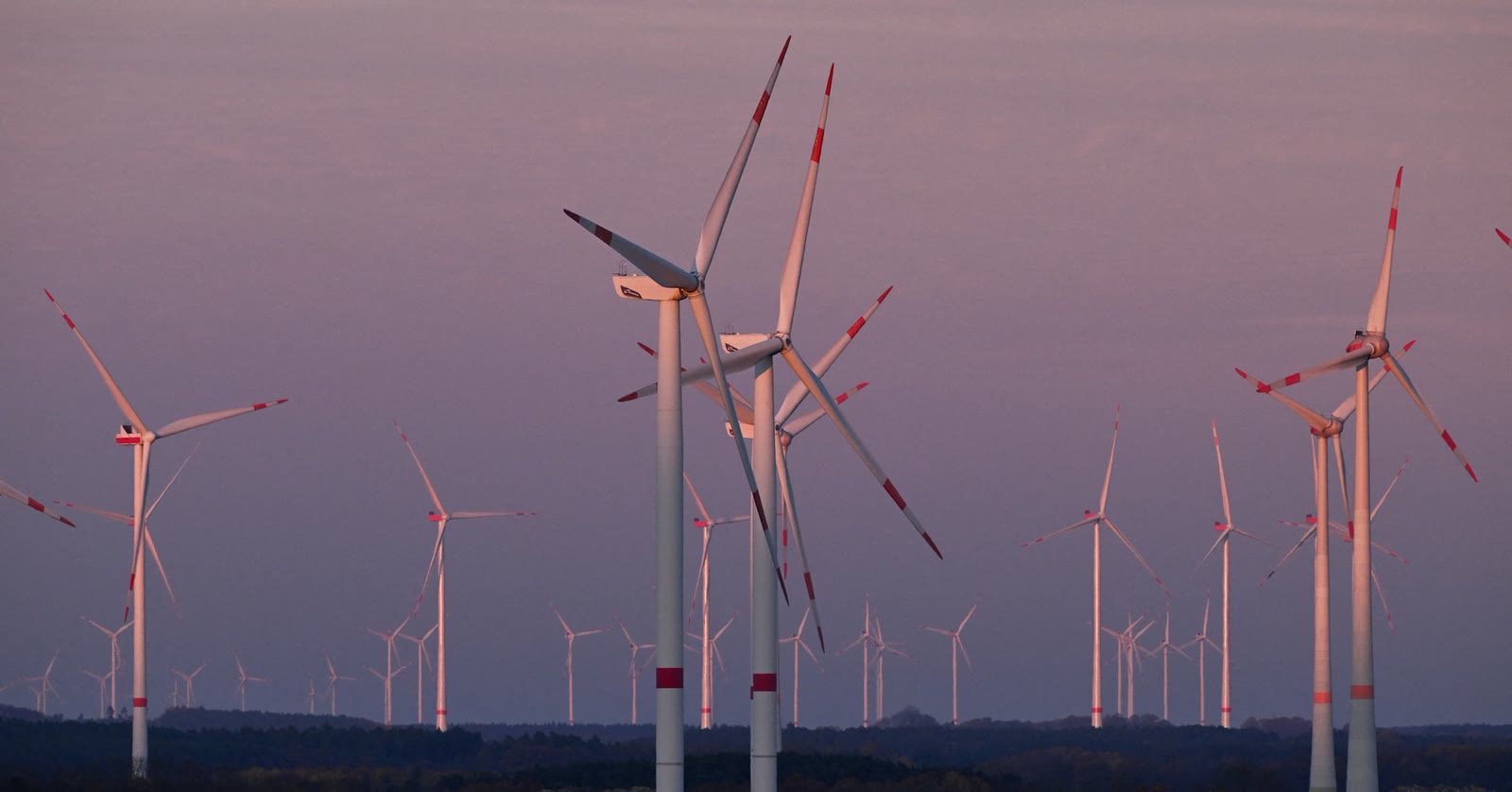
LITTLETON, Colorado, Nov 23 (Reuters) - Germany's power market has spent much of this autumn waiting for the wind to return. That wait might be over.
Over the first three weeks of this month, wind generation surged from less than 100 gigawatt hours (GWh) to more than 1,100 GWh, lifting wind's share of total electricity production from just 6% to 65%, according to data from Germany's federal network agency.
The Misinformation Monitor newsletter rounds up international misinformation narratives, with a "Real or Fake?" quiz in every edition. Sign up here.
As turbines across Germany spun back to life, coal and gas-fired generators rapidly surrendered market share, triggering one of the sharpest shifts in the country's generation mix this year.
The swing underscores a central reality of Europe's energy transition: when renewable output arrives at scale, fossil fuel demand can retreat with remarkable speed.
FROM WIND DROUGHT TO SURPLUS
The first half of November highlighted Germany's dependence on weather conditions.
Between November 8 and 10, wind generation averaged under 92 GWh and supplied less than 10% of total power output. During that period, fossil fuel generation climbed above 800 GWh a day and peaked at more than 910 GWh on November 10.
Gas plants carried much of the burden, generating nearly 418 GWh on November 10 alone, while output from lignite plants exceeded 316 GWh and hard coal generation approached 130 GWh.
The picture changed dramatically only a few days later.
By November 13, total wind output had climbed above 790 GWh. Two days later it reached nearly 736 GWh and supplied 56% of all electricity generation. On November 18, wind production exceeded 1,100 GWh and accounted for almost two-thirds of total generation.
Clean electricity output climbed in lockstep, reaching more than 1.3 terawatt hours (TWh) on November 18, the highest level in the period.
COAL TAKES THE BIGGEST HIT
The largest casualty of the wind rebound was coal generation.
Hard coal output fell from more than 136 GWh on November 11 to just 43 GWh by November 15. Lignite generation dropped from over 316 GWh on November 10 to below 149 GWh by November 18.
That pattern highlights how exposed coal generation has become to swings in renewable output. As wind production rises, coal is increasingly the first major source of supply to be displaced, making it the biggest loser in periods of strong renewable generation.
Germany's coal fleet remains crucial during periods of weak renewable generation. But the latest data show how quickly those plants can move from indispensable suppliers to secondary contributors when wind conditions improve.
GAS REMAINS THE SHOCK ABSORBER
Natural gas generation also retreated sharply as wind output climbed.
Gas-fired production fell from more than 417 GWh on November 10 to just 106 GWh on November 15, a decline of roughly three quarters in just five days.
Unlike coal, however, gas continues to serve a distinctive role within the system.
Gas units can ramp up and down far faster than coal plants, making them well suited to filling supply gaps when wind production fades and stepping back when renewable output surges.
The latest swings in generation demonstrate that flexibility has become one of the most valuable attributes in Europe's power market.
As renewable penetration rises, the ability to respond quickly matters as much as the ability to generate large volumes of electricity.
THE TAKEAWAY
The most important lesson from Germany's latest power data is not that wind generation has reached exceptional levels.
It is that fossil fuel demand has become increasingly dependent on weather conditions as renewable capacity expands. Once strong wind conditions emerge across Northern Europe, the resulting surge in renewable generation can erase vast amounts of coal and gas demand within days.
Within little more than a week, Germany moved from a system where fossil fuels supplied nearly three quarters of electricity generation to one where clean power dominated the mix and wind alone provided most of the country's electricity.
That is a glimpse of the direction of travel for Europe's broader power sector.
Each addition of wind and solar capacity increases the frequency and scale of periods when renewable generation displaces fossil fuels from the power mix.
Thermal power stations remain essential for reliability, but they are increasingly shifting from providers of routine electricity supply to providers of backup power during periods when renewable output falls short.
BLOWN AWAY
Only a week or so ago, traders were fixated on Germany's lack of wind and the pressure it was placing on power prices and fuel consumption.
Now the opposite challenge has emerged, as the return of strong winds has rapidly cut fossil fuel burn, squeezed coal generation and reduced the call on gas-fired power stations.
Power forecasters at LSEG are currently calling for German wind power generation to remain close to or above the long-term average for the next several weeks, which marks a sharp turnaround from early November forecasts that pegged wind generation at well below normal.
That reversal serves as a reminder that Europe increasingly operates two power systems at once: one determined by underlying electricity demand, and another determined by the weather.
When wind speeds collapse, coal and gas generation can surge within hours. When strong winds return, those same fossil-fuel plants can rapidly lose market share regardless of fuel prices or broader economic conditions.
For utilities, fuel suppliers and traders alike, that means weather forecasting is becoming ever more important in determining fossil fuel demand.
Germany's latest experience shows that as renewable capacity expands, the largest swings in coal and gas consumption may be driven not by policy decisions or geopolitical events, but by changing weather patterns across Europe's wind belts.
The opinions expressed here are those of the author, a columnist for Reuters.
Enjoying this column? Check out Reuters Open Interest (ROI), your essential new source for global financial commentary. Follow ROI on
LinkedIn, opens new tab
and
X, opens new tab
.
And listen to the Morning Bid daily podcast on
Apple, opens new tab
,
Spotify, opens new tab
, or the
Reuters app, opens new tab
. Subscribe to hear Reuters journalists discuss the biggest news in markets and finance 7 days a week.
Reporting by Gavin Maguire; Editing by Jamie Freed
Our Standards: The Thomson Reuters Trust Principles., opens new tab
Opinions expressed are those of the author. They do not reflect the views of Reuters News, which, under the Trust Principles, is committed to integrity, independence, and freedom from bias.
Gavin Maguire is the Global Energy Transition Columnist. He was previously Asia Commodities and Energy editor.