These ants head out at the exact moment every other animal flees. The reason is a surprisingly clever bargain. See the midday bargain →Their silver coat does something far stranger than reflecting sunlight. Discover the silver hairs →One speed record puts these ants in company with only two other creatures on Earth. Can you guess who? See the speed record →Engineers copied this insect's trick, and it's now on buildings in dozens of countries. Explore the ant-inspired coatings →
If an animal can figure out how to survive in inhospitable environments, there are plenty of rewards. They get the resources of that habitat to themselves or at least with very little competition. When it comes to adverse environmental conditions, heat is one of the most challenging! Very few organisms can survive, let alone thrive, in extreme temperatures. The silver ants of the Sahara Desert (Cataglyphis bombycine), however, have figured out heat resilience! This is how these small creatures cope with extreme heat and what they are teaching us.
Where Do Silver Ants Live?
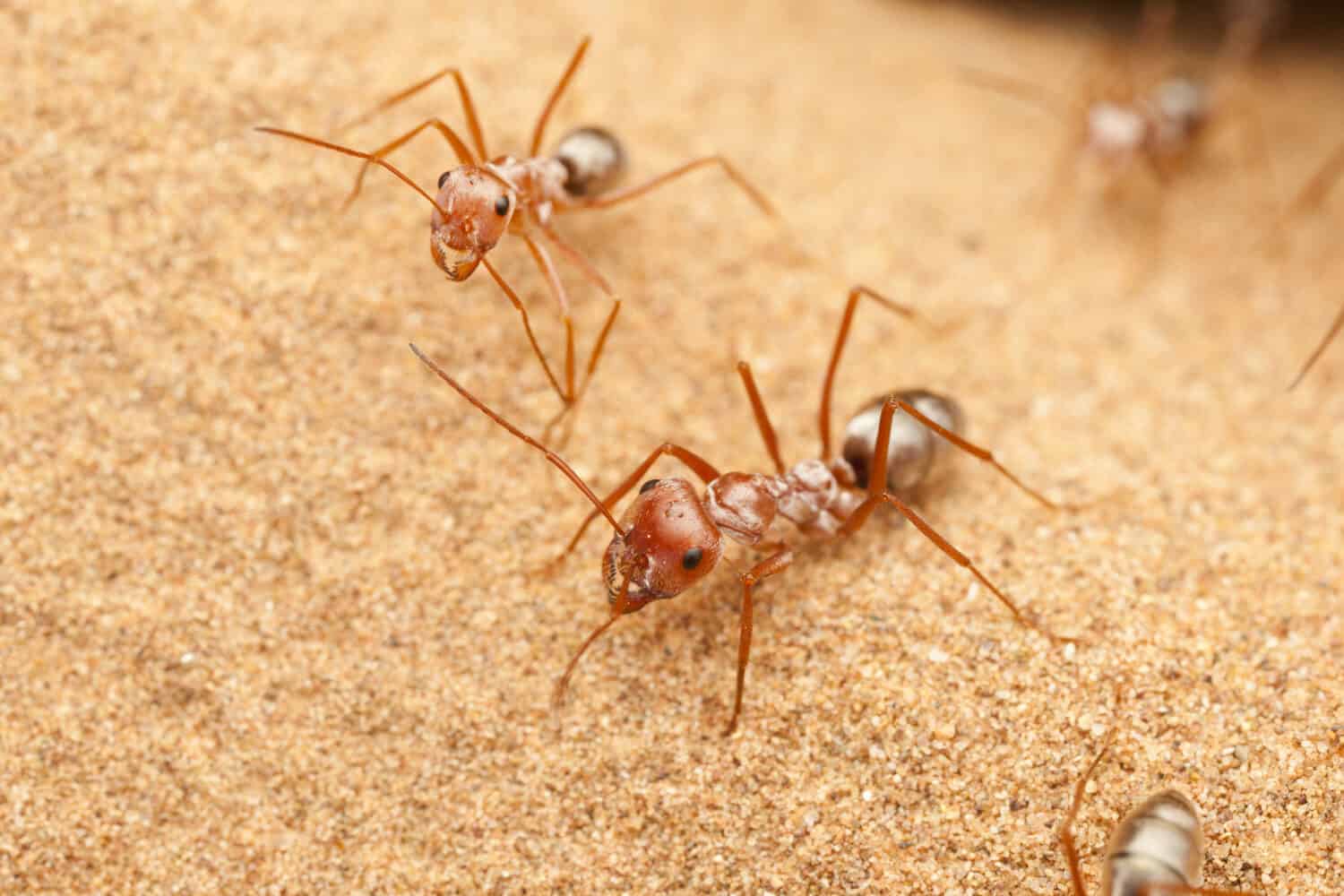
Saharan silver ants live in the Sinai and the deserts of the Arabian Peninsula. They are a common sight in the dunes of North Africa. Each ant is only around 3/8 inches long with a reddish head and a silver-white abdomen. They live in large colonies with a widespread network of galleries.
Living in habitats like these, the ants have evolved amazing abilities to withstand extreme heat. They live in one of the hottest terrestrial environments on Earth and have earned themselves the label “thermophilic scavenger”. They forage in temperatures of up to 158 degrees F. Their body temperatures reach up to 123 degrees F.
This Is How Saharan Silver Ants Survive in the Desert
The first element of the ant’s survival strategy is timing! They forage during the hottest part of the day when many insects have already succumbed to the heat. All they have to do is collect the corpses, which means they get a meal without having to expend a lot of energy chasing it. It also means the lizards who would normally prey on them are hiding away, so their foraging carries a lower risk.
Silver ants have physiological and behavioral adaptations for heat.
©Bjørn Christian Tørrissen / CC BY-SA 3.0 – Original / License
This hunting strategy, however, requires the ants to withstand heat that other animals cannot survive. Occasionally, they climb onto a stone or dry vegetation to get above the sand. Here it is cooler, and when temperatures are very high, they may spend 70 percent of their foraging time doing this.
The ants need to maintain their temperature below their critical thermal maximum of 128.48 degrees F. To do this, they need to reduce heat absorption from the environment.
Reducing Heat Absorption
This is where the ant’s silvery appearance comes in. They are densely covered in triangularly shaped hairs that reflect a lot of solar radiation in the visible and near-infrared (NIR) range of the spectrum. This reduces the heat reaching their body. They also radiate heat to the environment in the mid-infrared range, which cools them down. So, the ants can control a broad range of the electromagnetic spectrum using different physical mechanisms. Studies have shown that these special hairs reduce the body temperature of silver ants by 5 to 10 degrees.
Their bodies also have special water-repelling hydrocarbons, a volume-to-surface relationship that favors heat loss, a slender alitrunk (middle body section), and powerful muscles. Also, they have a discontinuous ventilation cycle, so they lose less moisture when they are respiring. They accumulate heat-shock proteins before they are exposed to heat to give them the best chance of survival.
Speed is Essential
These ants also use speed to survive! In fact, they are the fastest North African Cataglyphis desert ant species. They have high stride frequencies, ranging beyond 40 Hz. The ants achieve this through short stance phases (down to 7 ms) and fast leg swing movements (up to 1400 mm s-1). These tiny creatures can reach 108 body lengths per second, which is one of the highest values documented for running animals. The only animals faster than this are the Australian tiger beetle and the Californian coastal mite.
108
body lengths per second
Saharan silver ant running speed, one of the highest values documented for running animals
They need to forage in short bursts and get back underground quickly to cool off. So, in addition to speed, they have amazing navigation skills to get straight back to the nest when they need to.
Cooling Materials Inspired by Silver Ants
Scientists have realized that there is much we can learn from these ants when it comes to passive radiative cooling. It is an attractive prospect for design because it does not require any electrical input. In the past, ideas such as multilayer thin films and micro/nanophotonic structures have been proposed, but then attention turned to the ants.
Heatwaves damage infrastructure and put humans and wildlife at risk.
©Ed Connor/Shutterstock.com
Researchers have mimicked the photonic structure of the hairs on polydimethylsiloxane (PDMS), which is a commonly used silicon-based organic polymer. When these photonic structures were attached to glass, both the average reflectance and average emittance were increased. It was hoped that the application could be useful for cooling surfaces in vehicles, buildings, instruments, and even clothing.
Ant features and what they do
Silver ant
triangular hairs
led to Reflects solar radiation
Result: reduce the body temperature of silver ants by 5 to 10 degrees
Silver ant
photonic structure of the hairs
led to i2Cool cooling paint
Ant-inspired cooling has since reached the market. In 2020, the Hong Kong company i2Cool, whose founders began researching silver ant-inspired cooling in 2016, obtained several international patents for a composite passive radiative cooling paint. The paint allowed surfaces to dissipate heat continuously without consuming electricity or using refrigerants. What’s more, the same technology is now used in coatings, membranes, window films, and textiles in over 30 countries. As heatwaves become more frequent, this ant-inspired technology will likely be in even greater demand.
About the Author
Sharon Parry
Dr Sharon Parry is a writer at A-Z animals where her primary focus is on dogs, animal behavior, and research. Sharon holds a PhD from Leeds University, UK which she earned in 1998 and has been working as a science writer for the last 15 years.
A resident of Wales, UK, Sharon loves taking care of her spaniel named Dexter and hiking around coastlines and mountains.
Connect:
Thank you for reading! Have some feedback for us?
Thank you for your feedback!
We appreciate your help in improving our content.
Our editorial team will review your suggestions and make any necessary updates.
There was an error submitting your feedback. Please try again.