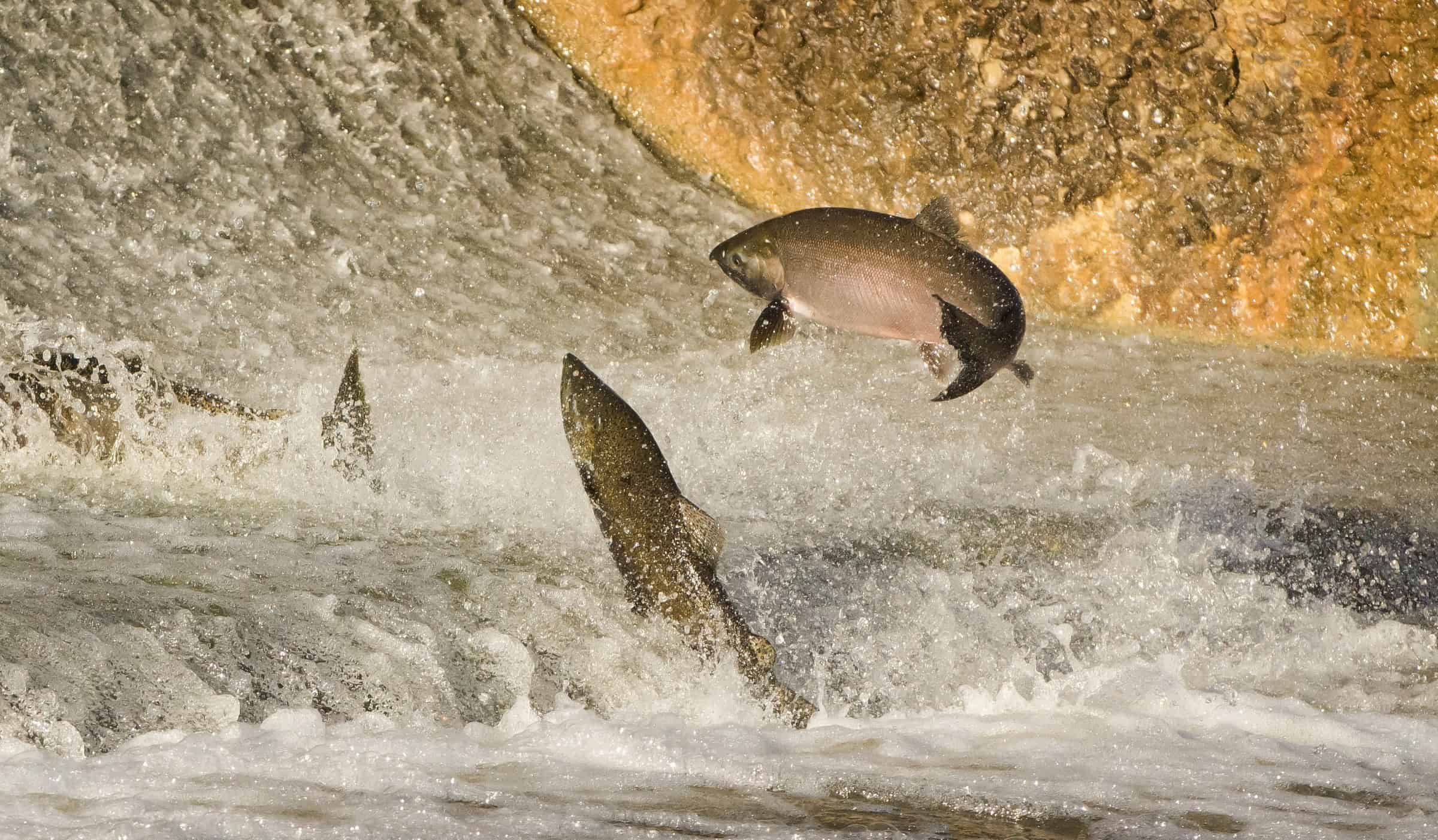
One fish nobody counted before the dams fell showed up anyway. Where did it come from?The salmon came back, but most don't go where scientists hoped. Something is holding them back.A century-old barrier wasn't the only obstacle. A mishap midway through demolition forced a costly fix.After 15 years of waiting, humans are about to give the fish a lift. Why is nature not enough?
Adult Chinook salmon returns to Washington’s Elwha River averaged 2,827 a year before two dams came out and 4,734 a year from 2015 to 2020, a 2024 study in Frontiers in Ecology and Evolution found. Young wild Chinook heading to sea averaged about 43,800 a year before dam removal and about 324,000 a year afterward, peaking at almost 1 million in 2020.
It’s too early to call the Chinook run recovered, the study’s authors wrote, and most of the fish still come from a hatchery. Few of them reach the top of the river, so 15 years after demolition began, people are getting ready to carry them there.
Why did two dams shut salmon out for a century?
Neither dam had fish passage, the Seattle Times reported. Elwha Dam stood 108 feet tall just 5 miles from the river mouth, and the 210-foot Glines Canyon Dam followed 8 miles upriver in 1927. They also trapped the sediment and wood that build spawning beds, side channels and pools.
Together the dams kept salmon out of more than 90% of the river for over 100 years, Olympic National Park said.
The blocked water included every snowmelt-fed stretch of the basin, according to a January 2026 report from the Lower Elwha Klallam Tribe and the Washington Department of Fish and Wildlife. Those uppermost reaches run cold, and getting there means climbing nearly 4 miles of chutes and falls in the Grand Canyon of the Elwha, the Seattle Times reported. The river’s original Chinook could do it: they were the biggest in Puget Sound, some heavier than 100 pounds.
How long did the removal take?
Demolition began in fall 2011, Elwha Dam was gone by spring 2012 and Glines Canyon Dam was out by August 26, 2014, according to the tribe and state report.
Then a rockfall blocked the canyon, and it took blasting in 2015 and 2016 to open it again, the Seattle Times reported. The $325 million project is still the largest dam takedown in the world, and it sent enough trapped sediment downstream to fill nearly 2 million dump trucks.
Fall 2011
Demolition began
Spring 2012
Elwha Dam gone
August 26, 2014
Glines Canyon Dam out
2015 and 2016
Blasting reopened the canyon after a rockfall
Wild young Chinook stayed scarce until three years after adult passage reopened, the 2024 study found, which suggests the sediment’s effects downstream had eased by then.
Which fish surprised the scientists?
Summer steelhead. Surveys before dam removal counted none, the Seattle Times reported. In 2019, snorkel surveyors counted 318 adults above the former dam sites, and fewer than 1% of the summer steelhead counted from 2017 to 2020 were hatchery fish, the 2024 study found.
Genetic analysis matched the new arrivals to wild rainbow trout from the upper watershed, the Seattle Times reported. Those trout had been locked behind the dams, and steelhead are rainbow trout that go to sea.
“This is as close to Lazarus as you can get,” John McMillan, steelhead science director for Trout Unlimited, told the paper.
This is as close to Lazarus as you can get,
John McMillan
steelhead science director for Trout Unlimited
When did the tribe fish the river again?
Coho have made the strongest comeback, the Seattle Times reported. In October 2023, the Lower Elwha Klallam Tribe held its first fishery on a free-flowing Elwha in more than a century, a limited coho catch for tribal and subsistence use.
“It’s been a long time coming,” Russell Hepfer, the tribe’s vice chairman, said at a ceremony attended by more than 100 people, the Seattle Times reported.
Tribal fishers harvested 177 coho that month, Olympic National Park said. Pink salmon numbers are up too: surveyors counted 11,607 in 2025, the most since the dams came out, according to the tribe and state report.
Why are so few Chinook reaching the top?
In 2025, only 8% of Chinook nests were in the upper river, the tribe and state report found. Eleven years after passage opened, Chinook use only 35% of their potential habitat, and a recently formed barrier in Rica Canyon stands in the way. Hatchery fish made up 94% to 97% of natural spawners from 2014 to 2019 and 82% to 85% from 2020 to 2024.
Scientists think that hatchery origin could be one reason, the Seattle Times reported. Mike McHenry, a habitat biologist for the tribe, said the historic upriver fish were likely a spring run that’s now locally extinct, while today’s hatchery fish descend from summer Chinook that may lack some of its traits. Some may be homing to the hatchery in the lower river, and with plenty of open habitat, they may feel little pressure to push higher.
What happens next?
The tribe and the state plan to reintroduce Chinook to the upper Elwha by releasing adults and fry there, beginning in 2026, according to their January report.
Thank you for reading! Have some feedback for us?
Thank you for your feedback!
We appreciate your help in improving our content.
Our editorial team will review your suggestions and make any necessary updates.
There was an error submitting your feedback. Please try again.