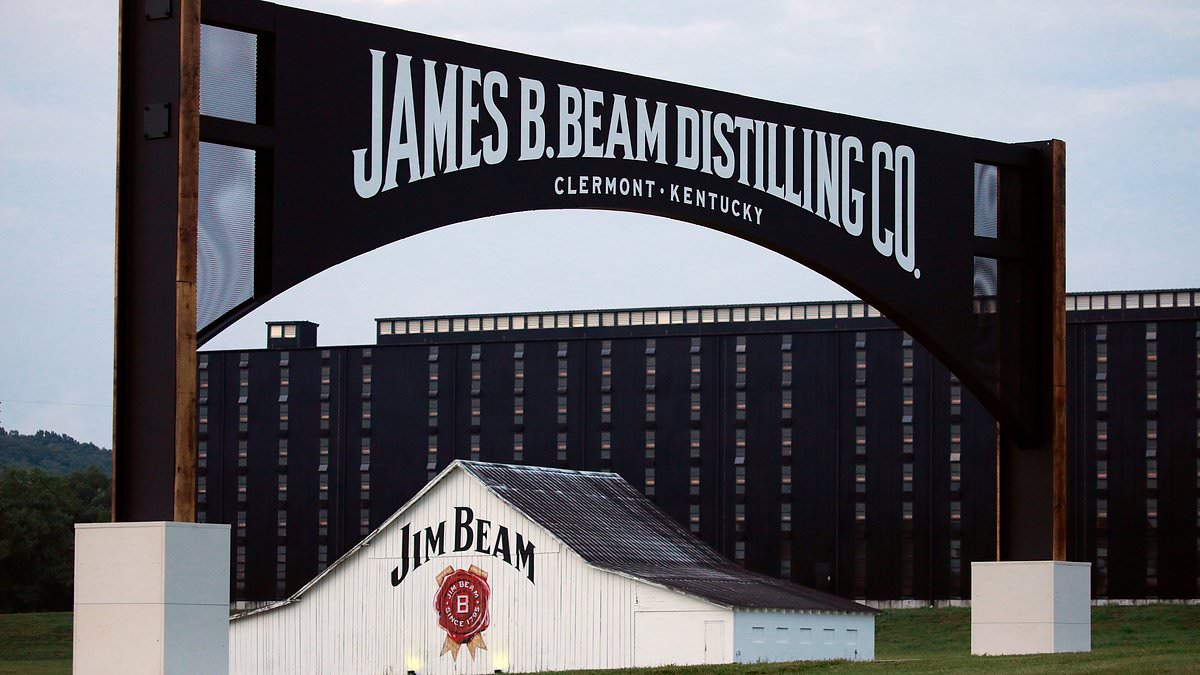
Bourbon lovers can breathe easy – Jim Beam isn’t running dry, but the famous whiskey maker is putting the brakes on production at one of its historic Kentucky distilleries.
The nearly 230-year-old brand, owned by Japanese drinks giant Suntory Global Spirits, had initially planned to pause operations at its flagship Clermont site for one year, with distilling expected to resume in 2027.
However, the shutdown has now been extended indefinitely as the company reassesses production needs amid a growing glut of unsold whiskey.
The move marks a significant shift for one of America's best-known bourbon brands, although it does not mean Jim Beam is disappearing from store shelves.
Suntory said it manages production across Kentucky according to consumer demand, inventory levels and longer-term business requirements, adding that it would continue to review its needs as forecasts change.
Instead, production of Jim Beam bourbon has been transferred to the nearby Booker Noe Distillery in Boston, Kentucky.
The facility is the brand's largest distillery, with the capacity to produce 45 million original proof gallons of whiskey annually.
A company spokesperson told the Daily Mail: 'Jim Beam production continues at our state-of-the-art Booker Noe distillery, our largest and most sustainable distillery in the world, while distillation at Clermont remains paused.
Jim Beam fans may have to wait a little longer for the next batch of their favorite bourbon, after the iconic American whiskey maker extended its production shutdown at a historic Kentucky distillery indefinitely
'This approach allows us to maintain the quality and consistency consumers expect while making the best use of our Kentucky distilling network.'
Importantly for bourbon enthusiasts, the Clermont site is not shutting down altogether.
Its aging, bottling and warehousing operations will continue, while the visitor center, restaurant and tasting experiences are also expected to remain open.
The nearby Fred B Noe Distillery, which sits on the same campus, will also continue producing other whiskey labels, including Knob Creek, Little Book and Booker's.
The company has said the production pause will not result in layoffs.
A spokesperson added: 'Aging, bottling and Fred B. Noe craft distillation continue in Clermont, alongside tours, tastings, dining and other visitor experiences.
'We are also advancing targeted infrastructure improvements at our Clermont distillery to support the site's long-term quality, safety and operational reliability.'
The company said it remains committed to investing in the historic site, with plans to further develop its visitor offerings.
'We remain committed to investing in Jim Beam and enhancing our Clermont campus as a hospitality destination that offers more ways to bring people together to experience the world's number one bourbon,' the spokesperson said.
The development comes as America's bourbon industry faces a rather sobering problem: there is simply too much whiskey being made.
Mila Kunis, Jim Beam’s global brand partner, and Fred Noe, the brand’s seventh-generation master distiller, toast fans at a Repeal Day event in Chicago in December 2018
The development comes as America's bourbon industry faces a rather sobering problem: there is simply too much whiskey being made
For years, distillers ramped up production to cash in on a booming appetite for American whiskey, particularly during the pandemic.
But whiskey takes years to mature, meaning barrels filled during the boom are now coming through the pipeline just as sales are losing momentum.
The result is a mountain of aging bourbon sitting in warehouses across the country.
US whiskey inventories are now estimated to be three times higher than annual demand, according to beverage alcohol research firm IWSR.
In Kentucky alone, members of the Kentucky Distillers' Association held a record 16.1 million barrels of whiskey as of October 2025.
Meanwhile, drinkers are increasingly watching their spending, cutting back on alcohol or choosing different types of beverages.
IWSR reported that total beverage alcohol volumes declined for the third consecutive year in 2025, with global spirits volumes falling 3 percent.
The pressure is particularly pronounced among mainstream and cheaper whiskey brands, while more expensive premium bottles are proving comparatively resilient.
IWSR reported that the value tier of whiskey declined 7 percent in volume during 2025, highlighting how the slowdown is hitting different parts of the market unevenly.
American distillers have also faced headwinds overseas, with trade tensions and retaliatory measures affecting important export markets.
Canada's backlash against US tariffs has been particularly damaging, with American spirits exports to the country falling more than 70 percent between March and December 2025 compared with the same period a year earlier.
The wider American whiskey category saw exports fall 19 percent over the course of 2025, according to the Distilled Spirits Council of the United States.