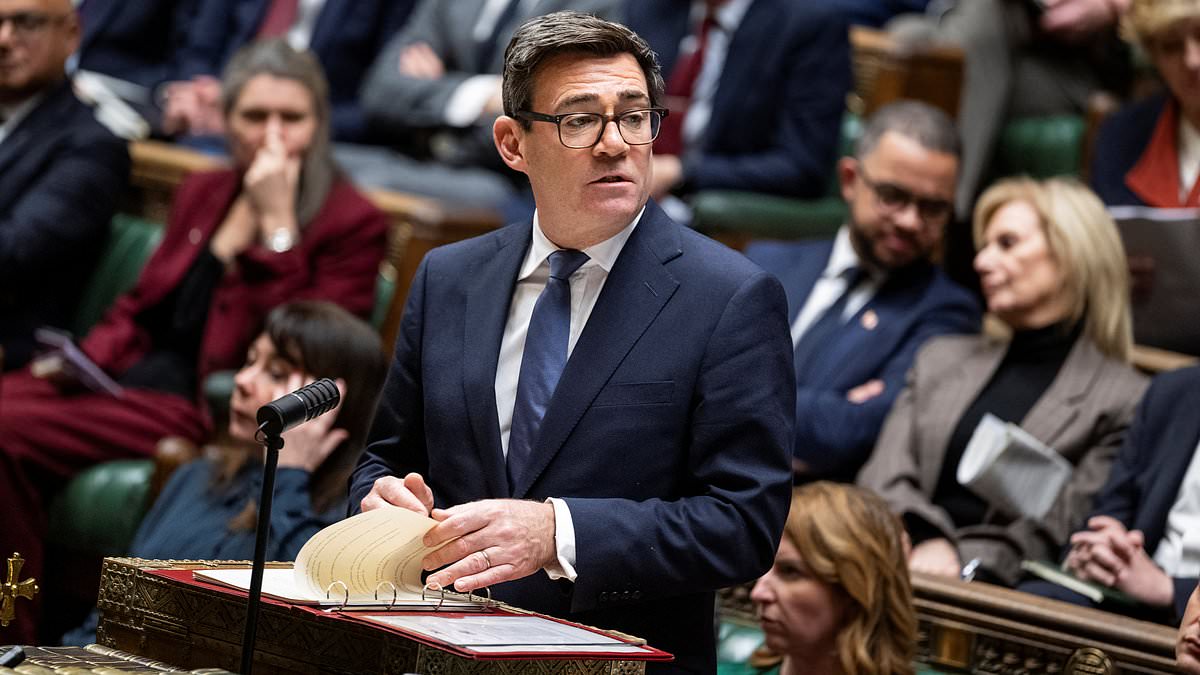
Published: 18:32 GMT, 23 November 2026 | Updated: 18:33 GMT, 23 November 2026
Andy Burnham is expected to use 490-year-old powers to sign Britain up to EU rules under his Brexit 'reset' deal.
The Prime Minister is set to introduce his European Partnerships Bill to Parliament later this week to implement his new pact with Brussels.
Mr Burnham last week travelled to meet EU leaders to sign agreements covering food and agriculture exports, emissions trading and a youth experience scheme.
The food and agriculture part of the 'reset' - aimed at ending post-Brexit export checks - will see Britain align with the EU on trade rules on sanitary and phytosanitary (SPS) goods, such as food and plants, from March 2028.
But there are concerns about the Government using centuries-old powers to sign the UK up to EU regulations without a full vote in Parliament.
It is expected the plans to ease 'dynamic alignment' with EU rules will happen using secondary legislation under so-called Henry VIII powers.
They are named after the Statute of Proclamations 1539, which gave the Tudor king the power to bypass Parliament and legislate by proclamation.
They allow ministers to change the law without the level of scrutiny that a full Act of Parliament would need.
Andy Burnham is expected to use 490-year-old powers to sign Britain up to EU rules under his Brexit 'reset' deal.
The use of this so-called 'secondary legislation' is commonplace, with roughly 1,000 considered by Parliament each year.
Secondary legislation can be put to a vote if MPs or peers object, but most pass through unchallenged.
On the whole, Parliament can either approve or reject secondary legislation, but cannot amend it.
Mark Francois, chairman of the European Research Group of Tory Brexiteer MPs, said Mr Burnham's 'reset' would be a 'major constitutional change and totally contrary to the spirit of the 2016 referendum'.
'What Burnham is trying to sell as a minor technical change is, in truth, quite the opposite,' he told The Telegraph.
'Dynamic alignment of veterinary and food regulation means that whenever the EU changes its laws in these areas, Britain would have to follow them automatically, regardless of the will of Parliament.
'That's a major constitutional change and totally contrary to the spirit of the 2016 referendum. It's time people woke up to that.'
Mr Burnham visited a Morrisons’ regional distribution centre in Kent on Monday where he said cutting red tape would help retailers to lower costs.
Downing Street said the PM's 'reset' deal would 'lighten the load on shoppers' but could not guarantee food prices will fall.
Asked about the use of Henry VIII powers in the new EU legislation, the PM's official spokesman said: 'The Cutting Costs Bill will be introduced this week.
'It provides the legal powers to implement these agreements and Parliament will scrutinise and vote on it in the usual way, it will publish an overall impact assessment when it is introduced.
'And then third, the detailed changes, for example to our food and carbon rules, will remain through secondary legislation.'