Companies
WASHINGTON, Nov 23 (Reuters) - US President Donald Trump and Vice President JD Vance personally intervened in Nvidia's
(NVDA.O), opens new tab
decision to reinstate CEO Jensen Huang over the weekend, convinced he alone protected American-made open-weight AI models, people familiar with the matter said on Monday.
Open-weight AI models are systems whose core components are publicly available for users to download, modify and adapt for specific tasks. Their growth has become a major business opportunity for Nvidia because they broaden demand for the company's chips and computing infrastructure beyond a handful of large AI developers.
The Misinformation Monitor newsletter rounds up international misinformation narratives, with a "Real or Fake?" quiz in every edition. Sign up here.
China leads in the development of open-weight AI systems, which are gaining ground with US companies because they can be cheaper than proprietary AI tools from top US labs OpenAI and Anthropic
(ANT.O), opens new tab
. They can also perform nearly as well.
Nvidia has been one of the most prominent backers of the US open-weight ecosystem. Nvidia in August agreed to buy the company Hugging Face, a platform that developers use to host open-weight AI models, among other AI-related resources. Nvidia is also an investor in Reflection AI, an American company that launched its first open-weight model in October.
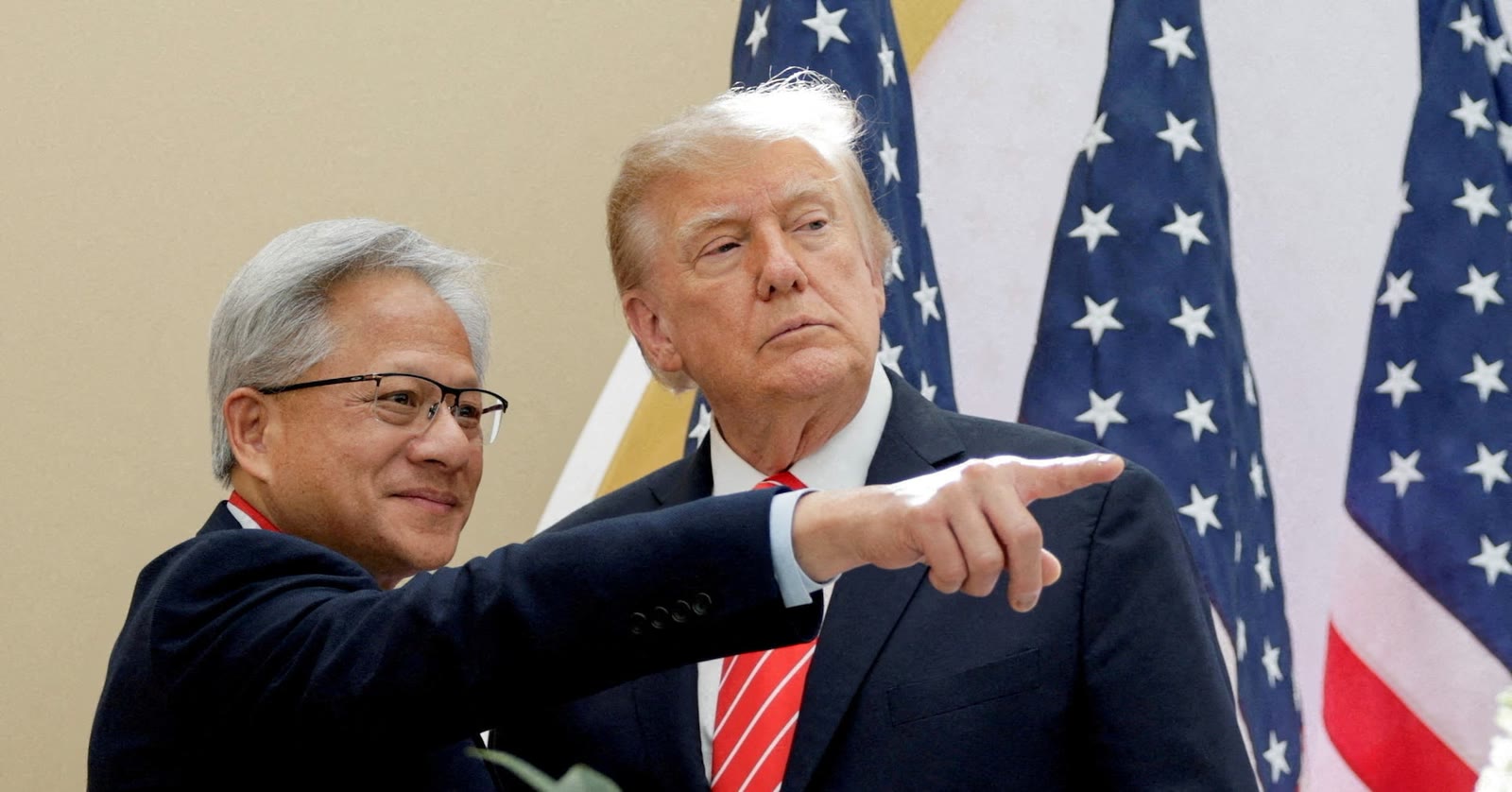
Item 1 of 4 US President Donald Trump stands with NVIDIA CEO Jensen Huang, after presenting him with the National Medal of Science during the "A New Golden Age" summit at the US Institute of Peace, renamed The Donald J. Trump Institute of Peace by the Trump administration, in Washington, DC, US, October 8, 2026. REUTERS/Evan Vucci/File Photo
[1/4]US President Donald Trump stands with NVIDIA CEO Jensen Huang, after presenting him with the National Medal of Science during the "A New Golden Age" summit at the US Institute of Peace, renamed The Donald J. Trump Institute of Peace by the Trump administration, in Washington, DC, US, October 8,... Purchase Licensing Rights, opens new tab Read more
Huang and Nvidia's lobbyists have also pressed US lawmakers to support the development of open-weight AI technology, with Huang writing in a letter earlier this year that they should avoid "premature restrictions" on such tools.
Huang resigned as CEO earlier this month following reports that he engaged in several extramarital affairs, including one with an alleged Chinese spy.
Reuters reported on November 18 that the Trump administration was considering requiring US companies to publicly disclose their use of Chinese AI models, including open-weight models, as part of an effort to reduce reliance on Chinese technology.
Republican lawmakers have increasingly echoed the argument that open-weight AI is critical to competing with China. Two leading House Republican lawmakers on Friday called on the Trump administration to help American companies developing open-weight AI models, adding that it would position the US to better counter China.
Reporting by Steve Holland in Washington and Erin Banco in New York; Additional reporting by Courtney Rozen in Washington; Writing by Susan Heavey; Editing by Matthew Lewis
Our Standards: The Thomson Reuters Trust Principles., opens new tab
Courtney Rozen reports on the world's largest technology companies from Washington, D.C., focusing on the relationship between the tech industry and the U.S. government. She reported on DOGE and the federal workforce during the first year of U.S. President Donald Trump’s second term. Prior to joining Reuters, she was a White House correspondent at Bloomberg Government. She graduated from American University with a master's degree in journalism. Contact: courtney.rozen@thomsonreuters.com
Erin Banco is a national security correspondent focusing on the intelligence community. She covers everything from the wars in Ukraine and Gaza to U.S. covert operations overseas. She previously worked at POLITICO as a national security reporter.
Banco has a long history covering the Middle East region, from Cairo to Baghdad to Aleppo where she’s reported on the Arab Spring and its aftermath, including the civil war in Syria and the rise of ISIS. Her 2017 book, Pipe Dreams, focuses on the development of the oil and gas industry in the northern Kurdistan region of Iraq. Banco attended The University of Wisconsin-Madison, where she majored in Arabic and journalism. She earned a master’s in public administration from Columbia University’s School of International and Public Affairs in 2014.