There’s a secret beneath Helsinki. Dig 25 metres down beneath its granite crust, and you’ll find vast hockey pitches, brightly coloured swimming pools, adventure playgrounds and the city’s first-ever axe-throwing venue. It’s called HELAXE, and notes on its website that “bowling is for pussies!”. Yet in a matter of hours, these spaces, one the size of a seven-storey building, can be utterly transformed: the pitches removed and the pool water drained to be replaced with decontamination showers and enough bunk beds for 6,000 people. With the Russian frontier just 100 miles away, and Putin’s grey-zone operations ramping up, these are bunkers fit for an age of uncertainty.
Helsinki has offered inspiration to a vast array of European leaders and delegations, each seeking to fashion their own approaches to shelters and civil defence. Across Europe, nations, cities, and even private citizens are reimagining subterranean space as we are told to prepare for a “Black Sky” event. It all reflects a distinct shift in the conception of conflict among its citizens. Where, in the past, wars might have seemed like something that happened in far-off fields, the rise in these dual-use bunkers, blending the mundane with the martial, suggests preparedness is increasingly becoming just another part of life. Today, we can’t tell where the threat is going to come from — though conflict seems to be getting closer. On Saturday, a drone strike in the Gulf of Finland set fire to a Russian cargo ship.
A swimming pool beneath Helsinki. (Helsinki City Rescue Department)
After the end of the Cold War, many governments immediately decided to slash military spending. Armies were cut, conscription cancelled, plans for civil defence disregarded. In the UK, for example, the defence budget slumped from about 5% in 1985 to just 2.3% by 2013. While Eastern Europe remained more cautious, not least given the enduring memory of Russian occupation, military and civil preparedness became less important too, particularly after Nato expanded from the late Nineties.
That’s clear enough when it comes to bunkers. Before 1990, a country like Poland built thousands, of which about 2,000 survive. They were a concrete insurance policy against the looming threat of nuclear catastrophe. Children were taught civil-defence training, practising drills and donning gas masks, while shelters were fitted with radiation decontamination points. Yet from the mid-Nineties, this abruptly stopped, with many remaining bunkers not meeting modern safety standards. Some have insufficient ventilation; others lack emergency exits. And in any case, there’s not enough of them. A 2022 report by the Polish interior ministry found that just 3% of the country’s 38 million people could fit in existing shelters.
“A survey found that about 60% of Poles still didn’t know where to go in an emergency.”
Especially after the invasion of Ukraine, Warsaw felt pressure to act. The result was a 2024 law requiring new public buildings and apartment blocks to include basements that can double as emergency shelters, and 0.3% of Polish GDP is now also dedicated to civil defence. But a survey conducted last month by the Wirtualna Polska newspaper found that about 60% of Poles still didn’t know where to go in an emergency.
Poland is a vivid example of the gap between the renewed political commitment to civil defence on the one hand — and the preparedness of the public on the other. Nor are Poles alone. Lithuania, to give one example, might have some 6,600 shelters, enough to accommodate 58% of the population. But according to one recent survey, only a fifth know where their nearest one is.
Nuclear bunkers, like this one near Nantwich, Cheshire, were key installations during the Cold War. (Christopher Furlong/Getty)
One obstacle here is clearly psychological. For almost 40 years, war has not touched Europe in the way it had for most of the 20th century — instead, conflict is associated with distant shores or only found on television. Contemporary warfare informs the same attitudes. Cyber attacks, disinformation, and different forms of “grey-zone” warfare are less visible than tanks on streets. Though they create rampant insecurity, such attacks still don’t feel like emergencies, with Brits consistently ranking immigration and the economy as more important than defence. Government language also complicates an everyday awareness of threats, as debates on deterrence and resilience clash with ordinary pressures around the cost of living.
Perhaps all this explains why many countries still seem unwilling to fully embrace the implications of their politicians’ dire warnings, instead blending civil defence with civilian architecture. Borrowing from a Ukrainian model, for instance, Warsaw’s metro is now being reimagined as a shelter. Across the River Oder, Germany is doing something similar. Earlier this year, a new civil protection act was declared, aiming to invest €10 billion into rescue forces, communication systems, and infrastructure — as well as reimagining everyday spaces, like underground car parks, as bunkers.
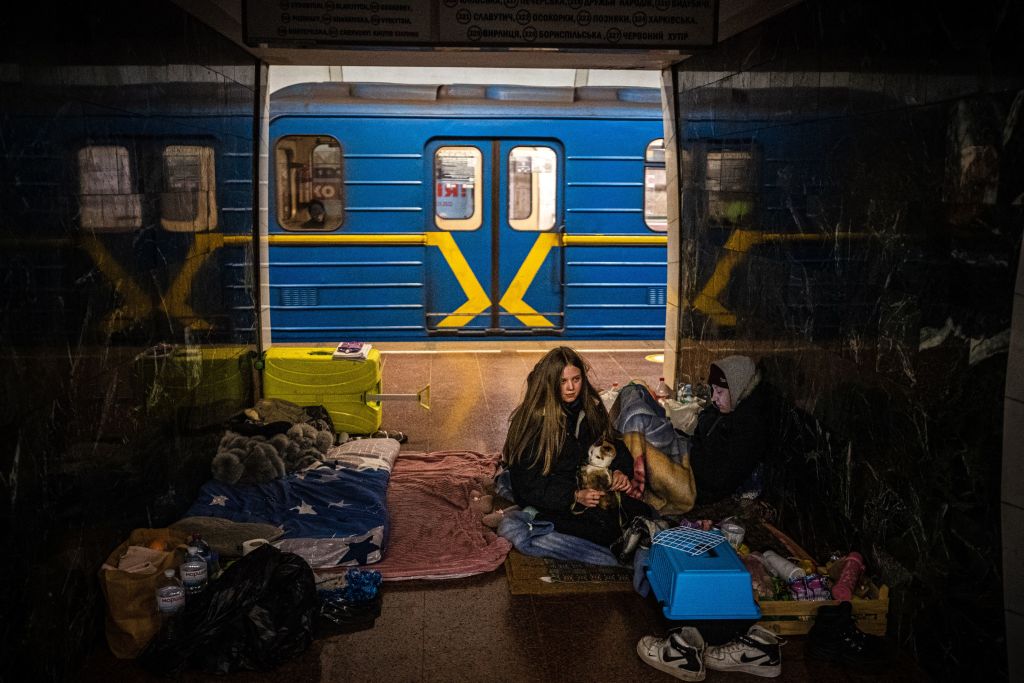
Ukrainians have become experts at blending military shelters with civilian life. (Sergey Bobok/AFP/Getty)
The deeper logic here is that as deterrence is integrated into everyday life, civilians are prodded, as gently as possible, towards adopting a war footing. This is working: 72% of EU citizens worry about conflict near the bloc’s borders. Given the continent’s dire economic state, meanwhile, this approach is obviously cheaper than building new bunkers wholesale. All the same, it suggests that Europeans, politicians and civilians alike, are less sure about the prospect of war than the soundbites imply — or hope that those swimming pools and axe-throwing venues never need to be converted. Certainly, it’s unclear how well these impromptu shelters might function in an actual crisis. These are far from the purpose-built monoliths of the Cold War, and Ukraine is discovering that even these are vulnerable to the most powerful Russian missiles.
There is, of course, another, less cynical, way of looking at all this. It’s a way of preparing for conflict, while still keeping normal life looking, well, normal. Ukrainians have predictably become masters at this balancing act, with everything from schooling to ballet now conducted underground. Their life-under-bombardment experiences are also informing designers elsewhere. Tallinn, for instance, recently installed modular bomb shelters for short-term use, made from reinforced concrete and based on a design used in Ukraine.
At the same time, there are other ways bunkers can be used while civilians wait for the drone strike. Switzerland offers an interesting case study here. Long famed for its extensive network of shelters — built to protect every inhabitant from nuclear fire in the decades before 1991 — the country has lately announced plans to refurbish these in line with contemporary standards. More to the point, an increasing number are being turned into data centres. With international tensions mounting, and floods and fires increasingly frequent, global tech giants are keen to keep their digital valuables safe.
A rendering of a bunker in the V37 project. (Lasovsky Johansson/Studio Sang)
In many respects, the power of bunkers lies in their ability to blend the mundane and the extraordinary. Once again, psychology arguably matters here too. “Each thing creeps back into its own nature within the shelter of the dark,” wrote the Irish poet John O’Donohue. “Darkness is the ancient womb.” If he’s right, bunkers offer a particularly reassuring idea of security, offering not just literal safety, but a feeling of retreat from the outside world. It feels appropriate that the most famous underground building in Helsinki isn’t a bunker at all — but a church, hewn into the granite and opened in 1969.
Yet if most bunkers are predictably centred on descending into darkness, there are some with radically different visions. The Bunker V37 project aims to transform prewar Czechoslovak fortifications, built in a doomed attempt to defend the country from Nazi Germany, into liveable spaces — by carving out and opening up the interiors. To quote Jurás Lasovský, one of the co-founders of the studio undertaking the project, the aim is to “negate their defensive purpose”, with vast new windows looking out to the landscape beyond.
That’s a powerful way of reimagining the infrastructure of death — though their defensive purpose remains their main selling point. Tthe private bunker business is booming as fears of an AI apocalypse grow and those with money to spend and fears to assuage — tech billionaires, for example — are sinking their fortunes into the ground. Perhaps the most unsettling thing about the reanimation of the bunker, then, is what it tells us about the nature of our current peace.
Juliette Bretan is a postdoctoral affiliate at the University of Cambridge, and writes about Eastern European politics, culture and history.