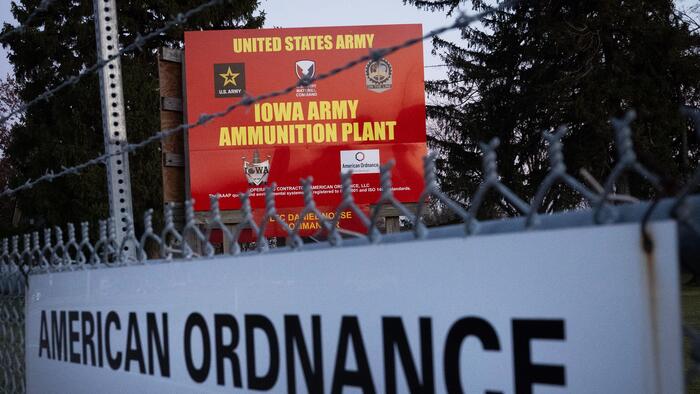
President Donald Trump said Monday he has ordered the Army not to detonate nearly five tons of degraded lead azide at the Iowa Army Ammunition Plant in Middletown until the Eighth Circuit Court of Appeals agrees it can go forward. In a Truth Social post, he made the operation "fully subject to" the agreement of Iowa Governor-elect Rob Sand, a Democrat.
The Army had set the blast for Wednesday, Nov. 25, its third target date.
Trump wrote that the proper course is still to get rid of the material, but that the Army will wait for the court and for Sand. If Sand or the courts "do not agree," he said, the Army will not proceed and he will be forced to hold the incoming Governor responsible for any and all death or destruction caused by the situation.
He said military leaders advised him that detonating the material soon is the safest option, and that the weather is "optimal" for it. Experts who have studied the stockpile for years, he added, see a "substantial chance" that it will "explode of its own volition" in the near future.
The Eighth Circuit froze the emergency permit the EPA issued Nov. 13 late Thursday, until it rules on an emergency motion from the Iowa Environmental Council and the Sierra Club's Iowa chapter to stop the blast. In a weekend filing, federal lawyers argued that the stay covers only the permit, and that the EPA's hazardous-waste rules let the Army act without one in the face of "an immediate threat to human health, public safety, property, or the environment."
Rachel Rintelmann, managing attorney at Earthjustice, which represents the two groups, told NBC News she could not yet say what effect Trump's post will have on the case, but that it "only adds further confusion to a situation that has already caused chaos."
Sand takes office in January. Iowa Gov. Kim Reynolds activated the State Emergency Operations Center Friday, and her office said Sunday state agencies are working with the EPA and the Army on air, land and water monitoring and with the USDA on help for crop and livestock producers.
Sand said in a Facebook post last Thursday that there had been an "unacceptable lack of communication and clarity," and asked why, if detonation is the safest option, the other options were worse.
The filing said the Army intended to act by Tuesday, and that temperatures are expected to fall below 30 degrees in the coming days. According to the Army, crystals in the degraded lead azide could fracture as it gets colder and set off an uncontrolled explosion. "In short, a controlled detonation is by far safer than an uncontrolled explosion," the Justice Department wrote, according to court records.
The two groups said in a joint statement Sunday that "this emergency is of the Army's own making." Michael Schmidt, general counsel for the Iowa Environmental Council, said the Justice Department's filing suggests the stockpile is more dangerous than the Army had disclosed, and that detonation may now be the only feasible option because the problem was allowed to persist. "The public deserves to know immediately which communities will be impacted," he said.
In March the Army hired Georgia-based MuniRem Environmental to chemically neutralize the material, a method that avoids a lead-dust plume altogether, then canceled the contract two months later, the New York Times reported. MuniRem CEO Valentine Nzengung told the paper that then-Army Secretary Dan Driscoll made the final decision to detonate.
According to the EPA, the lead azide in the plant's 68 drums recrystallized during long-term storage, which made it more sensitive to friction and shock, and disturbing the containers could set off an unintentional detonation. The Army says destroying it in place is the only responsible option.
By the Army's own most recent modeling, cited in the groups' motion, the blast threatens to deposit lead dust over an area about 25 miles long and 5 miles wide that takes in homes and tributaries of the Mississippi River, with lead in the air along a path stretching more than 100 miles. Which communities sit downwind depends on the wind that day, so each new date changes who is in the path. The Army has advised residents of the Middletown City Park neighborhood to temporarily vacate during the detonations.
As we reported last week, the blasts were first set for Friday at noon. Acting Army Secretary Adam Telle then pushed them to Monday, calling it "the latest possible moment prior to a forecasted temperature drop." The Army let that deadline pass, and announced the Wednesday date Sunday night, saying it was moving the blast "to allow for optimal weather conditions and all mitigation measures to be emplaced."
The controlled detonation at Iowa Army Ammunition Plant is now scheduled on Wednesday, November 25, 2026 to allow for optimal weather conditions and all mitigation measures to be emplaced.
The Army and our interagency partners have been working around the clock to safeguard all...
— U.S. Army (@USArmy) November 23, 2026