It is often described as Earth's final frontier – a vast, dark wilderness seemingly untouched by human activity.
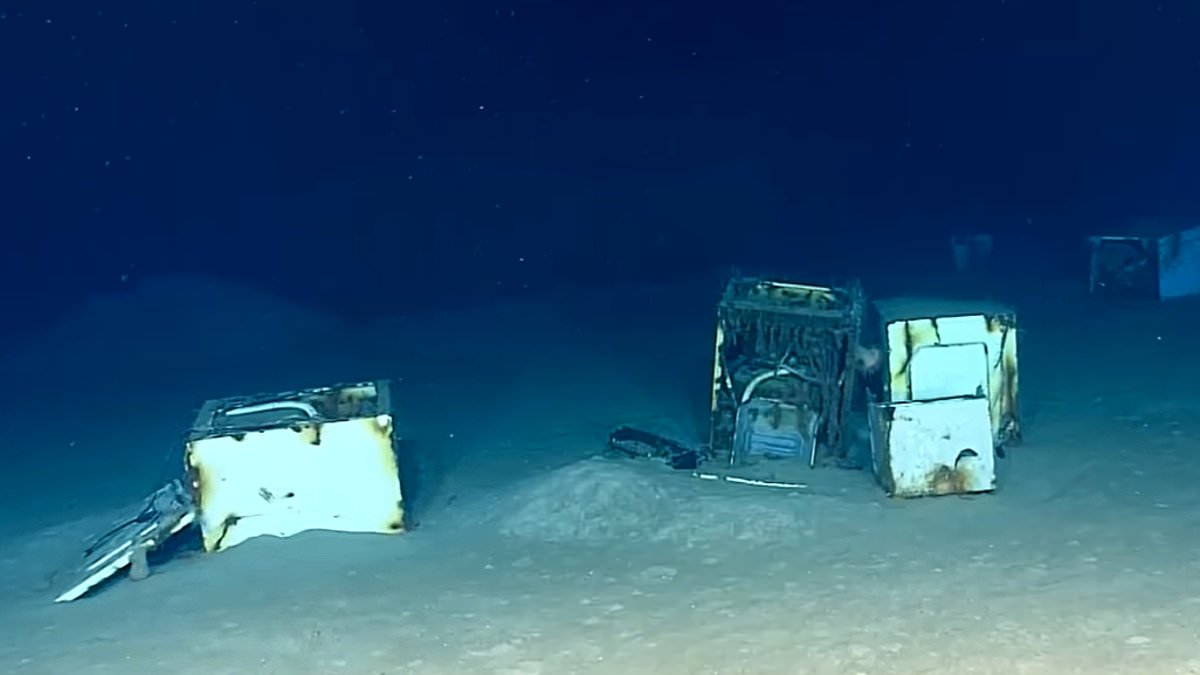
But a deep-sea expedition in the Gulf of Mexico has revealed just how far our impact extends, uncovering a bizarre debris field of washing machines, refrigerators and chest freezers 5,000ft (0.9 miles) below the waves.
A team of researchers from the US National Oceanic and Atmospheric Administration were searching the area in 2017 for what they thought would be a shipwreck.
But footage from their remotely operated vehicle (ROV), which has only just been released, reveals a graveyard of kitchen appliances.
'This is a bit surreal,' one of the crew said.
'We are at 1.5km (0.9 miles) in the deep sea, and here we are moving through a field of chest freezers, fridges, and washing machines.
'You think of the deep sea as a fairly untouched place, but this is just a reminder that it really is not. We still do manage to have an impact on this very alien area and ecosystem.'
Scientists from NOAA thought they were looking for a shipwreck, but they came across a graveyard of appliances
Analysis of the serial number on one of the machines suggests it was made before 2002 and as early as 1993, making the wreck up to three decades old
Experts believe the appliances were once packed inside a shipping container that was lost overboard during rough weather before plunging to the seafloor
As the ROV explored the deep sea, one of the researchers could be heard saying: 'Today is truly a day of exploration as we send the ROV over to this unknown sonar target.
'We're working off an AUV side-scan sonar image. It appeared to show a debris field plus a larger object which may be a hull of a ship.'
However, the distant outlines soon come into clear view, showing rows of white goods scattered across the seabed.
Some appliances were partially buried in sediment while others had become home to deep-sea creatures.
Once they realised what they were looking at, one person joked: 'I don't think spin cycle is going to be working on it. I'd like to return this to the manufacturer and ask about the warranty.'
Experts believe the appliances were once packed inside a shipping container that was lost overboard during rough weather before plunging to the seafloor.
Up to 90 per cent of the world's goods are transported by shipping containers before being offloaded and taken to the shops which sell them.
According to the World Shipping Council, nearly 1,500 containers were lost at sea in 2025, thanks to storms, heavy swells and accidents.
According to the World Shipping Council, nearly 1,500 containers were lost at sea in 2025, thanks to storms, heavy swells and accidents
The appliances could take hundreds of years to full degrade in the deep ocean, the researchers said
Some appliances were partially buried in sediment while others had become home to deep-sea creatures
The official dive note reads: 'This dive investigated a side scan sonar target thought to represent an archaeological site and related debris.
'Instead of a shipwreck, we discovered a 40-foot (12m) freight-shipping container with one corner ripped open to reveal a cargo of "white goods" – washing machines, dryers, chest freezers, dishwashers and refrigerators.
'Other appliances were scattered nearby as well as further afield, forming what we had assumed was a "debris field".'
The appliances were from brands including RCA and GE, but a lack of packaging suggests the cargo was going to be recycled.
Marine animals including tiny colony-forming sea creatures had grown over the shipping container, while fish were using it as a shelter.
Researchers also spotted a type of deep-sea coral growing on one of the washing machines.
The crew explained that while the appliances could take hundreds of years to fully degrade in the deep ocean, the information collected from the discovery could still be useful.
'For biology, one of the things that's very instructive about wrecks like this that we can actually date is it gives us some sense of how old the fauna is that's living on it and how quickly they can grow,' they said.
Marine animals such as tiny colony-forming sea creatures had grown over the shipping container, while fish were using it as a shelter
The NOAA team also spotted a type of deep-sea coral growing on one of the washing machines
Analysis of the serial number on one of the machines suggests it was made before 2002 and as early as 1993, making the wreck up to three decades old.
While the discovery may appear amusing, researchers said it highlights the extent to which human activity reaches even the planet's most remote environments.
The deep sea is often viewed as one of Earth's last great wildernesses, yet discarded objects, fishing gear and lost cargo have been found in some of the most inaccessible parts of the world's oceans.
Last year, scientists discovered plastic bags and cans littered across the Calypso Deep – a trench 16,771ft (5,112m) below the surface of the Mediterranean Sea.
A total of 167 objects – made of plastic, glass, metal and paper – were identified at the bottom.
This includes plastic bags, a plastic sack, plastic food containers, plastic cups and lids, plastic rope, paper cartons, metal drinks cans and glass bottles.
DEEP-SEA DEBRIS DATABASE REVEALS EXTENT OF OCEAN PLASTIC POLLUTION
Plastic pollution is a scourge that is ravaging the surface of our planet. Now, the polluting polymer is sinking down to the bottom of the ocean.
The deepest part of the ocean is found in the Mariana Trench, located in the western Pacific Ocean, to the east of the Mariana Islands. It stretches down nearly 36,100 feet (11,000 metres) below the surface.
One plastic bag was found 35,754 feet (10,898 metres) below the surface in this region, the deepest known piece of human-made pollution in the world. This single-use piece of plastic was found deeper than 33 Eiffel towers, laid tip to base, would reach.
Whilst the plastic pollution is rapidly sinking, it is also spreading further into the middle of the oceans. A piece of plastic was found over 620 miles (1,000 km) from the nearest coast - that's further than the length of France.
The Global Oceanographic Data Center (Godac) of the Japan Agency for Marine-Earth Science and Technology (Jamstec) launched for public use in March 2017.
In this database, there is the data from 5,010 different dives. From all of these different dives, 3,425 man-made debris items were counted.
More than 33 per cent of the debris was macro-plastic followed by metal (26 per cent), rubber (1.8 per cent), fishing gear (1.7 per cent), glass (1.4 per cent), cloth/paper/lumber (1.3 per cent), and 'other' anthropogenic items (35 per cent).
It was also discovered that of all the waste found, 89 per cent of it was designed for single-use purposes. This is defined as plastic bags, bottles and packages. The deeper the study looked, the greater the amount of plastic they found.
Of all man-made items found deeper than 20,000 feet (6,000 metres), the ratios increased to 52 per cent for macro-plastic and 92 per cent for single-use plastic.
The direct damage this caused to the ecosystem and environment is clear to see as deep-sea organisms were observed in the 17 per cent of plastic debris images taken by the study.