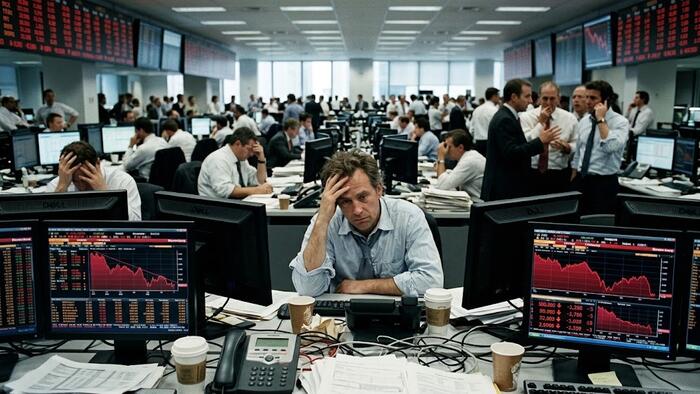
US futures are lower as Monday's forced-buying frenzy following Jensen Huang's reinstatement at Nvidia fizzles and AI caution returns, with chipmakers and memory names sliding, Anthropic breaking below its $83 IPO price and HPE tumbling on a margin warning; meanwhile oil keeps sliding on US-Iran diplomacy hopes even as Iran says tankers hit mines in Hormuz; as a result Treasuries extend gains with the 10Y yield dropping 7bps to 4.89%. As of 8:10am ET, S&P futures are 0.9% lower while Nasdaq futures slide 1.6% and Dow futures are down 0.4%. The pullback follows a session in which the S&P soared 4.7% to 7,237, its best day since April 2025, and the Nasdaq 100 jumped 6.9% as Nvidia surged 31.5%, its biggest gain since 2003, in what was mostly a short squeeze and levered-ETF rebalance (as we noted yesterday, McElligott sized the mechanical bid at $41 billion). In premarket trading, Nvidia gives back 5.7%, semis and memory are down 4-6% with Micron -7% and Intel -6.6%, and the Mag 7 is mostly lower ex-Apple; software outperforms the tech tape, confirming BTIG's Jonathan Krinsky's call to sell the Jensen squeeze. Ex-AI, there is a defensive tilt with health care and staples higher while energy leads cyclicals. The day's driver is the AI hangover: Nvidia's U-turn removed one uncertainty but opened several others, from governance and circular financing to export controls, with Huang due before three House committees on Dec 1 and the Senate Banking Committee on Dec 3, while the US added Megaspeed and Alibaba's Singapore unit to its trade blacklist. In rates, Treasuries rally across the curve with the 2Y down 5bps to 4.64% as cheaper oil eases inflation fears and haven demand returns; money markets still fully price a December Fed hike, and a Bloomberg survey of economists sees hikes in December and March. The Bloomberg dollar index slips 0.1% after hitting its highest since April 2025 on Monday, with the euro and pound outperforming and the yen lagging. In commodities, WTI dips toward $79.5 and Brent trades below $89 as Qatar works to revive US-Iran talks and Dubai spreads flip to contango; copper drops back below $12,200, silver slides over 2% and gold is modestly lower. Bitcoin is back below $60,000, fully reversing its Nvidia bump. US economic data slate includes the weekly ADP employment report (8:15am), September FHFA house prices and Case-Shiller (9:00am), and November Conference Board consumer confidence and Richmond Fed manufacturing (10:00am); the Treasury sells $90 billion of 6-week bills and $54 billion of 52-week bills at 11:30am, and [VERIFY] a 5-year note auction ([x] billion, [x] pm). No Fed speakers are scheduled, though the Fed's discount rate minutes are due; Thursday's Thanksgiving holiday closes US markets.
In premarket trading, Mag 7 stocks are mostly lower led by Nvidia (NVDA) which falls 5.5%, paring some of Monday’s surge (Apple (AAPL) -0.1%, Microsoft (MSFT) -0.5%, Amazon (AMZN) -0.9%, Alphabet (GOOGL) -0.8%, Meta Platforms (META) -1.2%, Tesla (TSLA) -0.5%).
Semiconductor stocks retreat after Monday’s rally.Agilent (A) is up 7% after the life sciences company gave a first quarter profit forecast that surpassed expectations.Analog Devices (ADI) falls 9% after the chipmaker forecast first quarter adjusted earnings that missed consensus estimate at midpoint of the guidance range.Anthropic (ANT) shares briefly traded below their $83 initial public offering price in premarket trading, wiping out gains for investors who piled into the artificial intelligence lab’s record-setting debut.Best Buy (BBY) gains 5% after the consumer electronics and appliance retailer’s comparable sales for the third quarter easily topped the consensus estimate. Management also boosted annual guidance metrics.Bristol-Myers Squibb (BMY) inches about 1% lower after the big pharma firm said CFO David Elkins will step down from the role, effective March 1, 2027.Dick’s Sporting Goods (DKS) rises 14% after the company raised forecast as its struggling Foot Locker chain returned to growth.Dollar Tree (DLTR) jumps 8% after the retailer’s third-quarter adj. EPS and comparable sales topped Street expectations. Management boosted its annual guidance for adjusted EPS and raised the low-end of its net and comparable sales ranges.Fluence Energy (FLNC) jumps 15% after the energy storage company reported a backlog that exceeded analyst estimates.HP Enterprise (HPE) slides 11% after the server maker gave a revenue forecast for the current quarter that fell short of the most optimistic estimates, disappointing some investors who were looking for a bigger boost from the AI boom.Insmed (INSM) jumps 14% after Sanofi SA agreed to buy US biotech for $41 billion.Kohl’s (KSS) gains 7% after the retailer reported comparable sales for the third quarter that beat the average analyst estimate. It also raised its full-year outlook.Medtronic (MDT) falls 1% after the medical device maker posted revenue for the second quarter that trailed the average analyst estimate.Semtech Corp. (SMTC) falls 12% after the semiconductor company gave guidance for fourth-quarter adjusted gross margin that was below the average analyst estimate.
In other corporate news, Sanofi agreed to buy Insmed for $41 billion, or $175 per share in cash, the biggest pharma deal in three years, as the French drugmaker scrambles to plug the hole left by the looming patent loss on its top seller (it lined up a $35 billion bridge loan from JPMorgan and BNP); Linamar will buy Terex's Genie unit for $1.4 billion; a China Southern unit will buy Boeing jets in a $7.4 billion deal; Compass Group plans to move its primary listing to the US by 2028; Xiaomi's 3Q revenue of 107.24 billion yuan topped estimates; Hon Hai launched up to $1.5 billion of convertible bonds; and subprime auto dealer America's Car-Mart filed for Chapter 11, a timely reminder that not everything was bailed out on Monday.
The global framing this morning is simple: stocks are giving back some (most) of the Nvidia-powered gains, with declines concentrated in AI-exposed names and chipmakers, while bonds rally everywhere, the dollar eases and commodities slip. Monday's move felt far more positioning-driven than fundamental, with volumes lower than during Friday's drawdown and much of the buying forced: dealers hedging levered-ETF exposure and short sellers rushing to cover. And while the VIX dropped more than 9 points to around 26, 20-day realized volatility of the VIX rose to around 300%, the highest since the April 2025 tariff turmoil, a sign of a fragile market primed for outsized swings in either direction.
AJ Bell's head of markets Dan Coatsworth summed up the drama as the most dramatic corporate reversal he can remember, and Bloomberg's Before the Bell notes that questions about circular financing, which were already worrying investors before the last two weeks, won't suddenly dissipate, while governance, succession, export controls and regulatory risk all remain open.
“The hype settles and the emotion fades and everybody starts thinking jagain,” said Jacopo Ceccatelli at Banca Finanziaria Internazionale SpA. “It’s going to be very, very important to see what happens in the next two to three days.”
Some, like Bloomberg's Garfield Reynolds, think that what happens next won't be pleasant: “The ebullience spilling across equities may prove fleeting, considering the way that government yields are grinding lower along with copper in the face of Jensen Huang-inspired relief rallies. The corollary is that the global economy is likely to slow down in a way that argues against a full revival of AI boom optimism.”
Strategists at Citadel Securities warned that markets are signaling a darkening growth outlook just as the Fed turns increasingly hawkish, echoing the late-2018 setup that preceded a sharp selloff in risk assets (see our earlier note on Citadel Securities' Shah).
Goldman's Brian Garrett argued over the weekend that plenty of bad news is already priced in, adding that volumes and implied vol spiking together have historically been more indicative of a crescendo than a continuation. Still, the rebound was narrow: Nvidia alone delivered 26% of the Nasdaq 100's gain, and the equal-weighted S&P rose only 2.6% against 4.7% for the cap-weighted index.
Goldman's Rich Privorotsky asked whether there was any doubt that the Trump put is back after Jensen's return sparked a massive squeeze of shorts added into the end of last week. His first-order read is that Huang's return removes some doubt about Nvidia's willingness to keep underwriting the AI buildout, and given how aligned Jensen is with the administration he may lean in harder (CoreWeave's 22% jump showed where that mattered). Yet Privorotsky concedes that the price action is bear-market in nature, too violent for anyone to hold, and that the best thing the market could do is sit still for a couple of days, let the excess vol premium bleed out and give systematics room to re-lever. Add decent year-end seasonals and even a temporary reprieve on oil or AI, and he sees a lot of potential demand; he also doubts shorts, deeply underwater after Friday, have already flipped long. On macro, the most impressive thing to him was how little the back end moved with the Nasdaq up 6.5%, while US 2Y inflation swaps appear to have slipped through the bottom of their range; if commodities keep falling and AI spending doubts persist, the market starts trading the last hike of the cycle. His watch list for today: Ifo, Dell, Workday, the 5Y auction, consumer confidence (the first print since the selloff), the dollar and commodities.
JPM's Market Intel desk under Andrew Tyler is moving back to Tactically Cautious, admitting it "whiffed" on its tactical bullish call last week. The team sees a tactical bounce as likely but no bottom forming in the very near term, with 2018 the best comp, when the late-year bounce was faded. JPM argues the Huang news creates a new "Trump/AI put" but also raises fresh governance questions, and its updated Monetization Menu now favors a market-neutral approach, with the Mag 7 and security software the safest spots in tech and UK/EU likely to outperform if the dollar sees profit-taking. A buyside poll by JPM's Marissa Gitler found most respondents calling Monday some form of dead cat bounce, or a bear-market rally capable of a squeeze nobody wants to stand in front of, while JPM's Ron Adler warned that the broader uncertainty around corporate governance and political involvement "just got A LOT worse."
Elsewhere at Goldman, the desk saw a $3.9 billion MOC to sell Monday, ETFs at about 37% of the tape (the highest since April) and S&P top-of-book depth at a YTD intraday low of about $2 million. GS Prime data show US ETF shorts rose 19% last week, the third-largest weekly increase in a decade, while the PB book long/short ratio is the lowest on record. Goldman's TMT specialist Sean Johnstone noted that SMH's 15% surge only took it back to where it was Thursday, and that after 8 prior Nasdaq +7% days the index averaged a 2.2% decline the next day (as we discussed in "Does This Feel Real?").
For Mohit Kumar at Jefferies, a rebound into year-end would require the Federal Reserve to soften its hawkish tone. With a day to go before the Fed’s favored inflation gauge is expected to show price pressures accelerating, traders are fully pricing in a 25 basis-point hike at next month’s meeting while leaning toward another two increases in 2027. Kumar said the rate cycle may resemble that of late 2018 and 2019, when a tighter policy outlook triggered a sharp fall in stocks as the growth outlook deteriorated. That prompted the Fed to turn more accommodative, sending stocks higher again.
The BlackRock Investment Institute concurred that the amount of tightening priced in for next year appeared excessive. “We expect headline US inflation to cool next year while economic growth moderates as oil prices, the effects of tariffs and AI-related price pressures ease,” the firm said in a client note. “That gives the Fed room to tighten less than markets expect.”
In Europe, the Stoxx 600 is down 0.3% at 635.35 with 315 members down and 273 up, as miners sink with copper resuming declines while Sanofi jumps on the Insmed deal; food, beverage and tobacco leads, while basic resources, retail and tech lag. JPM notes a roughly 4.3% range between the best and worst sectors, with value and quality leading and beta and momentum lagging; Goldman's James McGeoch saw Monday's commodity pop as short covering and expected European miners to open 1-2% lower. Germany's Ifo rose to 90.6 vs 90.5 expected, a seventh monthly gain in the outlook. Here are the biggest European movers:
Clariane surged as much as 40% in heavy volumes after two of its biggest shareholders announced a bid to buy out the French nursing home operator.GB Group shares gain as much as 9.4%, the most in a year, after the British identity verification and fraud prevention company reported in-line first-half results, with analysts saying cost cuts should support profit for FY27.Sanofi shares rise as much as 6.2%, to the highest since November 2025, after the French drugmaker agreed to buy US biotech Insmed Inc. in a $41 billion tie-up to expand its immunology and rare-disease portfolio.Balfour Beatty gains as much as 5.8%, the most since Aug. 12, as the UK builder says it expects 2026 profit from operations at its earnings-based businesses to be 20% to 25% above the prior year.Vallourec shares rise 3.1% after a Goldman Sachs analyst reiterates their buy rating, on the rationale that the post-3Q selloff overstates near-term headwinds and that earnings and free cash flow should rebound sharply in 2027.Burberry rose as much as 2.8%, before paring gains, after BofA says the luxury firm’s turnaround is showing good “traction,” and double-upgrades to buy from underperform.Kingfisher declines as much as 4.5%, with analysts at JPMorgan saying the “solid” print was not enough to move shares up given the high expectations going into results.Cranswick shares fall as much as 5.7%, the biggest drop in more than six months. Analysts cite a slowdown in second-quarter sales volumes after a robust first quarter, with Jefferies noting that some investors may have expected a nudge to profit growth outlook.Demant shares drop as much as 6.6%, to the lowest in more than a month, after the Danish hearing aids producer lowered its medium-term organic growth outlook.Marston’s shares fall as much as 7.3%, the most in over six months, as a decline in like-for-like sales and free cash flow overshadowed the UK pub operator’s in-line results and plans for a £15 million buyback.Tomra Systems shares fall as much as 8.8%, hitting the lowest level in more than five years, after the Norwegian maker of recycling machines provided targets for medium-term growth at its capital markets day.Aixtron drops as much as 10% as UBS cuts its recommendation to sell from neutral and slashes the price target by more than 50%, saying it expects the laser capacity buildout to slow in 2028 after a blowout 2027.
Asian stocks staged a powerful rebound, with the MSCI Asia Pacific Index rising as much as 4.3%, the most in four months, led by chipmakers. Taiwan's Taiex soared 9% to above 40,000 with TSMC and Hon Hai up nearly double digits and some 600 stocks limit-up (on turnover Goldman's Rachel Hu notes was the lowest YTD), while Korea's Kospi jumped 6.3% back above 5,000, triggering sidecars as foreigners turned net buyers after seven days of selling. Japan's Nikkei 225 gained 3.9% to 58,677 on its return from a long weekend, Australia's ASX rose 1.8%, but China barely participated: the CSI 300 edged up 0.1% and the Hang Seng fell 0.7% after erasing its opening gains. Taiwan's October industrial output jumped 29.8% y/y vs 22.2% expected, while China opened a probe into Politburo member and Shanghai chief Chen Jining and suspended some critical-mineral curbs on the US until Jan 27. India and Vietnam were closed for holidays.
In FX, the Bloomberg Dollar Spot Index slipped 0.14% after Monday's climb to its highest since April 2025; the DXY trades at the low end of a 104.14-104.40 range. ING's Chris Turner said his 104.60 DXY target has just about been reached and that the dollar has overshot short-term rate differentials, though a sustained pullback may not come before the Dec 9 Fed meeting. EUR/USD is little changed near 1.0910 after a fresh YTD low yesterday, cable steadies around 1.3040 and USD/JPY holds near 159 as the yen lags; Standard Bank warns a deeper AI rout could boost the yen by triggering a carry unwind.
In rates, Treasuries gain across the curve as falling oil eases inflation concerns and the AI rally loses momentum, with 10Y yields down 7bps to 4.89% and 2Y yields down 5bps to 4.64%, leaving the 10Y comfortably below 5% and well off the 5.36% peak hit a few months ago. Bunds and gilts are firmer too, with gilts higher for a third day as lower oil and gas prices lead traders to pare BOE hike bets, even as ECB hawks Kaasik and Simkus insist more tightening is needed. New York Fed's Williams said the Fed still has "work to do" and didn't rule out hikes at successive meetings, which DBS reads as a preference for a calibrated pace. Money markets still fully price a 25bp December hike (because nothing says "darkening growth outlook" like rate hikes). Supply comes in the form of 6-week and 52-week bills, plus [VERIFY] the 5Y auction, ahead of Wednesday's PCE.
In commodities, WTI trades in a $79.07-80.61 range and Brent below $89 (Feb Brent $85.63-87.13), extending Monday's 3% slide as Qatar's PM said Doha is working with Iran and the US to revive talks. That is despite Iran's army saying two "non-compliant" tankers hit mines and caught fire east of the Strait of Hormuz, with the IRGC reporting another, and Iran's army chief ordering the strait to stay closed until its conditions are met. Privorotsky notes more barrels are getting out of the Gulf and that, barring another serious escalation, Iran's grip on the marginal barrel is weakening; the Dubai timespread has flipped into contango and Chinese refiners are snapping up cut-price cargoes. Dutch TTF is firmer near €90/MWh on a cold snap. Spot gold trades in a $3,608-3,678 range, silver drops 2.4% and LME copper falls back below $12,200 on weak Chinese demand.
US economic data slate includes the weekly ADP employment change (8:15am), FHFA house prices and Case-Shiller (9:00am), and Conference Board consumer confidence and Richmond Fed manufacturing (10:00am). No Fed speakers. Earnings before the open include Analog Devices, Medtronic, Best Buy, Dollar Tree, Burlington, Dick's, Abercrombie, Kohl's and J.M. Smucker, with Dell, Workday, Autodesk and HP Inc after the close.
Market Snapshot
Top Overnight News
China extended the suspension of a ban on exports of several critical minerals to the US, preserving a key element of a fragile trade truce despite growing technology tensions: BBGThe US is investigating Iran’s potential involvement in cyberattacks against as many as 50 ships carrying oil, chemical products, and other potentially explosive cargo: WSJPrime Minister Lawrence Wong doesn’t want Singapore to be used as a route for companies seeking to circumvent US chip export controls, as authorities in the city-state investigate locally based firm Megaspeed over its purchases of Nvidia chips: TheEdgeThe Trump administration blacklisted a Singaporean subsidiary of Alibaba Group Holding Ltd., roping one of China’s biggest tech companies into its crackdown on Megaspeed International, the firm at the center of the NVDA controversy: BBGUS President Donald Trump and Vice President JD Vance personally intervened in Nvidia's decision to reinstate CEO Jensen Huang over the weekend, convinced he alone protected American-made open-weight AI models, people familiar with the matter said: ReutersChinese refiners boosted oil purchases this month to replenish stockpiles, with Unipec said to have bought up to 20 cargoes from West Africa for December loading, roughly equivalent to the region’s monthly average to all of China: BBGEuropean car sales rose for a ninth straight month in October as EV demand surged, with battery-powered cars accounting for 43% of new-vehicle registrations: BBGCoca-Cola said David Elkins, chief financial officer of Bristol Myers Squibb, will become its finance chief in April 2027, succeeding longtime CFO John Murphy, who plans to retire: ReutersMeta Platforms said it will not issue its planned Class C shares while it faces shareholder litigation challenging the company's proposed recapitalization, delaying a share sale program intended to help fund its artificial intelligence investments: ReutersSPY, QQQ, and IWM accounted for ~32% of notional ETF volumes last week, the highest of the previous 8 weeks, coinciding with more than 400 ETFs notching a $100mm+ volume day on Friday: GSEurozone auto registrations for Oct came in at +2.6% Y/Y, down from +9.3% in Sept: BBGGermany’s IFO Expectations Index for Nov came in at 91.9, up from 91.5 in Oct but a bit below the Street’s 92 forecast: BBGJapan’s flash PMIs were mixed, with a downtick in services (50.5 vs. 51.7 in Oct) and an uptick in manufacturing (53.7 vs. 53.3 in Oct): BBGSingapore’s Q3 GDP came in ahead of expectations at +1.5% Q/Q versus the Street +1.3% Q/Q: BBGTaiwan’s industrial production for Oct came in ahead of expectations at +29.8% versus the Street +22.2%: BBG
A more detailed look at global markets courtesy of Newsquawk
APAC stocks were predominantly higher as the region took impetus from the tech-led surge on Wall Street, owing to NVIDIA's decision to reinstate Jensen Huang as its President, CEO and Board Director following pressure from US President Trump, which boosted the tech sector and saw shares in the AI darling rocket by over 31%. ASX 200 was led higher by tech, with nearly all sectors in the green aside from energy after recent oil declines, while newsflow was light, although ANZ brought forward its RBA rate cut call to June 2027 from November 2027. Nikkei 225 surged on return from the long weekend after having averted Monday's regional selling pressure and with the advances spearheaded by NVIDIA suppliers and semiconductor stocks. KOSPI benefited from the relief rally in tech and prompted the activation of sidecars again. TAIEX outperformed with the likes of TSMC and Hon Hai gaining by nearly double-digit percentages on the NVIDIA-driven tech momentum and following the recent market support measures by authorities. Hang Seng and Shanghai Comp were mixed as the Hong Kong benchmark wiped out the entirety of its opening gains amid weakness in Chinese energy majors and some tech stocks, given that NVIDIA and its CEO Jensen Huang still face multiple investigations regarding potential export control violations, while the US added Megaspeed and Alibaba's Singapore unit Apex Enterprise Solutions to its trade blacklist.
Top Asian News
Japan is considering easing rules governing its foreign exchange special account to fund tax cuts, according to Kyodo.
European bourses (Stoxx 600 -0.2%) trade on the softer side as Monday’s NVIDIA-related upside pares back slightly. Markets reacted positively to the news that Huang was reinstated as the CEO of the tech behemoth, but overall risk sentiment has failed to follow through; silver -2.6%, bitcoin -2.2%, copper -3.6%, USTs +1+ ticks, NVIDIA -4.8% pre-market. This shows the fragility in the market, with some analysts pointing to the “too big to fail” risk, echoing similarity to the 2008 GFC. Sectors lack a clear bias. Food, Beverages & Tobacco tops the sector pile, with Optimised Personal Care and Insurance rounding out the sector gainers. To the downside reside Basic Resources, Retail and Tech. US equity futures are lower across the board, giving back some of Monday’s outsized gains. Focusing on the ES, a fairly balanced cash session was seen following the pre-cash upside, with focus being on the cash low of 7167 for buyers to defend heading into the 14:30GMT open. Click for the session's European pre-market equity newsflow Click for the additional news
Top European News
France reportedly to create strategic reserve of rare earths, according to Les Echos.
FX
DXY is modestly lower and trades at the lower end of its 104.14-104.40 range (vs yesterday's 103.48-104.53 range), taking a breather after yesterday's surge to a fresh YTD high on NVIDIA's reinstatement of Jensen Huang as CEO, which eased some AI growth concerns and spurred hawkish Fed bets. Fed's Williams said the Fed still has work to do to get inflation back to its 2% target and that risks are skewed to the upside. Ahead, US ADP weekly employment data and the Fed Discount Rate Minutes are due.EUR/USD is firmer within a 1.0896-1.0937 range (vs yesterday's 1.0881-1.1006 range), nursing some of yesterday's losses after the pair hit a fresh YTD low, with little reaction to a mixed German Ifo. The Business Climate edged up to 90.6 (exp. 90.5, prev. 90.2) and Current Conditions rose to 89.4 (exp. 89.1, prev. 88.8), while Expectations held at 91.6, short of the expected 92.0. The single currency remains beneath its 21 DMA at 1.1088, with ECB's Vujcic ahead. EUR/GBP trades within a 0.8359-0.8370 range (vs yesterday's 0.8357-0.8385 range).GBP/USD is higher within a 1.3024-1.3072 range (vs yesterday's 1.3011-1.3144 range), steadying after yesterday's tumble to a fresh YTD low, with BoE's Greene due later.USD/JPY continues to bid higher and trades within a 158.75-159.58 range (vs yesterday's 158.48-159.50 range), holding above its 21, 50, 100 and 200 DMAs. Japan downgraded its assessment of consumer spending in November, while Kyodo reported Japan is considering easing the rules governing its FX special account to fund tax cuts.Antipodeans are little changed, with AUD/USD within a 0.6620-0.6638 range (vs yesterday's 0.6598-0.6658 range) and NZD/USD within a 0.5442-0.5460 range (vs yesterday's 0.5433-0.5483 range), despite the broad rally in Asia-Pac stocks. ANZ brought forward its RBA rate cut call to June 2027.
Central Banks
Fed's Williams (voter) said the Fed still has work to do to return inflation to its 2% target, with inflation risks skewed to the upside despite limited signs of broadening price pressures. Williams expects inflation to end 2026 at 3.5% before returning to 2% in 2028, while forecasting US GDP growth of 2.75% in both 2026 and 2027 and unemployment declining to 4% next year. He noted that the economy remains resilient and the labour market stable, while uncertainty persists around energy prices and AI's economic impact. Furthermore, Williams said future policy decisions will be data-dependent and does not rule out consecutive rate hikes if necessary, although he has not determined a rate path.ECB's Simkus said further monetary tightening will be needed in 2027 if inflation remains persistent, with the ECB needing to act pre-emptively. He sees no risk of overtightening and notes recent EUR weakness is adding to inflationary pressures.
Fixed Income
Global fixed income benchmarks are mildly firmer, and have held a bullish bias throughout the European morning. USTs (+1+ ticks) hold just above the unchanged mark, while Bunds (+9 ticks) and Gilts (+10 ticks) post slight gains. Tentative trade, but ultimately in demand given today’s pull-back in the tech/AI space; NVDA -4.8% pre-market.USTs hold within a 106-16+ to 106-25+ range, and are currently at the upper end of the confines. As mentioned, the strength comes as the tech space gives back some of the hefty gains seen in the prior session, and also as crude benchmarks reside near recent lows.On the curve, yields are lower across the horizon with underperformance at the belly. The US 10yr (4.90%) remains shy of the 5.00% mark and well off the extremes seen a few months ago, which saw the 10yr surge towards 5.36%. Pressure stems from a) cooling oil prices and b) haven inflows as the tech trade unwound. The next theme to watch for USTs will be whether or not the recent reinstatement of Huang as NVIDIA CEO will renew demand for the tech space. The geopolitical environment remains tumultuous, with no progress yet seen between the US and Iran. And in monetary policy, the US PCE report tomorrow should keep inflation woes front of mind.Bunds follow the upward trend for the reasons mentioned above. The release of the German Ifo survey (in-line/mixed) spurred little reaction, but points to some stabilisation in the region; the Ifo Chief said the improved situation points to a return to growth in Q4. Bunds hold within a 122.80 to 123.09 range.Unsurprisingly, Gilts follow the above and hold within 86.32 to 86.59 confines. Bearish risk for the UK today comes in the form of the Timms review into PIP, expected from 12:30GMT. The review is not expected to make any direct cost-cutting recommendations, but the government remains of the view that the bill can be reduced over the long term, via a recommendation to align payments with needs rather than at fixed levels, according to The Sun.
Commodities
Crude benchmarks are softer and extend on the prior session's declines amid optimism over US-Iran diplomacy, after the Qatari PM said Qatar is working with both Iran and the US to revive the negotiation process and met US VP Vance and Secretary of State Rubio to discuss Iran talks. Rising Persian Gulf exports and forecasts of a supply surplus are also potentially weighing. This comes despite Iran's Army Chief Hatami ordering the Strait of Hormuz to remain closed until Iran's seven conditions are met, with restrictions to be tightened daily.WTI Jan'27 trades within a USD 79.07-80.61/bbl range (vs yesterday's USD 79.87-83.95/bbl range), while Brent Feb'27 moves within USD 85.63-87.13/bbl (vs yesterday's USD 86.20-90.51/bbl range). Dutch TTF is firmer within a EUR 88.21-91.75/MWh range (vs yesterday's EUR 88.23-96.08/MWh range), potentially supported by the latest Iranian rhetoric on Hormuz, while Kpler expects about 12mln tonnes per annum of Qatari LNG capacity to stay offline through 2027.Spot gold is lower within a USD 3,608-3,678/oz range (vs yesterday's USD 3,558.63-3,689.87/oz range), reversing earlier gains amid recent hawkish Fed bets, after Fed's Williams said inflation is still too high and risks are skewed to the upside. The yellow metal remains well beneath its 21 DMA at USD 3,899/oz. Spot silver underperforms within a USD 41.83-44.02/oz range (vs yesterday's USD 41.54-44.25/oz range).3M LME copper is lower within a USD 12,158.20-12,515.00/t range, falling back beneath USD 12,200/t and reversing gains that followed Jensen Huang's reinstatement at NVIDIA. This comes amid weak Chinese demand, potential Fed rate hikes and doubts about AI infrastructure spending, while copper talks between Antofagasta and China have reportedly stalled.Kpler's Asia LNG outlook expects about 12mln tonnes per annum of Qatari LNG capacity to stay offline through 2027.The LME is reportedly in the final stages of approving aluminium produced by Indonesia's PT Hua Chin Aluminum Indonesia for delivery into its warehousing network, Bloomberg reported.
Trade/Tariffs
US added Alibaba's (9988 HK) subsidiary in Singapore, Apex Enterprise Solutions, to its blacklist, while Alibaba responded that its Singapore unit never diverted restricted chips and it will pursue all legal avenues to protect its rights and reputation following the US blacklisting. US also added Megaspeed, the company at the heart of the NVIDIA (NVDA) scandal, to its trade blacklist.Singapore PM Wong said Singapore will not be used as a conduit to evade US export controls and that investigations into Megaspeed are ongoing, while they are focusing on whether Megaspeed breached any Singapore laws and will continue to have discussions with US authorities.The European Commission imposed provisional import quotas on hybrid vehicles. Following this, China's MOFCOM said it will closely monitor the EU's investigation into provisional safeguards on hybrid cars and reserves all rights, including seeking WTO dispute settlement and trade compensation.China is to suspend some critical mineral curbs on the US until January 27th 2027.
Geopolitics: Middle East
US eyes Iran as the possible culprit behind dozens of new cyber attacks on ships, according to WSJ.Qatari PM and Foreign Minister Al Thani said that they are working with both Iran and the US to revive the negotiation process, according to Al Jazeera.Qatari PM Al Thani and envoy Al-Thawadi met US VP Vance and Secretary of State Rubio to discuss Iran negotiations, according to The Washington Post.Qatar's Foreign Ministry said Qatari‑US talks covered developments including in the Gaza Strip, Syria, Lebanon, Iran and Afghanistan, while talks addressed strengthening cooperation in the areas of mediation and peaceful conflict resolution.Iran's Army Chief Hatami ordered that the Strait of Hormuz is to remain closed until Iran's seven conditions are met, with restrictions to be tightened daily and stronger controls imposed, IRIB reported.
Geopolitics: Ukraine
Russia's Defence Ministry said Russian forces hit a vessel carrying military‑purpose cargo southwest of Odesa and a power substation in Ukraine's Chernihiv region.US reportedly delays Patriot missile shipments to Ukraine with around 60 Patriot air‑defence interceptors agreed by the US for Ukraine still awaiting Pentagon approval to be sent, according to FT.
Crypto
Bitcoin turns back below the USD 60k handle, after completely reversing the NVIDIA-driven gains.
US Event Calendar
8:15am: ADP Weekly Employment Change8:30am: Philadelphia Fed Non-Manufacturing Activity9:00am: Sept. FHFA House Price Index MoM, est. 0.2%, prior 0.3%9:00am: 3Q FHFA House Price Index QoQ, prior 0.4%9:00am: Sept. S&P Cotality CS 20-City YoY NSA, est. 2.71%, prior 2.65%9:00am: Sept. S&P Cotality CS US HPI YoY NSA, est. 2.20%, prior 2.09%10:00am: Nov. Richmond Fed Manufacturing Index, est. -2, prior -210:00am: Nov. Conf. Board Consumer Confidence, est. 92.4, prior 91.711:30am: US to sell $90 billion of 6-week bills and $54 billion of 52-week bills[VERIFY] [x]pm: US to sell $[x] billion of 5-year notes12:00pm: Fed annual revision to Industrial Production
Central Bank Speakers
No Fed speakers scheduled; Fed Discount Rate Minutes due [x]11:30am: BoC Governor Tiff Macklem speaks at the Economic Club of Canada
DB's Jim Reid concludes the overnight wrap
Yesterday, after heated debate, rows, tantrums and tiaras, all Deutsche Bank's economists and strategists came together and published our latest World Outlook for 2027. It's called “Great Expectations, but Risky Business”. Given the current market swings, it feels like an appropriate title. It runs through all our economic and market forecasts for the year ahead. Among others, our equity strategists see the S&P 500 reaching 9,000 by end-2027 on extremely supportive earnings, whilst oil should provide some baseline relief as Brent falls towards $70/bbl in H2. Otherwise, our rates strategists are broadly neutral duration, with the 10yr Treasury yield at 5.05% at end-2027, whilst our FX strategists see EUR/USD falling to 1.08 in H1, before recovering to 1.15 by end-2027. Meanwhile, we see the global economic resilience continuing, with global growth at 3.5% in 2027, and 3.4% in 2028. See the full report here.
Imagine a scenario where you're perceived to be so important to a company that your stock increases nearly a trillion dollars on a day that you're reinstated as CEO. That sums up the last 24 hours. Indeed, as we published the World Outlook our equity strategist had an S&P 500 target +25% above current levels. A few hours later and nearly a fifth of that has been achieved after markets staged an astonishing recovery, with the S&P 500 (+4.73%) surging on the news that Jensen Huang had been reinstated as the CEO of Nvidia. In fact, it was the S&P’s best daily performance since April 2025, back when the 90-day tariff postponement after Liberation Day led to a huge unwind of the selloff. And in many respects, it felt like a similar day, with the most AI-exposed assets rapidly paring back last week’s selloff. For instance, Nvidia (+31.48%) saw its biggest share price jump since 2003, adding more than a trillion dollars of market cap at the peak of the day and $952bn by the close, which is more than double the largest ever previous daily market cap gain ($450bn for Microsoft in July 2026). The Philly semiconductor index (+14.03%) had its best day since the 90-day tariff extension. Moreover, other bullish catalysts boosted sentiment, with the November flash PMIs showing continued resilience across the global economy, whilst optimism on the oil supply outlook pushed Brent crude oil (-3.46%) to its lowest close since August, at $89.74/bbl. So it was a remarkable shift from where we ended last week, with a huge turnaround in market sentiment.
Asia tech is certainly catching up with the turnaround this morning with Taiwan’s TAIEX (+9.02%) surging, driven by sharp gains in heavyweight semiconductor stocks, although the index still remains just under 20% below its recent highs. The KOSPI (+7.27%) is also posting strong gains, while the Nikkei (+4.03%) is advancing after returning from a market holiday and the S&P/ASX 200 (+1.82%) is also firmly higher. Chinese equities are lagging the broader regional rally, with the CSI 300 (+0.35%) and Shanghai Composite (+0.34%) posting only modest gains, while the Hang Seng (-0.40%) is lower. S&P 500 (+0.29%) and Nasdaq 100 futures (+0.31%) are a lot calmer but are still edging higher.
Looking in more detail now at the Bobby Ewing style comeback of the decade. News of Jensen Huang’s reinstatement came out shortly before the US open. The statement from the board said that they had "received input from senior levels of the United States government”, and a post from President Trump said that “The United States Government has no reason to believe that Jensen’s return to NVIDIA poses any risk to National Security.”
Up until then, US equity futures were already pointing to a clear bounceback from last week, with the S&P 500 on course to end a run of 7 consecutive declines. However, the recovery was then turbocharged by those Nvidia headlines, with an immediate jump in S&P 500 futures. Before the news of Huang’s return, S&P 500 futures were “only” up +2.16%, but the actual index ultimately ended the session +4.73% higher, with even bigger gains across the AI space. Indeed, it means the S&P 500 is now back within 8% of its record high, a big contrast to last Friday when it briefly entered technical correction territory (more than 10% below its peak).
Whilst the Nvidia news caused the biggest moves yesterday, it’s worth remembering the note we highlighted yesterday from our US equity strategists (link here). They pointed out that last week’s selloff had already left equity positioning at a very low point, close to the bottom of its typical band (1 standard deviation either side). Then on top of the technical factors, the latest flash PMIs yesterday offered fresh reassurance that the global economy was still holding up. So unlike a lot of previous risk-off moves, there certainly hadn’t been a meaningful deterioration in the data, with Germany even seeing a notable acceleration. For instance, the German composite PMI was up to 55.0 (vs. 53.2 expected), the highest since 2022, whilst the Euro Area composite PMI remained broadly steady at 51.7 (vs. 52.0 expected). And over in the US, the composite PMI was still at 54.6 (vs. 55.6 expected), so clearly in expansionary territory still even if a little below expectations. To be honest, the only obvious point of weakness was France, where the composite PMI fell to a 6-month low of 46.2 (vs. 47.9 expected).
That rebound for US equities cascaded across global markets, with huge moves across sectors and regions. That said, the equity move was pretty concentrated, and even though the S&P 500’s rise was the biggest by far of 2026 (no other day has been above 3%), the number of companies rising yesterday (419) wasn’t the highest for the year, as we hit 423 a couple of weeks ago. So this was very much driven by the chip stocks. Indeed in Europe, the rally was a lot more moderate, with the STOXX 600 (+1.81%) and the DAX (+2.15%) seeing much smaller moves relative to the US.
With fears of an AI slowdown receding, it also led markets to price back in a more hawkish path for the Federal Reserve over the months ahead. So for the next meeting in December, markets are once again fully pricing in a 25bp hike, with 26.1bps priced in for that decision (+3.1bps on the day). Then looking further out, 70bps of hikes are now priced in by the September 2027 meeting, up +6.6bps relative to Friday. Those moves also came as NY Fed President Williams said the Fed “must take actions over time” to bring inflation back to the 2% goal and that it has “work to do to get that done”. All that led to a decent flattening in the US Treasury curve, with the 2yr yield (+4.6bps) rising to 4.69%, whereas the 10yr yield was unchanged at 4.95%.
Over in Europe, yields saw a sharper decline, with extra support from the latest decline in oil prices. In part, that followed comments from President Trump to Fox News over the weekend, warning about new strikes against Iran after the New Year. So although that left the door open to some kind of future escalation, it also pointed away from an imminent attack, and Brent crude (-3.46%) fell to $89.37/bbl in response. There were also signs of ongoing diplomacy, with Axios reporting that US Vice President Vance met the prime minister of Qatar, which has acted as a mediator, to discuss Iran negotiations. In turn, that offered a boost to European sovereign bonds, with yields falling on 10yr bunds (-1.6bps), OATs (-9.2bps) and BTPs (-6.3bps). The main exception to that came from European natural gas (+1.45%), which edged up after the latest weather forecasts suggested the current colder spell would persist over the next couple of weeks.
Early morning data in Asia showed that Japan’s latest PMI data pointed to a mixed start to November, highlighting an uneven recovery across the economy. Manufacturing activity strengthened, with the au Jibun Bank flash Manufacturing PMI rising to 53.7 from 53.3 in October and coming in above the consensus forecast of 53.5. However, momentum in the services sector softened, with the Services PMI falling to 50.5 from 51.7. As a result, the Composite PMI eased to 51.5 from 52.1.
Looking at the day ahead now, and US data releases include the Conference Board’s consumer confidence print for November, the FHFA house price index for September, and the Richmond Fed’s manufacturing index for November. Meanwhile in Germany, there’s the Ifo business climate indicator for November. Otherwise from central banks, we’ll hear from the ECB’s Kaasik, Vujcic, Kocher, Sleijpen, the BoE’s Greene, and Bank of Canada Governor Macklem.