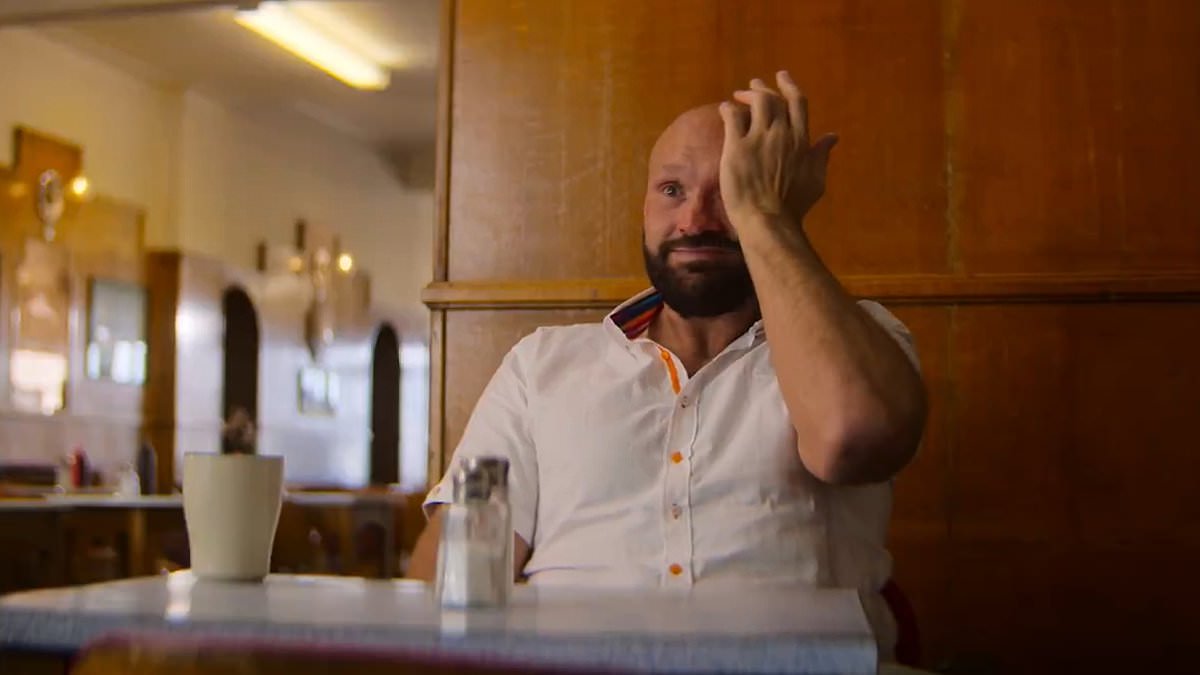
Tyson Fury revealed he's been diagnosed with schizophrenia as he opened up about his lifelong mental health struggles in a new Netflix documentary.
The boxer, 38, suffered a breakdown after achieving his life's obsession of defeating Wladimir Klitschko in 2015, during which time he suffered a bout of psychosis and began to hear voices.
It has now been revealed that Tyson suffers from schizophrenia, a lifelong mental health condition that can cause an individual to have hallucinations, delusions and lose touch with reality.
The boxer has also been diagnosed with bipolar disorder, depression, anxiety, obsessive-compulsive disorder and attention deficit hyperactivity disorder (ADHD).
Speaking on TYSON FURY, a feature-length documentary about the boxer's life and career, Tyson's wife Paris explained that upon reflection, she could always see signs that he was struggling with his mental health.
Paris, 36, said the signs were visible in their teenage years, as she recalled: 'When we were going out I saw differences in his brain pattern to other people.
'He didn't just have that level, one-tier personality. It was highs, it was lows, it was always like a different kinda person, you know?'
Tyson Fury revealed he's been diagnosed with schizophrenia as he opened up about his lifelong mental health struggles in a new Netflix documentary
Speaking on TYSON FURY, a feature-length documentary about the boxer's life, Tyson's wife Paris explained that she could always see signs that he was struggling with his mental health
She explained that their differences caused issues in their marriage, saying it got off to a 'rocky' start because Tyson was obsessed with training and clean-living while she wanted to go out dancing.
'It was two worlds completely colliding,' Paris recalled. 'I couldn't understand why he would want to train, eat, sleep, repeat...
'So we were two teenagers, very young, headstrong people getting married and being put in a 24-foot box caravan together.'
Yet Tyson's hard work paid off and he made his professional debut at the age of 20 on the undercard of Carl Froch vs. Jean Pascal against Hungarian fighter Bela Gyongyosi.
Tyson defeated Bela by technical knockout and quickly made a name for himself in the industry as he continued to win his fights.
Yet while there was no denying he was at his peak of fitness Tyson struggled with the fact he couldn't seem to build a six-pack.
'I hated being fat,' Tyson shared. 'All my life I've had a weight problem. I train hard, why aren't I in shape like all those fighters from the past?
'I'm a comfort eater. So if things aren't going well I'll either starve myself to my death or I'll eat a load of rubbish, I'll eat until I'm physically sick in the toilet.
'I'll eat junk food and sugar until I'm off my trolley. Then I brush my teeth and wash my face and I'll eat it all again.
'I was a compulsive emotional eater. And getting punched in the face is an addiction as well.'
Tyson shared: 'I'm a comfort eater. So if things aren't going well I'll either starve myself to my death or I'll eat a load of rubbish, I'll eat until I'm physically sick in the toilet'
Tyson's struggles with his mental health and self worth were exacerbated during traumatic periods in his life, including losing a child with Paris.
In 2014, Tyson's uncle Hughie, who served as his trainer, was admitted to intensive care after routine surgery to place a PIN below his knee left him with a blood clot.
During this time, Tyson's motivation was welcoming his third child with Paris.
Yet hardship struck again when she suffered a late miscarriage while five months pregnant.
Paris revealed that she'd been aware there were complications with her pregnancy but kept them from Tyson to protect him.
She recalled: 'I got a call from the doctors saying the baby was gone and I had to birth it. Up to this point I'd kept it quiet because Tyson already had his uncle in the hospital and I didn't add any more pressure.
'But it come to the point where there was no viable answer, there was no more not talking about it, so I told Tyson.
'Tyson was there and we went through it together, and when we came out we made the decision together to bring the baby home.'
Tyson said: 'At that age, they don't usually let them go but I said no that's my family, I'll take it.
'I had this big fancy watch from years ago, come in a massive box, all hard wood, mahogany and I just took the baby to my dad and we buried him in the garden, me and my brothers.'
Paris continued: 'I don't really remember a lot from that week, I remember being at home and seeing the little garden where he was and that was that.'
As the pair were still reeling from the tragic loss, Tyson's uncle Hughie passed away following '11 weeks of struggle'.
Tyson's approach was to push down the trauma and his grief, as he explained: 'I'm the one that's got to be strong, I'm the one that's got to pretend everything's ok.
'So that's what I did. Protect and provide, that's what men should do... there's so much s**t going on and I'm just putting it in the back of mind, buried it deep in the brain.'
Paris recalled: 'We didn't really talk about what had gone on. I couldn't talk about what happened with me and the baby.
'Even now I don't like talking about it. We were both heartbroken. The pain you feel and you can't imagine it's going to go away.'
The boxer, 38, suffered a breakdown after achieving his life's goal of defeating Wladimir Klitschko in 2015, during which time he suffered a bout of psychosis and began to hear voices
Paris struggled witnessing Tyson's downfall, saying: 'I was every emotion for Tyson. I was sad for him, I was ashamed of him, I was heartbroken by him' (pictured in 2016)
As Tyson repressed his emotions, he put his all into his fight with Klitschko, taking him on in a world heavyweight title showdown.
The fight became all that Tyson could focus on, with him explaining that in the build up he would have rather won and died the next day, than lost and continued living.
Tyson's dream came true when he won after 12 rounds by a unanimous decision, yet it ultimately became the start of a nightmare when he realised he'd lost all sense of purpose having achieved his ultimate career goal.
He began to self destruct, falling into a dangerous spiral of partying, drinking and taking drugs, with Tyson saying: 'I had the world in my hands and I threw it all away.
'I'm just a fat mess addicted to alcohol, drugs. I lost everything I ever cared about.'
Paris struggled witnessing Tyson's downfall, saying: 'I was every emotion for Tyson. I was sad for him, I was ashamed of him, I was heartbroken by him.'
Tyson's struggles came to a head when he was hospitalised, with Tyson convinced he was having a heart attack.
At the time, Paris was pregnant and rushed to be at Tyson's side, where doctors told her that Tyson was in fact suffering from an anxiety attack and was in the throes of a mental breakdown.
Recalling visiting Tyson, Paris shared: 'Tyson looks at me, he's on a bed and he's got wires on his heart, and he's seriously frightened.
'He looked me dead in the eyes and said "Paris, get me out of here, they’re trying to kill me. The illuminati, they're all in on it, they can't make me quiet so they're going to get rid of me".
Paris confessed: 'I was so scared, scared for him. I could see he was gone, he'd flipped the switch.'
Tyson added that in the throes of his psychosis he believed the radio was talking to him, threatening to kill him and his family.
'Words can't explain the darkness I was in,' Tyson explained. 'It was a living version of the pits of hellfire. I thought I'd end up in a padded room with the door locked and that scared me so much.
'The anxiety was crippling me, I could not overcome it.'
It was then that Tyson received his multiple mental health diagnoses.
Paris recalled: '[Doctors said] he's a mild schizophrenic and even then the penny didn't drop.
'I was like "don't be silly, what's she on about schizophrenic? Maniacs are schizophrenic, you're not schizophrenic".
'I'd never heard of bipolar. When someone actually explained it to me, it was wow, that's him to a T.'
After winning the fight with Klitschko, Fury began to self destruct, falling into a dangerous spiral of partying, drinking and taking drugs
Tyson reflected on his traumatising childhood in the documentary, revealing his father John was never around (pictured with his father and brother)
During the documentary, Tyson also reflected on his traumatising childhood, revealing his father John was never around and his mother Amber was struggling with the grief of multiple miscarriages.
Tyson explained: 'In my family growing up, it wasn't a good environment. Arguments, screaming and shouting, smashing things.
'My dad was flat out working all day, wouldn't come for breakfast, dinner or tea. There wouldn't be any family meals or family holiday, there was nothing like that.
'My mother had a lot of pregnancies, maybe 14 to 15, and she lost all of them apart from four boys [Tyson and his brothers John Jr, Shane and Hugh Fury].'
'There was one girl – she died after being alive for four days. I don't think she [mum] ever really recovered from it. She was a reclusive type of person and she's still like that today.'
Paris added: 'His mam just worked differently to the standard person and his dad was gone, so he pulled through life on his own from 14.'
Tyson also revealed the bizarre way he learnt that his father was having an affair.
He revealed that his father asked him to meet 'these lads of mine', saying they were big fans of Tyson's boxing career.
As Tyson asked if they were his friends, his father bluntly replied: 'They're your brothers, Tommy and Roman.'
Tyson recalled: 'He was like, "I've got another woman and by the way I've got a couple of other kids too". I don't have a victim mentality so I just got on with it really.'
The Gypsy King also explained how he finally overcame his addictions and set about working on his mental health.
He revealed that he had an epiphany on a night out, deciding that the party scene wasn't for him and he'd rather be at home with his family.
That night he prayed to God to ask for help before vowing to take on Deontay Wilder, with the upcoming fight forcing him to stay clean and focus on training.
These days Tyson manages his mental health with physical training, short-term goals and family support, crediting his loved ones with keeping him on the straight and narrow.
Tyson shared: 'If you look at my life there's a lot of achievements, a lot of good stuff, a lot of success.
'But the most successful thing I have in my life is my family, my kids and my wife.'
On wanting to prevent his children from making the same mistakes as him, he concluded: 'I try to tell my kids, talk about it all, we'll deal with the problem today.'
TYSON FURY will be released globally on Netflix on Friday, November 27.
If you have been affected by anything in this article, contact Samaritans on 116 123
WHAT IS SCHIZOPHRENIA?
Schizophrenia is a chronic and severe mental disorder that affects how a person thinks, feels, and behaves.
People with schizophrenia may seem like they have lost touch with reality.
The cause of schizophrenia is not understood and it is believed to be a mix of genetics, abnormalities in brain chemistry and/or possible viral infections and immune disorders.
Symptoms of schizophrenia usually begin between ages 16 and 30. In rare cases, children have schizophrenia too.
The symptoms of schizophrenia fall into three categories: positive, negative, and cognitive.
Positive symptoms are disturbances that are 'added' to the person's personality and include:
HallucinationsDelusionsThought disorders (unusual or dysfunctional ways of thinking)
Negative symptoms are capabilities that are 'lost' from the person's personality and include:
'Flat affect' (reduced expression of emotions via facial expression or voice tone)Reduced feelings of pleasure in everyday lifeDifficultly beginning and sustaining activities
Cognitive symptoms are changes in their memory or other aspects of thinking and include:
Trouble focusing or paying attentionProblems with 'working memory'Poor ability to understand information and use it to make decisions
Figures suggest around one percent of the world population suffers from schizophrenia with around two million in the US.
Source: National Institute of Mental Health