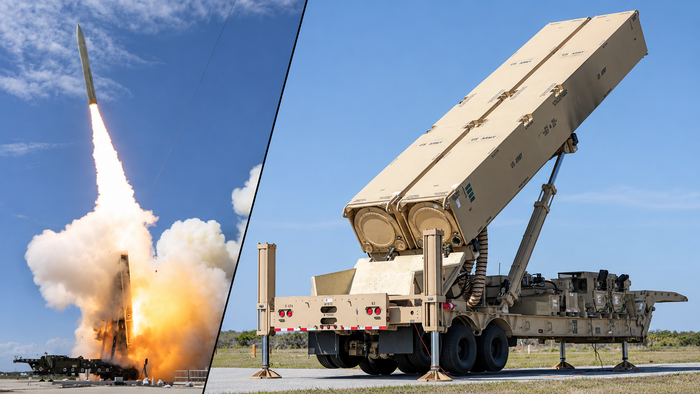
Three years after its original deadline, the Army says its first long-range hypersonic missile battery is finally operational. "It is fully fielded. It is ready to go," Lt. Gen. Frank Lozano, the Army's Program Acquisition Executive for Fires, told Breaking Defense in a Nov. 19 interview about the Long-Range Hypersonic Weapon, better known as Dark Eagle.
"It is a global deployable and employable warfighting capability," Lozano said. "Those soldiers and those units have everything that they need to employ, fight and win."
First Dark Eagle hypersonic battery 'fully fielded,' Lozano says
— Breaking Defense (@BreakingDefense) November 25, 2026
Lozano would not say when or where the battery was fielded. He noted that some of the system's ground equipment was delivered as early as 2021, which he said makes it hard to put a single date on it.
Last month, Bloomberg reported that the Army still had not completely fielded its first battery, nearly three years behind schedule, and the Army's program office said the system needed more training and sustainment work "before declaring the system fully fielded."
Asked whether that report was wrong, Lozano didn't "want to go so far as to say that." "[T]his is a rapidly evolving space, and things can happen very quickly, and for all the right reasons, we in the Army and we at PAE [Program Acquisition Executive] Fires are being very, very aggressive about producing, developing and fielding new capabilities that include Dark Eagle," he said.
From left, U.S. Army Capt. Alexander Vahadji, of 7th Infantry Division; Adm. Samuel J. Paparo, commander of U.S. Pacific Command; and Lt. Col. Alexander Mullin, 7th ID, observe soldiers training in June with the Dark Eagle Long-Range Hypersonic Weapon during exercise Valiant Shield. The Army on July 21, 2026, said the Dark Eagle was deployed on Guam at the time. (Brandon Rickert/U.S. Army)
The Army had planned three flight tests before fielding the first battery in fiscal 2023, according to a Congressional Research Service update. It then set a September 2025 target and missed that too. As of July, the Army's own schedule had the first battery, missiles included, arriving no earlier than the second quarter of fiscal 2026, and the second not until the second quarter of fiscal 2027.
Officials told the Government Accountability Office that "the contractor has continued to experience issues at its facility," and that some problems found in earlier flight tests "created a production bottleneck." Lockheed Martin builds the missile on a line shared with the Navy's version, and in a July report GAO said that facility "is currently capable of producing a maximum of six to seven rounds a year," with Army and Navy officials complaining that the work instructions used to build the missile "are too complex for the average worker to follow."
Graphic depiction of the complete LRHW weapon system. (Credit: US Army)
The Army plans to spend more than $10 billion to buy 48 missiles and their ground support equipment, GAO said. Each missile costs about $15 million, as we reported in April, when Central Command asked to send the still-unfielded Dark Eagle to the Middle East for possible use against Iran.
A Dark Eagle battery is four truck-drawn launchers carrying up to eight missiles, plus a battery operations center. The glide body travels at Mach 5 or faster, and the weapon has a reported range of 1,725 miles. The Army and Navy launched the common hypersonic missile from Cape Canaveral Space Force Station on March 26.
The second and third batteries are in the works, and the third is "already over halfway through production," Lozano said, but he gave no dates. "I don't have a firm date on the wall," he said. "I think we'll see that the second battery and the third battery will realize their full capability at a faster pace and a faster rate than the first battery did."
Artist's concept of a Dark Eagle battery in operationUS Army
"All of our long-range fires efforts and capabilities are significantly important to the Army and to the Department of [Defense], and so they all remain a very high priority for us," Lozano said. The Army is also pursuing a "scaled hypersonics program" for weapons with ranges between Castelion's shorter-range Blackbeard and Dark Eagle.
And after years of waiting on one contractor, Lozano wants more than one. "I'd like to have two or three vendors all in production against a singular requirement," he said. Should any one vendor have "any kind of quality or production or manufacturing challenge in delivering," he said, it would give him "options to kind of maybe buy more or less from one of the vendors over another."