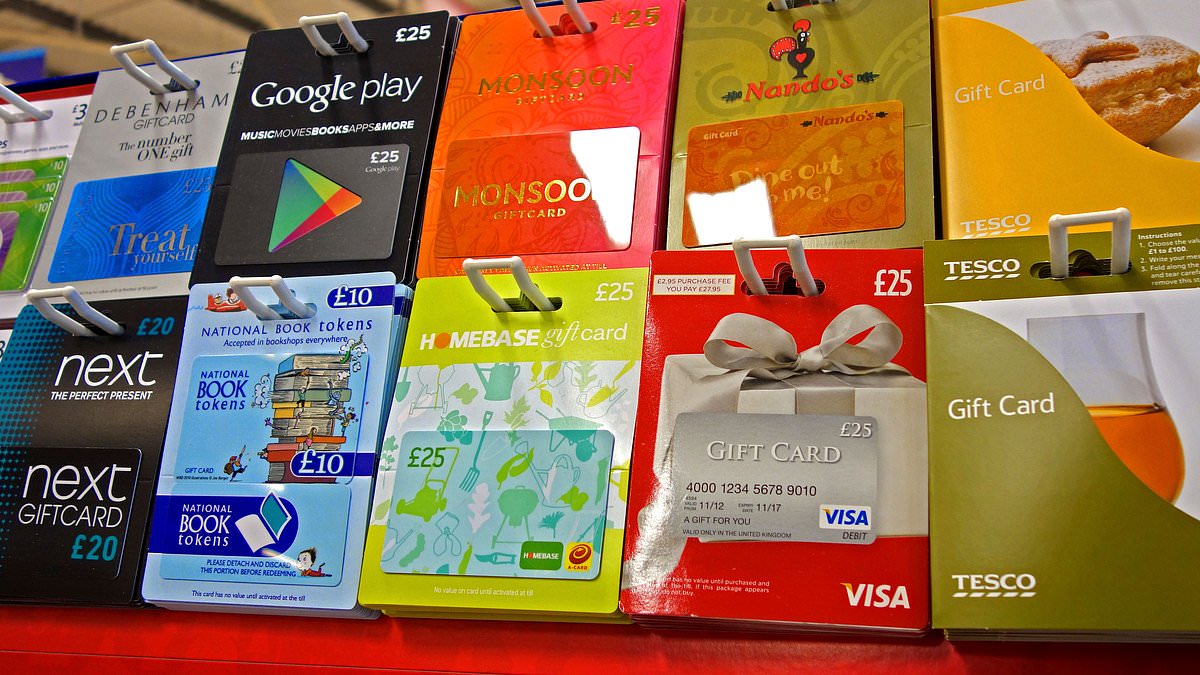
Gift cards are a popular present, but millions of pounds worth go unused each year.
While they may seem like an easy gift, some come with spending deadlines, fees for leaving money on the card and exposure to increasingly sophisticated scams.
At least £600million worth of gift cards are wasted annually, the Gift Card and Voucher Association (GCVA) estimates, while the average consumer is thought to lose £86 a year through forgotten balances.
If you're considering buying them this Christmas, read on to find out why they could cause a headache for your friends and family and why cash may be a safer option.
Easy present... but gift cards can catch recipients out with hidden small print
Short expiry dates can catch people out
Different retailers have varying spending cut off dates so it’s important to know when yours expires.
Costa coffee vouchers are only valid for 12 months, though this limit resets every time you make a purchase - the same as vouchers for the cinema chain, Vue.
Those looking for a gift for music lovers may also want to bear in mind that Ticketmaster gift cards also have 12 month validity.
John Lewis gift vouchers expire 24 months after a purchase or the date last used.
However, every time you make a purchase or check your balance, the expiry date resets to a fresh 24 month window.
Meanwhile, Marks and Spencer vouchers last for four years. The GCVA has claimed that combined, John Lewis and M&S both were holding a combined £300million in outstanding gift card balances.
If you are looking to buy a gift card for a small or local business, such as a cafe, restaurant or spa, these can often have shorter expiry dates so it is worth checking before you book. Some are as little as six months.
On the other side of the spectrum is the Apple Store with some gift cards which are valid forever with no expiry date.
Most retailers allow you to check your balance, expiry date and other details online, so it’s important to do this and avoid having your gift wiped out.
If you are giving a gift card, include a note pointing out when the card expires.
Check the expiry date Retailer Validity Costa coffee
Ticketmaster
Vue cinemas
Love2Shop
John Lewis
Argos eGift
M&S
Sainsbury's/Argos physical cards
Tesco
Amazon
Apple
One4all
1 year (resets after purchase)
1 year
1 year (resets after purchase)
1 to 2 years depending on product
2 years
3 years
4 years
5 years
5 years
10 years
No expiry in the UK
Doesn't expire but charges fees after 18 months
Hidden fees
Some gift cards, like One4all, charge you for not spending the money.
The multi-store gift card is accepted across thousands of UK brands and outlets.
However, starting from 18 months after purchase, recipients will be charged a 90 monthly 'maintenance' fee until the balance runs out.
One4all says this is: ‘to cover continued access to the card programme and any operational and processing charges.’
In this instance, if you received a £25 gift card from One4all approximately three years and ten months ago, the balance would probably be at zero now.
The 90p fee does not apply to Restaurant Favourites or Foodie Favourites Gift Cards, which are valid for 12 months from the date of purchase.
Mike Hayman, founder and managing director of gift card resale website Cardyard, notes that One4all cards may have a 'validity date' printed on the front - but that the card will still start being drained after 18 months, even if the validity date is longer.
‘Instead they have a "drain down" date 18 months after purchase when a 90p monthly charge begins,' says Cardyard. 'So way before the validity date arrives, the card may have nothing on it.'
The other popular multi-store gift card, Love2Shop, usually charges a £12 one-off fee on the day the card expires, if there is still money on it.
Checklist Check expiry dateCheck inactivity feesBuy directly from retailersKeep receiptRegister or spend quicklyCan you get a refund for a gift voucher?
Unfortunately, most shops that sell gift cards won't offer a refund for a voucher, and this will be stated in the terms and conditions.
On the rare occasions they do, you will usually need proof of purchase and the money usually has to go back to the person who paid for it - requiring an awkward conversation many are unwilling to have.
One exception is vouchers for 'experiences' – such as an afternoon tea or a racing track day.
Many of the companies selling these offer a refund or exchange within 30 days of purchase, but again this would usually require you to tell the gift giver.
The exception to the 30 day rule is if you try to book the experience and there are no slots available before the expiry date, in which case they should refund you in full.
If you won't use a gift card, sell it
If you've received a gift card you don't think you will use, you could consider selling it.
Websites such as Cardyard allow people to sell them online, though they will usually have to accept a deduction of a few pounds off the retail value.
Cardyard says the most lucrative gift card to resell is Amazon, where shoppers can sell for 90 per cent of the retail price - for example a £100 Amazon card could fetch £90.
Supermarket vouchers are also popular, as they are easy to spend for most people.
Virgin Experience days are a harder sell as the days out on offer can be quite niche. It says a £100 voucher could fetch £65.
How much is your gift card worth? Gift card value Typical resale value 1. £100 Amazon
2. £100 average retailer
3. £100 experience voucher 1. £90
2. £80
3. £65 Scams on the rise
For the past few Christmases, shoppers have reported a gift card draining scam.
This is where they buy physical vouchers displayed in a shop, loading them up with cash for the intended recipient.
But when the recipient tries to spend it by putting in the voucher code and pin number listed on the card, it shows that there is a balance of zero.
This is because fraudsters have taken the cards from the shop and scratched off the panels, noting down the information.
At this point, this information they have obtained is useless because they have not yet been loaded up with cash.
However, once the vouchers have been bought and have money on them, they can be used by the fraudster – so long as they drain the balance before it is spent by the genuine recipient.
They bank on there being a sizeable gap between the card being loaded and the money being spent.
Scams are also becoming increasingly prevalent for those looking to sell a voucher online.
Hayman says: ‘Scams are also becoming an increasing concern. Fraudulent exchange websites often promise immediate payment, but never pay out.
‘Consumers should stick to established, reputable exchanges and check platform rules carefully. Some major marketplaces explicitly prohibit gift card sales, leaving buyers without platform protection if transactions breach their terms.’
It's not advised to sell or buy gift cards on social media, such as on Facebook Marketplace, as there is often little recourse if something goes wrong.
What happens if a retailer goes bust?
Gift cards are essentially unsecured credit. If a company goes into administration, it is at the discretion of administrators whether gift cards are honoured - and more often than not, they stop accepting them.
If they do not honour them, the gift vouchers are effectively worthless - so avoid buying gift cards for businesses that may be in trouble.
This is Money podcast