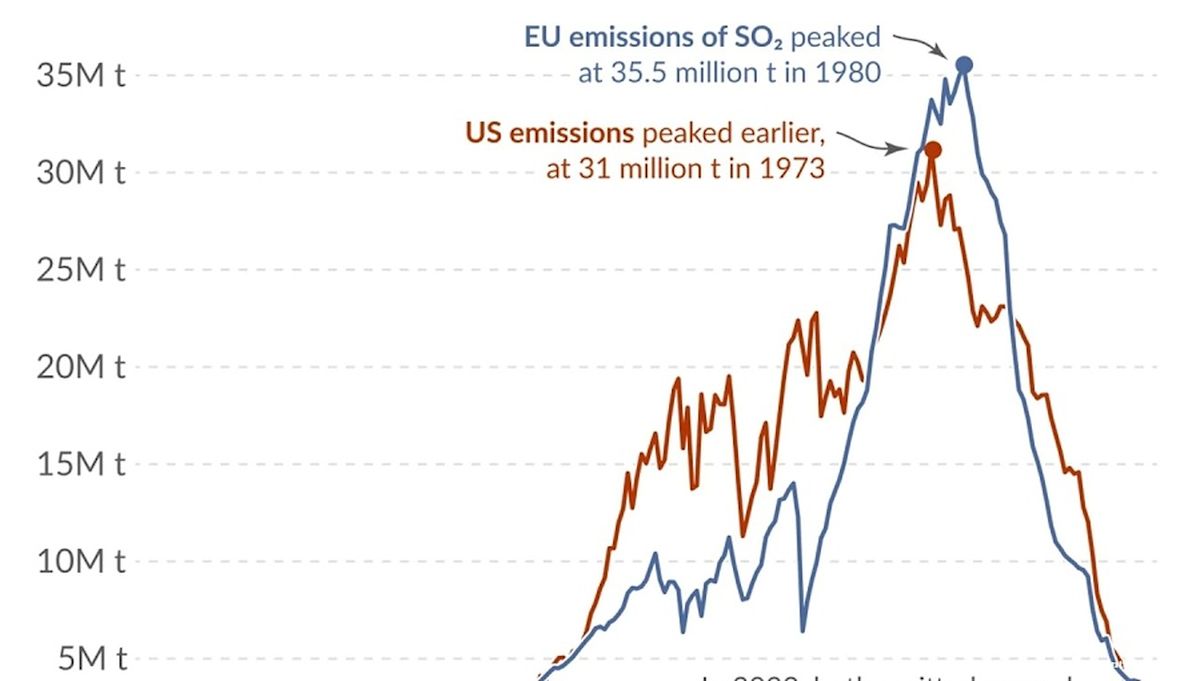
India has overtaken China as the world's biggest emitter of sulphur dioxide, the gas behind acid rain, while the US and the EU have cut theirs by around 94% from peak.
Both western blocs have all but solved the problem that dominated environmental headlines in the 1970s and 1980s, a Data Insight published by Our World in Data on November 28 shows. US emissions peaked at 31.1mn tonnes in 1973 and EU-27 emissions at 35.5mn tonnes in 1980. By 2022 both were down to about 2mn tonnes a year.
The fall was achieved by fitting 'scrubbers' to power-plant chimneys to capture the gas before it escapes, by switching to coal with less sulphur in it and by burning less coal overall, Our World in Data said. Global emissions have fallen too, but by much less: they peaked at 141mn tonnes in 1979 and were 73.5mn tonnes in 2022, down 48%.
Emerging markets, where coal-fired power has grown fastest, now account for most of what is left. The underlying figures, from the Community Emissions Data System (CEDS) compiled by Hoesly et al. (2024), show India emitted 11.3mn tonnes in 2022, or 15% of the world total. That is two and a half times its level in 2000 and the highest on record for the country. India passed China in 2021, the data show.
India's lead is not new on every measure. A Greenpeace analysis of NASA satellite data put India at the top of the global ranking as long ago as 2019, with almost all its emissions coming from coal burning.
China's emissions peaked at 38.1mn tonnes in 2006 and had fallen 73% to 10.4mn tonnes by 2022, after Beijing ordered its coal plants to fit desulphurisation equipment. India went the other way in 2025, when the government scrapped a requirement for 79% of its coal plants to fit flue-gas desulphurisation units, keeping it only for plants near New Delhi and other big cities.
Elsewhere in the emerging markets the trend is still upwards. Indonesia's emissions have tripled since 2000 to 3.8mn tonnes, and scrubbers already installed at its coal plants may not be running round the clock, according to the Institute for Essential Services Reform. Pakistan's emissions have more than doubled over the same period to 2.1mn tonnes and Vietnam's have quadrupled to 1.3mn tonnes. Turkey's 3mn tonnes in 2022 was a quarter higher than in 2000 and close to its 2019 record.
Russia is the world's third-largest emitter on the CEDS figures, at 5.3mn tonnes in 2022. That is 61% below its Soviet-era peak of 13.4mn tonnes in 1980, but only 13% below the level of 2000, so most of the fall came with the industrial collapse of the 1990s. Greenpeace and the Centre for Research on Energy and Clean Air named the Norilsk smelter complex in Russia's Arctic as the single biggest source of man-made sulphur dioxide in the world in 2019.
The EU's eastern members have cut almost as hard as the West. Poland's emissions are down 90% from their 1980 peak to 0.4mn tonnes, Romania's by 95% and Bulgaria's by 99% from theirs. The Western Balkans, outside the EU, lag behind: coal plants in Bosnia & Herzegovina, Kosovo, North Macedonia and Serbia emitted sulphur dioxide at 6.6 times their legal limits in 2025, according to the environmental watchdog Bankwatch, even as Serbia began trial runs of a desulphurisation plant at one of its main power stations in April.
US and EU-27 annual sulphur dioxide emissions, mn tonnes, 1800-2022. Source: Hoesly et al. (2024), Our World in Data (CC BY)
Annual sulphur dioxide emissions of India, China, Russia, Indonesia, the EU-27 and the US, mn tonnes, 1990-2022. Source: Hoesly et al. (2024), Community Emissions Data System, via Our World in Data. IntelliNews
This article was produced with the help of the IntelliNews Lambda analytical tool