IntelliNews summary:
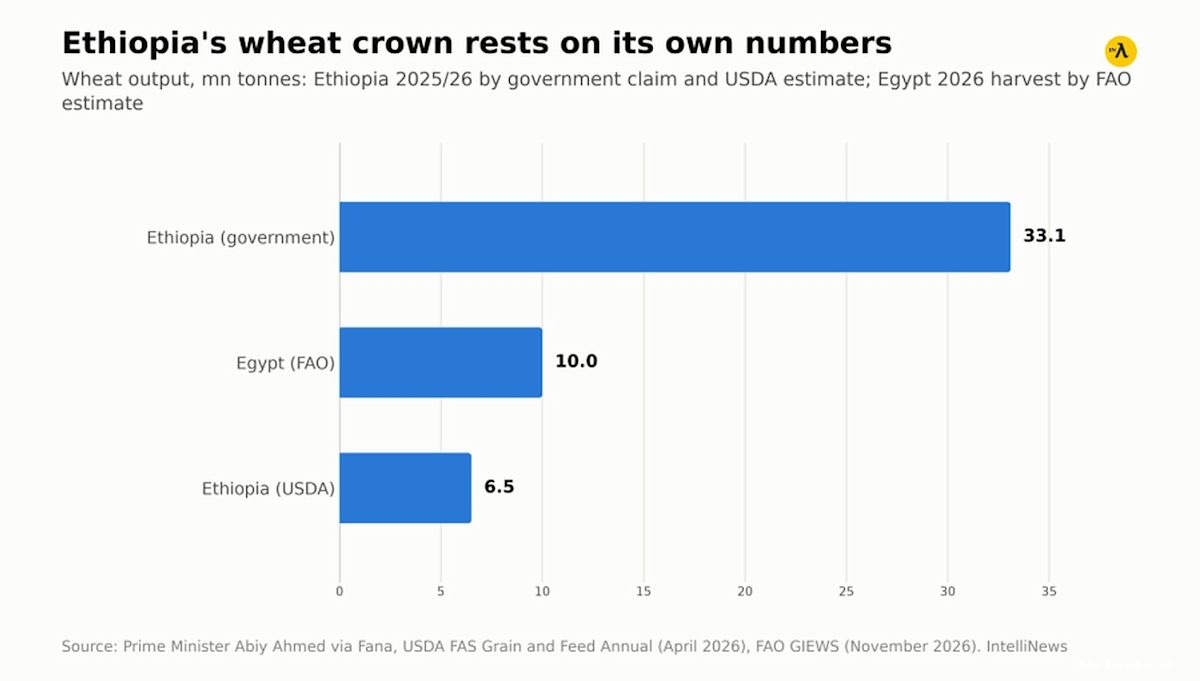
USDA puts Ethiopia's 2025/26 wheat crop at 6.5mn tonnes and its harvested area at 1.95mn hectares, against the government's 33.1mn tonnes from more than 8mn hectares.
Ethiopia imported 1.06mn tonnes of wheat grain in 2024/25, 68% of it from Russia, and USDA expects no exports.
Egypt harvested about 10mn tonnes in 2026 but still needs to import about 12mn tonnes, FAO says.
El Niño rainfall deficits damaged the 2026 main-season harvest in Tigray, eastern Amhara and eastern Oromia.
____________________
Ethiopia says it has overtaken Egypt as Africa's biggest wheat grower, adding grain to a long-running rivalry with Cairo over the waters of the Nile.
Prime Minister Abiy Ahmed put this season's harvest at 331mn quintals, or 33.1mn tonnes, up from 28mn tonnes a year earlier, during a visit to a wheat farm in Oromia's North Shewa zone, Fana reported on May 6. No other African country produces at that level, he said, adding that output could reach 50mn tonnes within a short period.
If the figure is right, Ethiopia grows more than three times as much wheat as Egypt, Africa's largest wheat buyer, which harvested about 10mn tonnes this year. Independent estimates point the other way. The US Department of Agriculture puts Ethiopia's crop at a fifth of the official number, below Egypt's, and still counts Ethiopia as an importer of more than 1mn tonnes a year.
Africa's farming systems: the irrigated Nile valley and delta in Egypt (blue) and Ethiopia's highland crop belt (dark green), circled. Graphic: Nestor Siurana on X
Water, then wheat
The harvest is now being cast as a weapon in the Nile dispute. 'Whoever controls water and grain in Northeast Africa not only ensures their people's survival but also defines the balance of power across an entire region,' commentator Nestor Siurana wrote in a post on X on November 28, translated from Spanish.
For more than a decade the quarrel has centred on the $5bn Grand Ethiopian Renaissance Dam on the Blue Nile, which Abiy inaugurated in September 2025. Egypt, a desert country that depends on the river for almost all of its fresh water, sees the dam as a threat to its water security.
Addis Ababa accused Egypt, Sudan and Eritrea of backing the Tigray People's Liberation Front after a rebel offensive, and in early October the two capitals expelled each other's diplomats. Egypt and Sudan denied the charge.
A food-secure Ethiopia would hold a card Egypt lacks. Ethiopian President Taye Atske Selassie said in February 2025 that the country's move from wheat importer to self-sufficiency sent 'a clear and powerful message that Africa can indeed feed itself'.
A harvest four times the land
Wheat output, mn tonnes. Ethiopia 2025/26 by government claim and USDA estimate; Egypt 2026 harvest by FAO estimate. Source: Prime Minister Abiy Ahmed via Fana; USDA FAS; FAO GIEWS. IntelliNews
USDA's office in Addis Ababa estimates the 2025/26 crop at 6.5mn tonnes and forecasts 7mn tonnes for 2026/27, up 8%, in its annual grain report published in April. It credits more irrigation, better seed, cluster farming and mechanisation for the growth. Most of the gap between the two numbers is land. Abiy counted 4.4mn hectares sown in the main rainy season and 3.8mn hectares of dry-season irrigated wheat, more than 8mn hectares in all. USDA puts the harvested area at 1.95mn hectares, yielding 3.33 tonnes per hectare. The official harvest implies a little over 4 tonnes per hectare on four times as much land.
Ethiopia imported 1.06mn tonnes of wheat grain in the 2024/25 marketing year, up 30% on the year, with Russia supplying 714,000 tonnes, or 68%, according to USDA. It expects wheat and wheat product imports of 1.4mn tonnes in 2026/27, no exports, and says there are no official records of commercial wheat exports from Ethiopia.
Millers told USDA that local supply remains tight. Retail wheat prices rose 28% in the year to February 2026, and in January imported Black Sea wheat cost $420 a tonne, about $45 less than local grain. Food inflation climbed back to 13.5% in April as the birr's slide raised the cost of imported fuel, fertiliser and wheat.
El Niño-related rainfall deficits severely damaged the 2026 main meher season crop in Tigray, eastern Amhara and eastern Oromia, causing significant shortfalls in the worst-hit areas, the UN Food and Agriculture Organization said in a country brief dated November 12. Oromia and Amhara are the heart of Ethiopia's rain-fed wheat belt, and local maize prices have hit records.
Cairo pays for its bread
Egypt's harvest is smaller than Ethiopia's claim but far less disputed. FAO puts the 2026 wheat crop at about 10mn tonnes, nearly 7% above average, and wheat import needs in 2026/27 at 12mn tonnes, in its November brief on the country.
Egypt consumes about 20mn tonnes of wheat a year, 8.5mn tonnes of it for subsidised bread, and state buyers resumed imports in November after a five-and-a-half-month pause, as disruption to Black Sea shipping pushed up grain prices and fed a food price shock.
Cairo is paying farmers to close the gap. Its procurement price for next season's crop is EGP2,650 ($48) per ardeb, a 150 kg measure, up 6% and more than 40% above international prices, according to FAO. Smallholders get a 50% discount on mechanisation for 1mn feddans (420,000 hectares), and the government wants wheat self-sufficiency to rise from 43% to more than 60% by 2030.
Ethiopia's gains hold up even on USDA's count. Output has risen in each of the past three seasons on USDA's numbers, helped by the National Wheat Flagship Program, which since 2019 has pushed irrigated wheat into the lowlands, and the African Development Bank leads a $94mn project meant to turn the country into an exporter.
On the independent numbers Egypt is still Africa's bigger wheat grower, and both sides of the Nile still rely on Black Sea grain to keep their mills running.