SummaryChina issues first response to Taiwan's local electionsTaiwan ruling party doubles number of cities, counties it controlsTaiwan holds presidential election in early 2028Unclear who opposition will chose as presidential candidateChina claims Taiwan as its own territory
TAIPEI, Nov 29 (Reuters) - China warned on Sunday that "reunification" cannot be stopped, responding to Taiwan's local elections where the ruling Democratic Progressive Party (DPP) doubled the number of cities and counties it controls, though it lost the Taipei mayoral vote.
China views democratically governed Taiwan as its own territory and has never renounced the use of force to bring the island under its control. Taiwan's government rejects Beijing's territorial claims.
Make sense of global markets with the Trading Day newsletter. Sign up here.
China's Taiwan Affairs Office said in a statement that it "noted" the election result, adding that "mainstream public opinion" in Taiwan wanted peace, development, exchanges and cooperation.
"No matter how Taiwan's political landscape changes, it cannot alter the direction and trend of cross-Strait relations moving forward, and it cannot stop the historical trend that the motherland must and will inevitably be reunified," it said.
The government will continue to "firmly crack down on Taiwan independence separatist forces and oppose external interference" and "advance the great cause of national reunification," it said.
Taiwan's government said China should respect its democratic system and choices of its people and face the election result pragmatically.
Beijing should talk with Taiwan's democratically elected, legitimate government on the principles of "no preconditions and equal dignity", the China-policy making Mainland Affairs Council said in a statement.
China refuses to speak with Taiwan President Lai Ching-te, saying he is a "separatist". Lai, who is also the DPP chairman, says only Taiwan's people can decide their future.
The China issue did not feature prominently during the election campaign, with a focus on domestic issues such as water safety and school meals.
But in the run-up to the vote China relentlessly attacked the DPP's Taipei candidate Puma Shen, whom Beijing has sanctioned, also for "separatism".
China also sent dozens of warplanes and warships into the skies and waters around Taiwan on Friday.
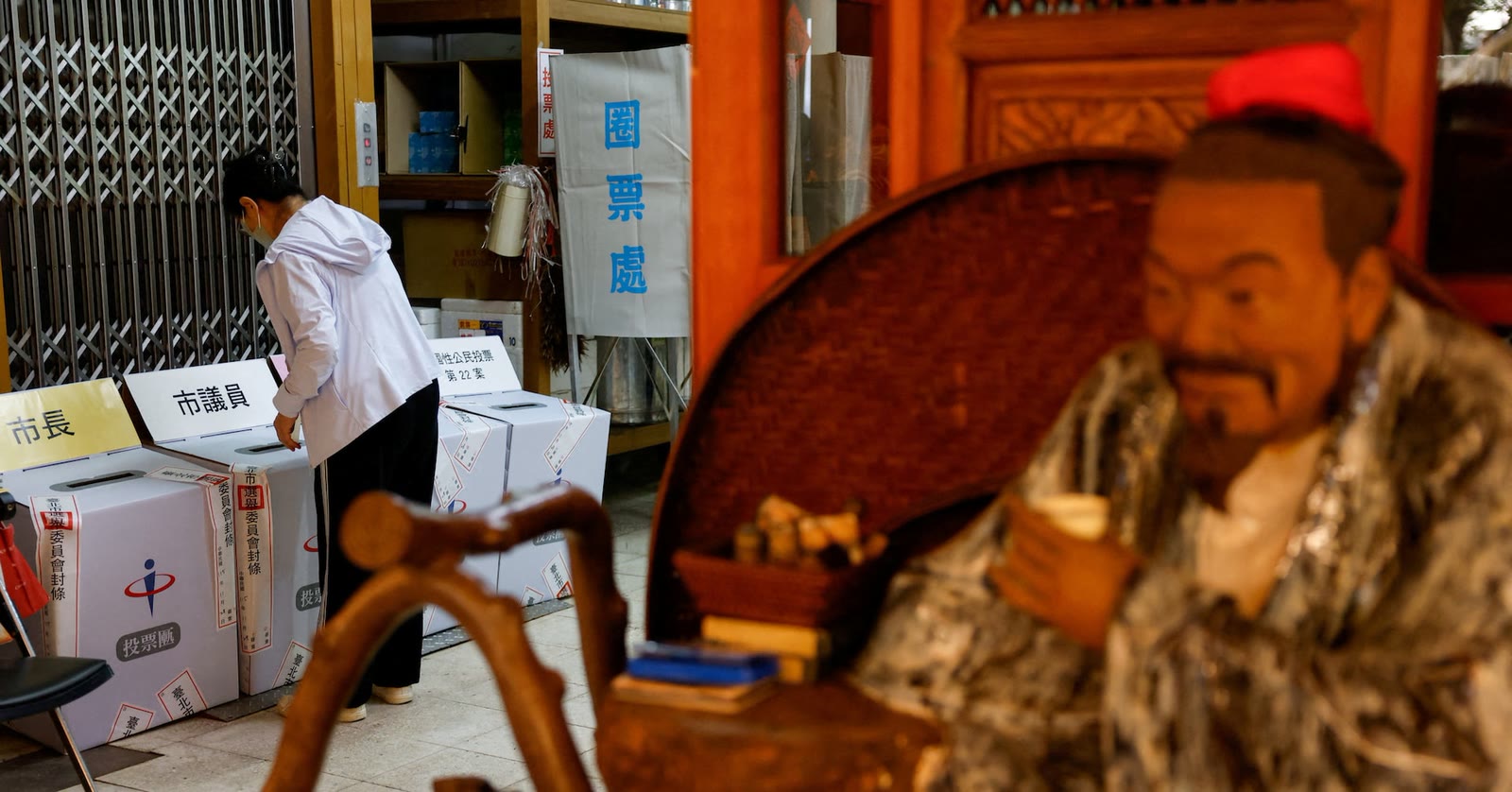
A voter casts a ballot at a polling station set up inside a tea shop during local elections in Taipei, Taiwan, November 28, 2026. REUTERS/Ann Wang Purchase Licensing Rights, opens new tab
LOOKING AHEAD TO 2028'S PRESIDENTIAL ELECTION
Attention now turns to Taiwan's next presidential election in early 2028.
While Lai will almost certainly seek his second and constitutionally limited last four-year term, the candidate for the main opposition party the Kuomintang (KMT), which traditionally favours close ties with Beijing, is unclear.
KMT Chairwoman Cheng Li-wun, who met Chinese President Xi Jinping in Beijing in April, told reporters late Saturday there was a lot of work ahead, including for the 2028 vote, though she offered no clues about the KMT candidate.
"We must immediately begin all of our work and preparations," she said.
The KMT's Chiang Wan-an, who won re-election convincingly as Taipei mayor, is widely considered a possible future presidential contender.
But Chiang gave no indication he was interested in standing for president in two year's time.
"For the next four years, I am the mayor of Taipei," Chiang told reporters on Sunday, adding that as a KMT member he would of course offer a supporting role for 2028.
The KMT also suffered a big setback in losing control of the central city of Taichung, the DPP's biggest scalp of the night.
Although the academic-turned-lawmaker Shen, who is an expert in Chinese disinformation, lost in KMT stronghold Taipei, he managed to raise his profile by attracting an unexpectedly high amount of voter attention all over Taiwan, not just in the capital.
That could set him up as one of the next generation of DPP leaders, though Shen said on Sunday the next election is still a long way off, and for the time being he would be returning to teaching and his lawmaker duties.
"For the DPP, they gained promising new stock by fielding Puma Shen to fight an impossible battle, but he lost beautifully," said Charles Lo, a professor at the Kaohsiung University of Science and Technology.
Reporting by Ben Blanchard; Additional reporting by Taipei newsroom; editing by Lincoln Feast.
Our Standards: The Thomson Reuters Trust Principles., opens new tab